

🔥 Discover this must-read post from Hacker News 📖
📂 Category:
📌 Main takeaway:
Christian Kriticos explores J. R. R. Tolkien’s long-lost satire of a motorized world.
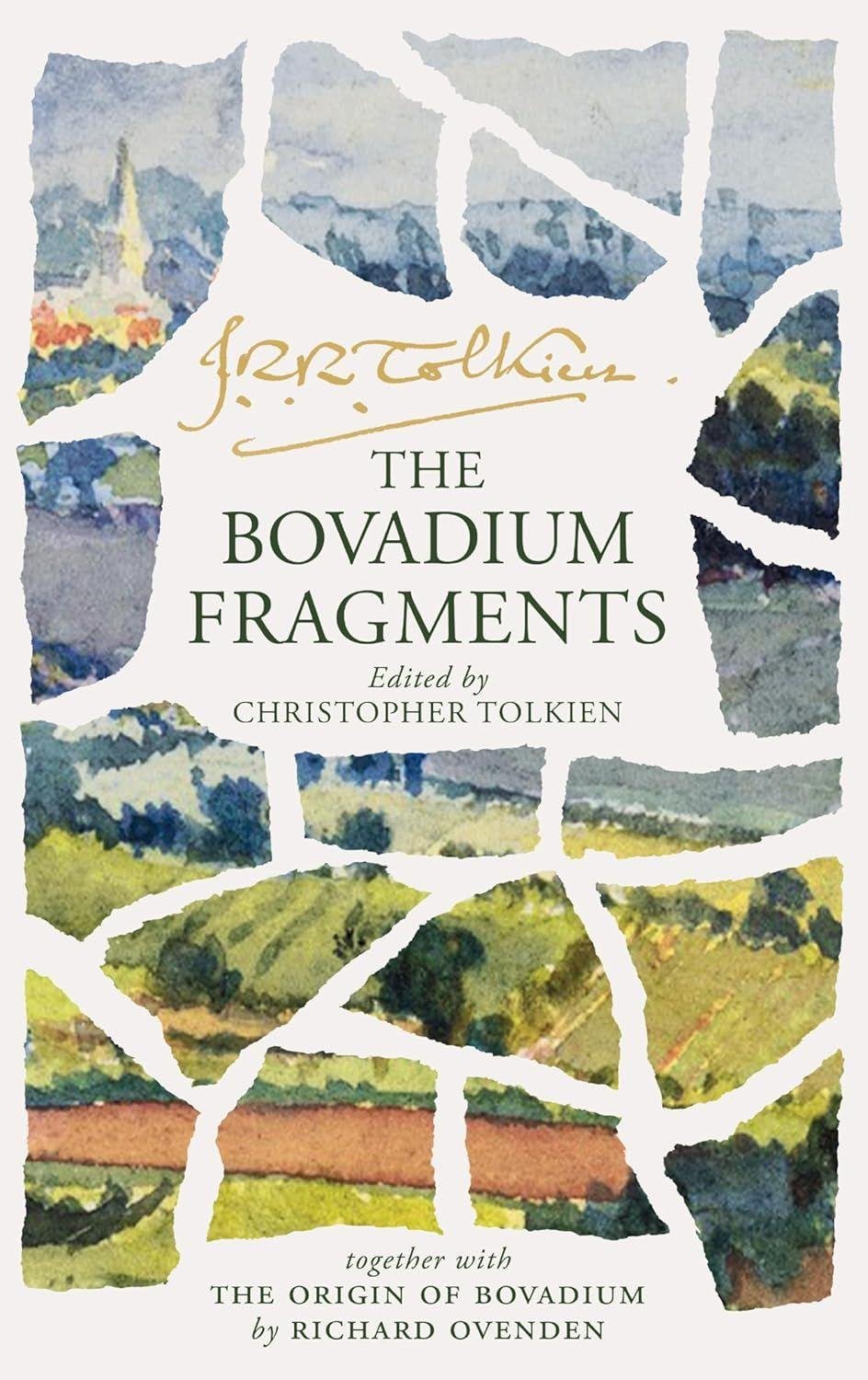
The Bovadium Fragments by J. R. R. Tolkien. William Morrow, 2025. 144 pages.
READERS OF J. R. R. Tolkien are used to dealing with fragments. In the half century since the author’s death, dozens of his unfinished works have been released, including everything from early draft materials to abandoned stories. But despite its title, the latest posthumous Tolkien publication, The Bovadium Fragments (published in November by William Morrow), is a complete work. Given Tolkien’s enduring popularity, it is remarkable that it has taken so long for it to be released.
Tolkien originally tried to have the short story published in the 1960s. His longtime publisher Rayner Unwin was supportive, suggesting he submit it to a magazine. By the end of the decade, however, Tolkien had declared that he no longer had any intention of publishing it, his mind apparently changed by Clyde Kilby, a friend who deemed the work “unpublishable.” Perhaps Kilby’s position had some merit at the time, when only a handful of works had been released under Tolkien’s name, but today, as Tolkien’s bibliography stretches to some 50 volumes, Kilby’s objections seem totally unfounded, and The Bovadium Fragments seems a worthy addition to his corpus.
Anyone who has read Tolkien’s letters will know that he is at his funniest when filled with rage, and The Bovadium Fragments is a work brimming with Tolkien’s fury—specifically, ire over mankind’s obsession with motor vehicles. Tolkien’s anger is expressed through a playful satire told from the perspective of a group of future archaeologists who are studying the titular fragments, which tell of a civilization that asphyxiated itself on its own exhaust fumes. Tolkien’s fictional fragments use the language of ancient myth, reframing modern issues like traffic congestion and parking with a grandeur that highlights their total absurdity. It is Tolkien at his angriest and funniest, making The Bovadium Fragments a minor treasure in his ever-growing catalog.
Of course, “minor” is the operative word, because the shortness of the work makes for a very slender volume. The page count for the story itself is around 50, but much of that is in Latin. (Tolkien presents some sections of the story in the ancient language, before repeating the same content in English.) And several pages are taken up by editorial notes, interspersed between each section to explain Tolkien’s more obscure allusions and philological references.
Outside the story, we also have a publisher’s note, an introduction, and a lengthy essay explaining the context that inspired Tolkien to write it, bringing the total number of pages to around 140. This supplementary material builds additional layers around the story’s frame narrative, creating a dizzying construct of frames within frames. If the reader is not careful, it is easy to get lost in this nested structure, but if you can keep your bearings, the extra content provides a historical backdrop that adds richness to Tolkien’s creation.
Of the three contributors of this supplementary material, Christopher Tolkien’s input is the most welcome. As longtime literary executor and editor for his father, the younger Tolkien is familiar to anyone who has dipped into his father’s posthumous works. But most fans will have assumed that his voice had been silenced by his death in 2020. Even before then, he had declared The Fall of Gondolin (2018) to be his final editing job. So, it seems something of a miracle to have another of his editorial efforts appear. It is also a testament to the extraordinary longevity of the Tolkien publishing industry. We are now at a point where we are receiving not only posthumous works by Tolkien but also posthumous edits by his son.
Christopher Tolkien’s introduction brings a personal touch, including the letter his father sent him around 1960 when first sharing the story. But the former’s notes are the more important contribution, drawing on his linguistic expertise to help us understand the parallels between the latter’s fiction and the real-life controversies that inspired it. For instance, he breaks down the name “Bovadium” to its Latin root “bovinus,” which means “pertaining to oxen.” Thus, he explains, the extinct civilization of the story is analogous to Oxford—the city where Tolkien spent virtually all his adult life.
J. R. R. Tolkien first arrived in Oxford as a student in 1911. At that time, it was still a quaint and quiet university town. But a couple years later, a motor manufacturing plant opened nearby. Soon, thousands of cars were being churned out and thousands more people were being drawn to the area to support this growing industry. That combination of a motorized culture and a population explosion transformed the city. By 1945, the congestion had gotten so bad that Oxford City Council commissioned renowned town planner Thomas Sharp to propose solutions. In his 200-page report, Sharp explained what the city was like at that time: “To-day heavy traffic breaks up what once was an urban paradise into a crowd of islands surrounded by vehicular torrents.”
As a lover of nature and an enemy of the motor vehicle, Tolkien would surely have agreed with Sharp’s description. What he didn’t agree with, however, was Sharp’s solution. Sharp proposed building a new road through the unspoiled Christ Church Meadow as the only way to alleviate congestion in the center of the city. As Tolkien put it in one of his private letters, “the spirit of ‘Isengard,’ if not of Mordor, is of course always cropping up. The present design of destroying Oxford in order to accommodate motor-cars is a case.”
Readers of The Lord of the Rings (1954–55) will recognize the allusion. In the author’s magnum opus, Isengard is a kind of industrial hell, endlessly feeding its furnaces with felled trees. Images of the evils of environmental destruction recur in Lord of the Rings, notably in the penultimate chapter, which sees the Edenic Shire degraded by the pollution of industry. Of course, there are no cars in Tolkien’s fantasy legendarium, but his disdain for them is implied in other writings. His posthumously published children’s book Roverandom (1998), originally written in 1925, features the title character choking on exhaust fumes, and another children’s story, Mr. Bliss (1982), chronicles the misadventures of a man who buys an automobile that brings him nothing but ill fortune. (The story ends with Mr. Bliss reverting to a donkey cart.)
While his children’s stories are simply silly tales without a serious message on the harms of motor vehicles, The Bovadium Fragments brings Tolkien’s visceral hatred of such machines to the fore for the first time—on the same level as Isengard or the scoured Shire. In Tolkien’s story, the words “Motores” and “monsters” are interchangeable. And with his grand, mythic register, Tolkien defamiliarizes the car enough for modern readers to see it as he does—as truly monstrous. “[T]he Motores continued to bring forth an ever larger progeny,” Tolkien writes. “[M]any of the citizens harboured the monsters, feeding them with the costly oils and essences which they required, and building houses for them in their gardens.”
Of course, much of this is rather funny—who else has ever referred to gasoline as a “costly essence”? But that humor masks a genuine seriousness. Indeed, it was for that reason Kilby deemed the work “unpublishable”: he believed that “a reader’s eye would focus on its playfulness rather than its serious implications.” For example, in one passage, Tolkien writes that “on the days formerly set aside for prayers and rites in the temples many would now wheel their Motores out upon a platform before their houses and there tend them and worship them, prostrate upon the ground.” It’s an amusing way of describing the Sunday car wash, but it also reveals a change in culture that would have aggrieved Tolkien, a devout Catholic: the search for spiritual salvation replaced by the worship of material possessions.
As well as the broader “commercialization of our world” (as Kilby put it), Tolkien also alludes to the Oxford controversy directly. “Planners brought plans,” he writes. “But the only remedy that they had devised was the making of still more roads.” Remarkably, by the time Tolkien was seeking to publish The Bovadium Fragments in the 1960s, the debate around Sharp’s proposal was ongoing. It would take until 1971 (about a quarter of a century after it had been put forward) for the plan to finally be abandoned. Perhaps Tolkien might have considered that a minor victory. But the controversy around Oxford’s traffic problem continues to this day.
Indeed, in 2023, Oxford made international headlines thanks to a new traffic filter system proposed by the local government. As part of the plans, residents would need to apply for a permit to drive through certain neighborhoods or else risk a £70 fine. In the context of recent COVID-19 lockdowns, this initiative was touted online as another example of a global UN agenda to restrict individual liberties. Author and political commentator Jordan Peterson amplified the hysteria, with a tweet that was viewed over 7.6 million times:
The idea that neighborhoods should be walkable is lovely. The idea that idiot tyrannical bureaucrats can decide by fiat where you’re ‘allowed’ to drive is perhaps the worst imaginable perversion of that idea—and, make no mistake, it’s part of a well-documented plan.
As the supplementary notes and essays within The Bovadium Fragments suggest, the modern proposal for congestion control in Oxford is probably not a UN conspiracy. Indeed, Sharp was first commissioned to look into the issue before the UN had even been founded. Rather, it is a continuation of a story that has been going on for over 80 years, in a city built centuries ago, now needing to reimagine itself in the age of motorized transport.
This strange moment we are living in today, in which Oxford traffic schemes are mistaken for shady UN plots, gives an extra relevance to The Bovadium Fragments. And one can’t help but speculate on what Tolkien would have thought of the recent controversy. In his story, he writes that “the only plan that was never put forward in any debate was that the Motores should be restricted or even prohibited.” That suggests he might have approved of the new traffic filters. More likely, however, he would have felt that the proposals did not go far enough: one suspects that Tolkien would have preferred to see Oxford return to the era of the donkey cart.
That kind of nostalgia is familiar in Tolkien’s work—the idea that we developed just a little too far, skipping past an Eden we failed to recognize a generation or two ago. (For Tolkien, the paragon of paradise seems to have been a rural village around the time of Queen Victoria’s Diamond Jubilee.) But he also knows that mankind’s impulse to develop is something we cannot help. And the inevitable blowback we get from our hubris is something we cannot avoid.
That defeatist attitude is suggested in the frame narrative to The Bovadium Fragments, in which the archaeologists smugly declare their superiority to the extinct citizens of old Oxford. “We at any rate are not likely to fall into such folly,” one of them says. In their more enlightened future, we are told, they only pursue the more benign science of longevity. Their wish is that one day they shall “at last conquer mortality, and not ‘die like animals.’” But humans are animals, Tolkien argues. And in stretching beyond that, we may find progress and modern conveniences like motorcars. But perhaps we also pave a road to Isengard. And we may not recognize that destination until it is too late—until we are trapped within its walls, suffocating on our own exhaust fumes.
LARB Contributor
Christian Kriticos is a freelance writer based in London. His articles have been published by The New York Times, The Guardian, The Telegraph, the BBC, and many other outlets.
Share
LARB Staff Recommendations
-
Dennis Wilson Wise reviews two books on Tolkien and the challenges Tolkien studies faces when engaging the wider discipline.
-
Christian Kriticos reviews “The Collected Poems of J. R. R. Tolkien.”
🔥 What do you think?
#️⃣ #Isengard #Oxford #Los #Angeles #Review #Books
🕒 Posted on 1766304688
