

🔥 Read this trending post from Hacker News 📖
📂 **Category**:
📌 **What You’ll Learn**:
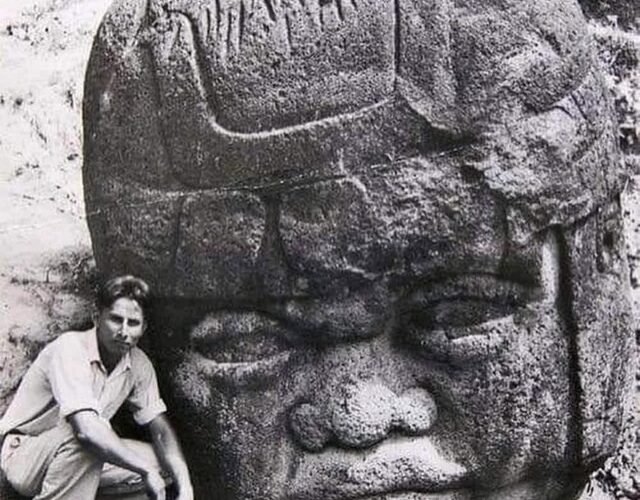
One bad thing about archeologists is that some of the successful ones get a big head.

People used to think the Olmecs, who made these colossal stone heads, were contemporary with the Mayans. But in 1939, an archaeologist couple, Marion and Matthew Stirling, found the bottom half of an Olmec stone that had part of a date carved on it!
It’s called Stela C:

The Stirlings guessed the date was 7.16.6.16.18. In the Meso-American Long Count calendar this corresponds to September 3, 32 BC. That meant the Olmecs were extremely old—much older than the Mayans.
But the first digit was missing from the bottom half of the stone! All the Stirlings actually saw was 16.6.16.18. And the first digit was the most significant one! For example if it were 8 instead of 7, the date of the stone would be much later: roughly 362 AD, when the Mayans were in full swing.
The Stirlings guessed that the first digit must be 7 using a clever indirect argument. But perhaps because of the subtlety of this argument, and certainly because of the general skepticism among experts that the Olmecs were so old, few believed the Stirlings.
But then, 30 years later, in 1969, they were proven correct! A farmer found the other half of the stone and confirmed that yes, the missing digit was a 7. So the date on Stela C really is September 3, 32 BC.
That’s a wonderful story of delayed vindication. But it leaves two mysteries.
• First, how in the world could the Olmec calendar be so damn good that we can look at that date and know it meant September 3, 32 BC?
• Second, what clever argument did the Stirlings use to guess the missing digit?
You can only fully understand the answer to this if you know a bit about the Olmec way of counting time. Like the Mayans, they used the Mesoamerican Long Count Calendar. This identifies a day by counting how many days passed since the world was created. The count is more or less base 20, except that the second “digit” is in base 18, since they liked a year that was 18 × 20 = 360 years long. So,
7.16.6.16.18
means
7 × 144,000 + 16 × 7,200 + 6 × 360 + 16 × 20 + 18 = 1,125,698 days
after the world was created. Or, if you’re a Mayan, you’d say it’s
7 baktuns, 16 katuns, 6 tuns, 16 uinals and 18 kins
But then we have to ask: when did the Olmecs and Mayans think the world was created? Experts believe they know: September 6, 3114 BCE in the proleptic Julian calendar, where ‘proleptic’ means roughly that we’re extrapolating this calendar back to times long before anyone used this calendar.
But enough background. I asked my friend Gro-Tsen
how in the world could the Olmec calendar be so damn good that we can look at that date and know it meant September 3, 32 BC?
And while I’ve already given a kind of answer, I’ve skimmed over many subtleties. So, it’s worth reading his answer:
I did the math. 🙋
👉 It’s Sept. 3, 32BCE (reminder: “32BCE” actually means “−31” 😒) in the proleptic Julian calendar = Sept. 1 prol. Gregorian.
The Western equivalent of the Mesoamerican Long Count is the “Julian Date”. The Julian Date simply counts the number of days from an arbitrary remote reference point (Nov. 24, 4714BCE proleptic Gregorian). More practically, on 2000-01-01 it equaled 2 451 545 (at 12:00 UTC if we want to use fractional Julian dates).
For example, today as I write is Julian Date 2 461 082 (well, 2 461 081.9 because it’s not yet noon UTC). And the date of Sept. 1, 32BCE [prol. Greg.] we’re talking about corresponds to Julian Date 1 709 981. More convenient than all this dealing with complicated calendar conventions.
So to convert a Long Count date to the Western calendar, we first convert the Long Count to an integer (trivial: it’s already just an integer written in base 20-except-18-in-the-penultimate-digit), we add a constant (C) to get a Julian Date, and we convert to our messy calendars.
BUT! What is this constant C? This is known as the “Mayan correlation”. For a long time in the 20th century there was a debate about its value: scholars could relate any two Mayan dates, but not situate them exactly w.r.t. our own calendar. Various values were proposed, ranging from the (frankly rather ludicrous) 394 483 to 774 078, an interval of about 1000 years! (😅)
This C = 584 283 or “GMT” correlation value places the “Long Count epoch” 0.0.0.0.0 on August 11, 3114BCE in the proleptic Gregorian calendar (the day with Julian Date 584 283), although IIUC it’s not clear if this precise date held any particular importance to the Olmecs (or later Mayans).
Maybe it was just arbitrary like the start of our own Julian Date (because, no, Julius Scalier didn’t think the world started on November 24, 4714BCE proleptic Gregorian).
One Mayan inscription suggest that the Long Count was the truncation to the last 5 “digits” of an even longer count, and that a Long Count value such as 9.15.13.6.9 was in fact 13.13.13.13.13.13.13.13.9.15.13.6.9 in this Even Longer Count (why 13 everywhere? I don’t know!). But this may be one particular astronomer’s weird ideas, I guess we’ll never know.
But back to the Mayan correlation constant C.
Wikipedia suggests that this “GMT” value C = 584 283 for the Mayan correlation is now settled and firmly established. But between 1905 and now there was some going back and forth with various authors (including the three Goodman, Martínez and Thompson after which it is named) adding or removing a day or two (I think Goodman first proposed 584 283, then changed his mind to 584 280, but nobody really cared, Hernández resurrected the proposal in 1926 but altered it to 584 284, then Thompson to 584 285 in 1927, and then Thompson later said Goodman’s initial value of 584 283 had been right all long, and while this is now accepted, the confusion of ±3 days might still linger).
The Emacs program’s calendar (M-x calendar) can give you the Long Count date (type ‘p m’ for “Print Mayan date”) and uses the GMT value C = 584 283. Today is 13.0.13.5.19. (You can also go to a particular Long Count date using ‘g m l’ but Emacs won’t let you go to 7.16.6.16.18 because its calendar starts on January 1, 1 prol. Gregorian = Julian Date 1 721 426 = Long Count 7.17.18.13.3. So close! This caused me some annoyance in checking the dates.)
So anyway, 7.16.6.16.18 is
(((7×20+16)×20+6)×18+16)×20+18 = 1 125 698 days
after the Long Count epoch, so Julian Date 1 125 698 + 584 283 = 1 709 981 if we accept the GMT value of C = 584 283 for the Mayan correlation, and this is September 1, 32BCE in the proleptic Gregorian calendar, or September 3, 32BCE in the proleptic Julian calendar. (I write “proleptic” here, even though the Julian calendar did exist in 32BCE, because it was incorrectly applied between 45BCE and 9BCE, with the Pontiffs inserting a leap year every 3 years, not 4, and Augustus had this mess fixed.)
Also, confusingly, if we use Thompson’s modified (and later disavowed) correlation of 584 285, then we get September 3, 32BCE in the proleptic Gregorian calendar, so maybe this could also be what was meant. Yeah, Julian Dates are a great way of avoiding this sort of confusion!
PS: I wrote the pages
http://www.madore.org/~david/misc/calendar.html
(and also http://www.madore.org/~david/misc/time.html) many years ago (starting on Long Cont 12.19.10.13.1), which I just used to refresh my memory on the subject.
All this is great. But it leaves us with the second puzzle: how in the world did the Stirlings guess the missing first digit of the date on the bottom half of Stela C?
Here’s the answer, as best as I can tell:
The Olmecs and Mayans used two calendars! In addition to the Mesoamerican Long Count, they also used one called the Tzolkʼin. This uses a 260-day cycle, where each day gets its own number and name: there are 13 numbers and 20 names. And the bottom half of Stela C had inscribed not only the last four digits of the Mesoamerican Long Count digits, but also the Tzolkʼin day: 6 Etz’nab. This is what made the reconstruction possible!
Here’s why 7 was the only possible choice of the missing digit. Because the last four Long Count digits (16.6.16.18) are fixed, the total day count is B × 144,000 + 117,698, where B is the unknown baktun. The number of days in a baktun is
144,000 = 0 mod 20,
and there are 20 different Tzolkʼin day names, so changing the baktun never changes which Tzolkʼin day name you land. But there are 13 different Tzolkʼin day numbers, so a baktun contributes
144,000 ≡ –1 (mod 13) days to the Tzolkʼin day number.
This means that after the day
7.16.6.16.18 and 6 Etz’nab
the next day of the form
N.16.6.16.18 and 6 Etz’nab
happens when N = 7+13. But this is 13 × 144,000 days later: that is, roughly 5,094 years after 32 BC. Far in the future!
So, while 32 BC seemed awfully early for the Olmecs to carve this stone, there’s no way they could have done it later. (Or earlier, for that matter.)
Here is the Stirlings’ actual photo of Stela C:

This is from
• Matthew W. Stirling, An Initial Series from Tres Zapotes, Vera Cruz, Mexico. National Geographic Society Contributions, Technical Papers, Mexican Archaeological Series, Vol. 1, No. 1. Washington, 1940.
By the way, in this paper he doesn’t actually explain the argument I just gave. Apparently he assumes that expert Mayanists would understand this brief remark:
Assuming then that the number 6 adjacent to the terminal glyph represents the coefficient of the day sign, the complete reading of the date would be (7)-16-6-16-18, or 6 Eznab 1 Uo, since only by supplying a baktun reading of 7 can the requirements of the day sign 6 be satisfied.
I can’t help but wonder if this was much too terse! I haven’t found any place where he makes the argument in more detailed form.
Puzzle 1. What does “1 Uo” mean, and what bearing does this have on the dating of Stela C?
Puzzle 2. Why does the Tzolkʼin calendar use a 260-day cycle?
The second one is extremely hard: there are several theories but no consensus.
⚡ **What’s your take?**
Share your thoughts in the comments below!
#️⃣ **#Stela #Azimuth**
🕒 **Posted on**: 1770893963
🌟 **Want more?** Click here for more info! 🌟
