


✨ Read this trending post from Hacker News 📖
📂 **Category**:
✅ **What You’ll Learn**:
|
Table of Contents
Flawed Routers Flood University of Wisconsin Internet Time Server
    Netgear Cooperating with University on a Resolution
    The Initial Flood
            Figure 1. The Initial Flood
        Blocking the Flood
    Background: Simple Network Time Protocol (SNTP)
            Figure 2. A SNTP Request Packet
            Figure 3. A Unicast SNTP Reply Packet
    The Flood Continues
            Figure 4. The Flood Continues: One Month Later
    Investigation
        Contacting Source Networks
            Figure 5. Email Notification to Peer Institution
        Gathering Background Information
        Examining the Netgear Code
    Contacting Netgear
            Figure 6. Email to Netgear Support
            Figure 7. Email from Netgear Support
    The Review Process
    The Flawed SNTP Client
        Impact to Netgear Customers
        Code Upgrades for Affected Netgear Products
            Figure 8. Affected Netgear Products
        Flawed Product Counts
            Figure 8a. Netgear SNTP Clients Per Day
    Suggested Fixes
        The Initial Fix: "Instant" Code
    Network Operational Options: To Serve or To Sever?
        Endgame A: UW-Madison Netgear Anycast Time Service
            Figure 10. A WiscNet BGP-based Anycast Time Service
        Endgame B: Attempt to Suppress the Requests
            Figure 11. Using the Global BGP Routing Table to Squelch Requests
        Endgame B: IP Resources Required
            Figure 12. IP Resources Required for BGP-based Suppression
    Inform the Internet Community
    Clarify Internet Best Current Practice and Protocol Standards
    Status, August 21, 2003
            Figure 13. The Most Recent Flood
    Afterthoughts
    Acknowledgements
    Analysis Tools
    References / Further Reading
    Frequently Asked Questions
        What is Netgear's liability for causing (however inadvertently) this denial of service for your network?
        Have you considered putting up a server which sends back fake answers to netgear clients, to cause people to upgrade?
        What is the expected life-time for these products?
        In figure 13, could that "shark fin" spike have anything to do with last week's power grid failure (Blackout 2003), and subsequent "rolling" restoration?
        Are there other devices than those mentioned which also suffer from the flaw which causes inadvertent flooding of your network?
        What was the effect of this article being slashdotted?
        Why is a traditional manufacturer recall/defect solution not a possibility?
        I'm with [the IT press], do you have some time to speak with me?
        How has this story been covered in the press?
Figure 1 is a graph of inbound traffic to our campus over a 48 hour period,
tuesday through thursday, May 13-15, 2003.
The first half of the graph shows typical traffic levels for our campus,
with peak inbound packet rates
of about 40,000 packets-per-second. However, as you can see, our inbound
packet-per-second rate increased dramatically
starting May 14 at about 8AM localtime, primarily from our commodity Internet
Service Provider, WiscNet.
At about 9:40AM this additional traffic began to cause problems with our
measurement infrastructure and some of our legacy intra-campus routers.
By 11AM we had identified the inbound flood traffic by protocol and port
numbers. It was destined for our public time server and we
blocked the incoming traffic upstream, at WiscNet’s border routers, which
alleviated the problem for the time being. This is a typical action for
network operators to take in reaction to malicious Denial-of-Service flood
attacks, of which we assumed this was one.
The traffic in question appeared to be Network Time Protocol (NTP) queries
in that they consisted of 76-byte IP packets destined for UDP port number 123
(NTP).
However, these packets had an unusual characteristic: although they appeared
to come from many sources, they all had the same source port number: 23457.
Therefore, it was possible to configure our routers to block just a subset
of inbound queries to our NTP server, and continue to service the other
legitimate requests normally. We just blocked all UDP traffic sourced
from port 23457 and destined for port 123 (NTP) of the NTP server in
question. (Note that the number 23457 seems hand-picked, as the number
subsequent to 23456.) At this point we simply chalked it up to
naivete on the part of the “attacker”, which we presumed was forging
many random source addresses, and left it at that, presuming that the
flood would subside within hours as “script kiddie”-launched flood
attacks often do.
Paraphrased from RFC2030 by Dave Mills:
The Simple Network Time Protocol (SNTP) is an adaptation of the Network
Time Protocol (NTP) used to synchronize computer clocks in the
Internet. It is a simple, stateless remote-procedure call (RPC) system
with accuracy and reliability expectations similar to the UDP/TIME
protocol described in RFC-868. SNTP can be used when the ultimate
performance of the full NTP implementation is not necessary.
Note that SNTP uses the same packet format as NTP.
In this way, SNTP clients can utilize NTP servers, even though they do
not implement the complexities of the full peer-to-peer NTP protocol.
SNTP conversations typically follow these steps:
-
A client that would like to know the time sends a UDP packet containing
the SNTP request to the well-known NTP port number 123 of an NTP
server, and awaits a reply.Figure 2. A SNTP Request Packet
+-+-+-+-+-+-+-+-+-+-+-+-+-+-+-+-+-+-+-+-+-+-+-+-+-+-+-+-+-+-+-+-+
|LI | VN  |Mode |    Stratum    |     Poll      |   Precision   |
| =0|= 1-4|= 3  |      = 0      |     = 0       |      = 0      |
+-+-+-+-+-+-+-+-+-+-+-+-+-+-+-+-+-+-+-+-+-+-+-+-+-+-+-+-+-+-+-+-+
|                          Root Delay                           |
|                             = 0                               |
+-+-+-+-+-+-+-+-+-+-+-+-+-+-+-+-+-+-+-+-+-+-+-+-+-+-+-+-+-+-+-+-+
|                       Root Dispersion                         |
|                             = 0                               |
+-+-+-+-+-+-+-+-+-+-+-+-+-+-+-+-+-+-+-+-+-+-+-+-+-+-+-+-+-+-+-+-+
|                     Reference Identifier                      |
|                             = 0                               |
+-+-+-+-+-+-+-+-+-+-+-+-+-+-+-+-+-+-+-+-+-+-+-+-+-+-+-+-+-+-+-+-+
|                                                               |
|                 Reference Timestamp (64 bits)                 |
|                             = 0                               |
|                                                               |
+-+-+-+-+-+-+-+-+-+-+-+-+-+-+-+-+-+-+-+-+-+-+-+-+-+-+-+-+-+-+-+-+
|                                                               |
|                 Originate Timestamp (64 bits)                 |
|                             = 0                               |
|                                                               |
+-+-+-+-+-+-+-+-+-+-+-+-+-+-+-+-+-+-+-+-+-+-+-+-+-+-+-+-+-+-+-+-+
|                                                               |
|                  Receive Timestamp (64 bits)                  |
|                             = 0                               |
|                                                               |
+-+-+-+-+-+-+-+-+-+-+-+-+-+-+-+-+-+-+-+-+-+-+-+-+-+-+-+-+-+-+-+-+
|                                                               |
|                  Transmit Timestamp (64 bits)                 |
|                             = n                               |
|   (some number: zero, or the time of request sent by client)  |
|                                                               |
+-+-+-+-+-+-+-+-+-+-+-+-+-+-+-+-+-+-+-+-+-+-+-+-+-+-+-+-+-+-+-+-+
-
The server responds with a UDP packet containing the SNTP reply from
the well-known NTP port number 123 to the SNTP client.Figure 3. A Unicast SNTP Reply Packet
+-+-+-+-+-+-+-+-+-+-+-+-+-+-+-+-+-+-+-+-+-+-+-+-+-+-+-+-+-+-+-+-+
|LI=| VN  |Mode |    Stratum    |     Poll      |   Precision   |
|0-2|=req.|= 4  |    = 1 - 14   |   (ignore)    |   (ignore)    |
+-+-+-+-+-+-+-+-+-+-+-+-+-+-+-+-+-+-+-+-+-+-+-+-+-+-+-+-+-+-+-+-+
|                          Root Delay                           |
|                           (ignore)                            |
+-+-+-+-+-+-+-+-+-+-+-+-+-+-+-+-+-+-+-+-+-+-+-+-+-+-+-+-+-+-+-+-+
|                       Root Dispersion                         |
|                           (ignore)                            |
+-+-+-+-+-+-+-+-+-+-+-+-+-+-+-+-+-+-+-+-+-+-+-+-+-+-+-+-+-+-+-+-+
|                     Reference Identifier                      |
|                           (ignore)                            |
+-+-+-+-+-+-+-+-+-+-+-+-+-+-+-+-+-+-+-+-+-+-+-+-+-+-+-+-+-+-+-+-+
|                                                               |
|                 Reference Timestamp (64 bits)                 |
|                           (ignore)                            |
|                                                               |
+-+-+-+-+-+-+-+-+-+-+-+-+-+-+-+-+-+-+-+-+-+-+-+-+-+-+-+-+-+-+-+-+
|                                                               |
|                 Originate Timestamp (64 bits)                 |
|            (copied from request Transmit Timestamp)           |
|                                                               |
+-+-+-+-+-+-+-+-+-+-+-+-+-+-+-+-+-+-+-+-+-+-+-+-+-+-+-+-+-+-+-+-+
|                                                               |
|                  Receive Timestamp (64 bits)                  |
|             (time request was received by server)             |
|                                                               |
+-+-+-+-+-+-+-+-+-+-+-+-+-+-+-+-+-+-+-+-+-+-+-+-+-+-+-+-+-+-+-+-+
|                                                               |
|                  Transmit Timestamp (64 bits)                 |
|                 (time of reply sent by server)                |
|                             = n                               |
|                                                               |
+-+-+-+-+-+-+-+-+-+-+-+-+-+-+-+-+-+-+-+-+-+-+-+-+-+-+-+-+-+-+-+-+
-
Upon receiving the response, the client optionally uses the Originate
Timestamp from the reply to validate the response, attempting to assure
that it is indeed a response to this client’s request. (If the reply
were spoofed from another source, it would be unlikely to contain the
correct value as the Originate Timestamp). Then it plucks the value
from the “Transmit Timestamp”, perhaps modifying it slightly to
account for the estimated one-way end-to-end delay, and uses the
result as the current time to set its local clock.
Now, back to our story…
One month later, we discovered that the flood of inbound NTP traffic
persisted at an even more incredibly high rate, as evidenced by Figure 4
which plots our router’s discarded packet rates beginning in early June
2003, for the traffic in question.
In Figure 4, note that: (1) there are slight daily fluctuations in rate
(perhaps due to diurnal user behavior), (2) generally, the rate stays at
a value over 250,000 packets-per-second (and over 150
megabits-per-second), and (3) that the traffic rate increases
throughout the time shown. The sharp drops in traffic rate in this
figure are not due to the flood subsiding but rather were due to
network maintenance and a temporary block upstream from the observation
point.
Once we found that this flood was continuing and was still increasing in
rate, we investigated further. By carefully removing the block on some
ingress interfaces, we allowed a trickle of traffic through to the
server and captured the packets including their payload. We learned
that these packets appeared to be legitimate, well-formed Simple
Network Time Protocol (SNTP) version 1 queries, albeit at an
inexplicably high rate from each client host. For instance, during one
trace, many clients produced about one query per second. This would be
highly unusual for a properly constructed SNTP client, since an
application which uses SNTP is merely interested in setting its own
clock relatively accurately so that its host has some reasonable
notion of the current time. One query per second is ridiculous, and is
far from best practice for NTP client behavior.
Also, we discovered that many of the IP addresses could be resolved to
DNS names and furthermore that the IP addresses all appeared to be
valid sources for the given ingress interface from which we removed the
block. This indicated that it was quite possible that the source
addresses were not forged but instead were real Internet hosts
running some very unusual SNTP client.
Alas, none of the client source hosts were within our local campus
network. This meant we would need to recruit the help of staff at
remote sites to aid in the investigation.
Of the top talker source IP addresses from the aforementioned packet trace,
I selected two client hosts from other universities with talented
network staff who would be familiar with responding to such incidents.
The following is an email I sent to the Incident Response Team at one of
those institutions to which one of the client host addresses belonged.
(To maintain a modicum of anonymity, I have replaced the real SNTP client’s
IP address with 10.42.69.10 and have also removed the email domain names.)
Figure 5. Email Notification to Peer Institution |
||
|
Network staff from two universities investigated two source hosts which
I reported as being sources of these anomalous SNTP queries. Both reported
that a Netgear brand router was the source of the traffic. (Specifically,
one was identified as model MR814.)
Now things started to make some sense. Many source hosts all using the same
source port number could be explained by an embedded SNTP client in which
the programmer hard-coded the source port number (23457).
While searching the web for background information on Netgear products’
acclaimed NTP support, I came across the following quote (from ICSA Labs Firewall Lab Report on the NETGEAR FR114P):
The Netgear FR114P relied on a separate NTP-based time source to set
the current date and time, as it did not have an internal battery and
clock. The product is hard-coded with specific NTP time sources that
are accessible through the public Internet. Even after configuring the
product to access a specific NTP server, the product still attempted to
access its hard-coded NTP time sources, while simultaneously accessing
the time source specifiedConclusion
The Candidate Firewall Product met all the criteria elements in the
Baseline and Residential modules and therefore has attained ICSA Labs
Firewall Certification.
Note that Netgear reports that the FR114P does not contain the specific
SNTP flaws described here. I just found it interesting, since that was
the only NTP-related flaw about which I found information on the web.
In order to verify our hypothesis that the source of the flood of SNTP
queries are the Netgear Platinum family products and to properly
characterize this problem to the vendor, the Netgear code for a number
of their products was downloaded and investigated.
Simply by using the Unix “strings” command, I was able to verify that indeed
the Netgear code seems to contain the magic number 23457 (as a port number):
$ strings RP614_4_12.bin |grep 23457
 on 23457 port.
$ strings MR814_4_11.bin |grep 23457
 on 23457 port.
Using a similar technique, I found the following IP addresses embedded
as ASCII strings in RP614_4_12.bin:
128.105.39.11 # ntp1.cs.wisc.edu (a.k.a. "caesar.cs.wisc.edu")
192.168.1.101
66.37.215.43
12.234.94.14
192.168.0.1
(Note that I added the DNS name comments for clarity; those strings did not
occur in the binary file.)
Likewise, these IP addresses were embedded in MR814_4_11.bin:
0.0.0.0
12.234.94.142
66.37.215.43
192.168.0.102
128.105.39.11 # ntp1.cs.wisc.edu (a.k.a. "caesar.cs.wisc.edu")
192.168.0.1
192.168.1.101
Of 3 globally routable IP addresses therein, only 128.105.39.11
appears to be used as an NTP server. One of the others was an IP
address previously used by the “dyndns.org” dynamic DNS name service.
Netgear has reported to us that the remaining embedded globally
routable IP addresses are no longer used and that they are part of dead
code left over from debugging by one of the developers.
On June 16, 2003 I sent the following email message to Netgear
support. Since this issue is more significant than the typical customer
support inquiry, I also sent it directly to some Netgear employees
(whose email addresses were culled from the web) asking them to
communicate it to the proper people in engineering and/or to have
someone contact me by phone or email.
Figure 6. Email to Netgear Support |
||
|
After receiving no response for days, I called
Netgear’s headquarters, leaving messages with two executives explaining
the seriousness of the situation. I also emailed members of Netgear’s
executive team by guessing their email addresses, based upon their
email naming convention. I included a “Return-Receipt-To” header, and
their Mail-eXchanger notified me that all were delivered successfully.
Here’s a portion of that message:
At this point I have a complete write-up of this continuing incident,
including traffic measurement statistics evidencing the flood and an
analysis of its root cause ready to be released publicly.I absolutely need to hear from responsible parties at NETGEAR
immediately, if NETGEAR wishes to begin a dialogue before this goes
public. We’re not expecting an immediate solution; in fact, I’m fairly
certain there is no complete solution without UW-Madison’s involvement.
On Thursday, June 19, I received a voicemail message from the director
of support for Netgear. He confirmed that they have located some fault
in their code. Soon afterward, I began to exchange email and voicemail with
him. Having now established initial contact, we proceeded to work this
issue outside of Netgear’s support system, continuing on with the
review process described below.
Netgear’s support organization was completely unresponsive. Curiously,
I did finally receive the email message below from Netgear’s
email-based customer support system, some 23 days after I submitted the
problem report on June 16.
Figure 7. Email from Netgear Support |
||
|
Shortly after beginning a dialogue with Netgear, I proposed the
formation of a review team to discuss possible solutions. Netgear
agreed, and a review team was formed with about fifteen members, a
third from each of these areas:
- Netgear employees
- University employees
- Independent experts from their respective fields:
- Regional Internet Registries
- Internet Measurement Research
- Network Time Protocol
The independent experts agreed to participate without prematurely
disclosing the details of the situation.
A number of action items and directions were developed during the review
process. These included:
- Fix the SNTP Client
- Propose the Network Operational Options
- Inform the Internet Community
- Clarify Internet Best Current Practice and Protocol Standards
The Flawed Netgear SNTP Client implementation in the products affecting
UW-Madison has the following characteristics:
-
Uses a hard-coded IP address for the NTP server 128.105.39.11,
that of ntp1.cs.wisc.edu. -
Uses a fixed UDP source port number 23457.
This was incredibly advantageous as it allowed UW-Madison to identify
and count the Netgear clients. However, due to the widespread use of
Network Address Port Translation (NAPT, or NAT/PAT)
upstream from some Netgear products, the SNTP request source port
number is sometimes rewritten before the request packet reaches its
destination.Note to network operators: Please do not block UDP
traffic involving port 23457 nor traffic involving our NTP server’s IP
address of 128.105.39.11. While we appreciate attempts to help, it
may interfere with the best possible solution to this problem. -
Polls at one second intervals until it receives a response
from the NTP server, after which it uses a longer poll interval such as
one minute, ten minutes, two hours, or 24 hours,
depending upon product model and firmware version.
As of this writing (August 2003) the University is making its best
effort to service the Netgear time requests. As such, users
of the affected products should not normally notice any problems due to
this flaw. Furthermore, based on experience so far, it seems that
only a small subset of the customers are even aware of the time-related
features of these products (which include logging, policy scheduling,
and email notifications).
In parallel, Netgear has produced and continues to work on firmware
that does not exhibit the aforementioned problems. Customers can
upgrade to newer firmware versions, which are available for download
from Netgear’s support site. At the time of this writing (August
2003), the most current version of firmware available for the RP614v2,
RP614, DG814, and MR814 models does not utilize UW-Madison’s time
service nor does it poll too frequently.
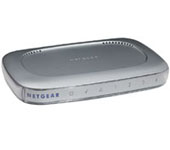
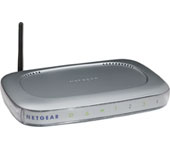
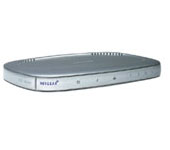
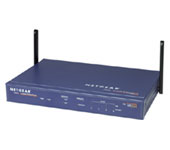
Based on information supplied or confirmed by Netgear, the following
products contained these SNTP design flaws. Where applicable, I have
labeled each with the earliest version of code containing a fix:
Figure 8. Affected Netgear Products |
||||
|
I have counted more than 500,000 unique Netgear sources that queried our
time server in one day. This measurement likely underestimates the actual
count because of Network Address Port Translation, which modifies the
source IP address and port number, and because some broadband residential
services drop the customer’s link when the service is not in use.
As of June 30, 2003, Netgear reported a total of 707,147 affected
products manufactured. Some simple math: If there are 700,000 errant
SNTP clients each of which can generate one SNTP request per second to
our time server, then the worst-case aggregate rate will be about
700,000 packets per second. Since each SNTP packet is 76 bytes in
size, that is also 426 megabits per second of traffic.
Figure 8a shows the actual number of unique NTP Netgear client IP
addresses observed per day by a router on UW-Madison’s network.
Theoretically, counting the clients in this way could overestimate
the count if the clients’ DHCP servers changes the client IP address
frequently. However, based on the number of products
reported as having been manufactured, it seems fairly accurate.
During the review process a number of improvements to the SNTP client
were suggested.
These included that an SNTP implementation:
- SHOULD use a poll interval within the range from 64 to 1024
seconds or longer - SHOULD use local NTP server(s) or multicast when available, as
configured by the operator or determined by a discovery mechanism
such as via the DHCP “Network Time Protocol Servers Option”, which
is defined in section 8.3 of RFC 2132. - MAY performance exponential backoff of poll interval (within the
aforementioned range) upon failure to receive a response from the
NTP server(s) - MUST NOT use a shorter poll interval upon failure to receive a
response from the NTP server(s) - MUST allow the operator to configure the query behavior with respect
to whether or not it is enabled or disabled and with respect to
which candidate time servers can be queried. - SHOULD use the Domain Name System to determine candidate server(s)
IP address(es), so that the NTP server’s zone administrator can
influence the client behavior. - SHOULD resolve the server IP address via DNS before each poll/query,
so that the pertinent DNS entries’ Time-To-Live values are respected. - SHOULD support the existing NTP access-control mechanism by, upon
receiving a valid `kiss-of-death’ packet, reporting the condition
and discontinuing queries to the server in question until
reinitialization. - MAY use an implementation-defined fixed source port number
Some of these have been implemented in the initial fix
but others are only under consideration.
Hopefully these suggestions will be evaluated during
an upcoming SNTP standardization effort.
During the review process, we learned that Netgear already was having
SNTP-related code changes developed for the RP614v2 product prior to my
initial notification of the problems the flaw was causing to the
University.
Regarding Firmware v5.13 RC7 for the RP614v2, Netgear made this new
code available to me on July 10. My testing found that the modified
SNTP client had these characteristics, much as they described:
-
Now requires a DNS server to be configured (or learned via DHCP) before
generating any SNTP queries. -
The code performs DNS queries for “time-a.netgear.com” and
“time-b.netgear.com” at ten minute intervals until success, alternating
names if no response is received. I verified also that it supported
responses with CNAMEs or multiple A records as well. -
Following successful DNS resolution, it sends an NTP query to the resolved
IP address and waits for a reply. If no reply comes in ten minutes, it
again resolves the name, and requeries. It appears to give up after five
retries. -
Whenever any configuration change is applied via the
web interface, it causes the device’s clock to be zeroed, the NTP
server to be re-resolved, and subsequently queried.
However I also found these bugs:
-
The SNTP client in this code does not appear to validate the NTP
response packet. It will accept any incoming packet to port
23457 as a valid response even if the flags are set wrong (for
instance, indicating that it is another client query rather than a
server response). -
While the SNTP client is awaiting a response (after
querying either time-a or time-b) it seems to accept any UDP
response packet, even if the source IP address of that UDP packet is
not that of the time server that it queried.
This code was made available for download on the Netgear web site for
the RP614v2 on or about July 11, 2003.
Netgear continues to develop improvements to their SNTP client and
has vetted the design with the review team.
These flawed devices are not easily reconfigurable. Representatives
from both Netgear and UW-Madison believe that it is not a viable option
to rely on Netgear’s customers to upgrade to the newer firmware (the
first of which was released in July) to correct the errant behavior.
Our review team has considered a number of possible options about how
to deal with the errant Netgear time requests. While I won’t discuss
all the details here, the two primarily endgames on which we’ve focused
are outlined below.
In this option we would deploy highly-reliable, redundant NTP servers
at WiscNet’s borders and route the inbound requests destined to
128.104.39.11 to them using BGP anycast. (Anycast is a
technique that can often be employed to route traffic for some
stateless RPC services, such as DNS or NTP, which are based upon UDP.)
Implementing this option would likely include placing a pair of
rack-mount NTP servers at each of three locations within WiscNet:
UW-Madison, UW-Milwaukee, UW-Eau Claire. These are nearest the three
current border Internet exchange points and therefore provide the most
diverse paths for reliability of connectivity to the global Internet.
One distinct advantage of this configuration is that UW-Madison
retains as much control as possible over its precious IPv4 address
allocations. Because this BGP anycast deployment resides solely within
WiscNet (which will honor a single /32 host-address route), this option
consumes as little of UW-Madison’s IP address space as possible – just
the address to which Netgear time requests were directed.
Endgame A has some risk. Whether or not the servers’ responses
reach the requesting client host is not wholly within the University’s
control, consequently some amount of flooding will likely continue.
There are many reasons other than server failure for disruptions in the
end-to-end path between the SNTP clients and servers that could cause
the clients not to receive the responses and to flood requests toward
our servers anyway. These include asymmetric routing problems,
firewalling policies, and disasters affecting any link between the
clients and servers. Indeed, even while our time server is dutifully
responding to all netgear SNTP requests, we still regularly observe
that hundreds of them continue to flood. Apparently these “zombies”
never receive our responses.
To limit the possibility of the multiple servers being simultaneously
isolated from the Internet, one could consider an even more
geographically diverse set of deployment locations, such as that done
by the AS112 Project, which
effectively mitigates the damage caused to the Internet’s root name
servers by RFC1918-related queries.
Figure 10 is a diagram showing how this service would work. The
Netgear SNTP requests heading toward UW-Madison are shown in green.
Note that multiple NTP servers, all with the same IP address, are
located in multiple locations. WiscNet’s border routers divert the
inbound SNTP requests to the nearest server. The server responses are
shown in red. If any of the servers fail, the traffic should route
to one of the remaining NTP servers with the same address.
To prevent Netgear time requests from being forwarded to our network
would require UW-Madison to sacrifice a block of IP address space
within the class B network which includes the IP address of
ntp1.cs.wisc.edu.
Because of the way the Internet’s backbone routing is operated, and to
keep the number of routes manageable, network routes are sometimes not
respected unless they are sufficiently large. In today’s Internet,
that means a route might not be considered legitimate unless it
represents 2,048 or 4,096 contiguous addresses. Respectively, network
operators would call those size “/21” or “/20” (pronounced “slash
twenty”) blocks because they represent networks having netmasks of 21
or 20 contiguous bits.
Figure 11 is a diagram showing this configuration. The BGP updates
originating from UW-Madison’s border router are shown in red. The Netgear
SNTP Requests are shown in green. The ICMP unreachable messages returned
to the client by BGP-aware border routers throughout the Internet are shown
in blue. These inform the client that the network in which the NTP server
would reside is unreachable.
This endgame that tries to suppress the forwarding of requests comes at
a significant cost to the University – we may have to sacrifice, likely
for the lifetime of the flawed products, as many as 4,096 IP
addresses. Figure 12 shows how our existing 128.105.0.0/16 network
could be divided, and the one slice “/20” block which would be excluded
from the Internet’s global BGP routing table.
The risks of endgame B include the possibility that some portions of the
Internet might not be able to reach legitimate campus IP addresses that
lie near the sacrificial, unadvertised block. Input from the backbone
network operations community and real-world experience must determine
which solution best serves the University and Internet community as a
whole.
The public release of this document is part of an effort to inform the
Internet community of this flaw and the resulting floods, with the hope
of minimizing the likelihood of such a mistake being repeated
elsewhere. Note that Netgear was notified of our plan to publicly
disclose the details herein weeks in advance of its release.
Furthermore, earlier revisions of this document were provided to them
for review.
Because of the scope of the resulting problem, with hundreds of
thousands of ill-behaved Internet hosts distributed world-wide, and
because of the scale and unexpected nature of the flooding, with
aggregate rates which could completely fill some network links, I felt
that it was important to inform others and solicit advice from experts.
Following this disclosure, it’s my intent to find appropriate venues to
further present and review the dangers and potential solutions to this
and similar problems.
For instance, during the review process we learned that
the Commonwealth Scientific & Industrial Research Organisation
(CSIRO) in Australia is having
similar trouble with about 85,000 SMC brand routers that poll the CSIRO
time server twice a minute when they don’t receive a response.
A story about that incident, “Rogue routers cause havoc for CSIRO”, can be found here:
http://australianit.news.com.au/articles/0,7204,6716567%5e15340%5e%5enbv%5e15306-15318,00.html
While the scale of the CSIRO problem is orders-of-magnitude less,
with floods of perhaps 2,800 packets per second and 1.7 megabits per
second, it is strikingly similar and perhaps not as likely to be as
responsibly addressed with the assistance of that manufacturer.
Also during the review process, some members of the review team began
work on Internet Drafts
to improve documentation pertinent to this issue.
There are at least two such efforts currently in their infancy:
- I am in the process of preparing an Internet Draft, currently
titled “Embedding Globally Routable Internet Addresses Considered
Harmful”, which denounces the practice of embedding unique, globally routable
IP addresses in Internet hosts, describes some of the resulting problems,
and considers selected alternatives. - Members of the NTP community have revised and reviewed the existing
Informational RFC2030 that describes SNTP. Through their efforts and
perhaps those of other interested parties, it may be possible to
revisit NTP and SNTP as a standards track protocol within the
IETF.
I’m pleased to report that Netgear has cooperated with us on the initial
steps of this process and we are forging an agreement that will enable
us to implement a suitable solution.
For the time being, UW-Madison continues to service Netgear SNTP
requests in spite of receiving occasional large-scale floods of traffic
from Netgear products. A recent incident is shown in Figure 13. The
shark-fin shaped anomaly on the right is a flood of inbound
Netgear time requests which grew to about 100,000 packets per second
before subsiding.
Both the magnitude and duration of the Netgear-caused incidents
continue to present a serious operational problem for UW-Madison.
While essentially involved in a game of russian roulette at the moment,
we are hoping to utilize the expertise of both UW-Madison and the
Internet operator community to design and implement a good solution.
Here are some questions, offered as food for thought, that were brought
to mind by this case study:
-
What does this unintentional Denial-of-Service flood indicate about the
viability of some public Internet services? -
Can the Internet routing infrastructure be improved to enable less disruptive
solutions to such problems? -
Are incidents such as this a likely side-effect of ubiquitous, low-cost,
perhaps even disposable Internet hosts? -
Are the manufacturer, vendor, Internet operations, and user communities
willing and able to cooperate to address such problems?
The following provided assistance with the data gathering, analysis,
and people networking:
-
University of Wisconsin-Madison:
Jeff Bartig, Jim Gast, Michael Hare, Adam Kunen, Dave Thompson - University of Florida: Robert Bird, Greg Goddard
- Harvard University: Greg Mazzu
- k claffy, Nevil Brownlee, George Michaelson
I’d also thank the members of the review team, including those remaining
anonymous. I’m certain we’ll come to a better solution because of their
participation.
The following tools were used during this investigation:
- RFC2030: Simple Network Time Protocol (SNTP) Version 4 for IPv4, IPv6 and OSI (status: Informational)
- RFC1305: Network Time Protocol (Version 3) Specification, Implementation and Analysis (status: DRAFT STANDARD)
- home of the Network Time Protocol (NTP) project
- Public NTP Time Servers
- Public NTP Secondary (stratum 2) Time Servers
- RFC2132: DHCP Options and BOOTP Vendor Extensions
- RFC1546: Host Anycasting Service
- http://www.networksorcery.com/enp/protocol/sntp.htm
- an article on how to change Windows’ time server configuration using regedit
- Basic Operation of the Windows Time Service
- http://www.microsoft.com/windows2000/docs/wintimeserv.doc
- Flawed Routers Flood University of Wisconsin Internet Time Server (NANOG 29 presentation)
- A Case Study in Internet Pathology: Flawed Routers Flood University’s Network (LISA ’03 talk)
-
What is Netgear’s liability for causing (however inadvertently) this denial of service for your network?
My work responsibilities are not ones that would make me a participant in such
negotiations. However, as I reported, an agreement is being forged.Note to others: Please do not ask me for financial or legal details.
This document is a technical summary of the situation and is not the vehicle
by which to deliver such details.You may be interested in this news article:
http://www.doit.wisc.edu/news/story.asp?filename=322 -
Have you considered putting up a server which sends back fake answers to netgear clients, to cause people to upgrade?
Yes, but we didn’t consider it for long. Both Netgear and others
on the review team agreed that it would likely
have very little effect, since only a small subset of the customers
seem to even be aware of the NTP-related features of the affected
products. Besides, the proposed “dishonest” time server (which would
report the wrong time) would have to be operated at the IP address that is
currently that of our well-known reliable time server. It would be
quite rude for it to suddenly become unreliable since the whole purpose
of the public time service is to answer with the correct time. The
University intends to provide the best possible service, regardless of
how it’s abused. -
What is the expected life-time for these products?
Personally, I think its likely that many of them will be around until five
to ten years from now. Its only a guess, but perhaps the half-life is five
years, after which we’d expect to see less than 350,000 of the affected
products remaining in use. -
In figure 13, could that “shark fin” spike have anything to do with last week’s power grid failure (Blackout 2003), and subsequent “rolling” restoration?
No, it did not coincide with the blackout that affected the east coast
in August 2003.
However, I did look for evidence of the blackout in the netgear SNTP traffic,
and found only slight less during the outage. Relatively little of the
Internet was actually affected by the power outage. Early reports were
that only a few thousand BGP prefixes from only a couple hundred autonomous
systems were offline. Those that were offline were unreachable in both
directions, so we didn’t receive requests from them until power was returned.
The rolling restoration served to distribute the load to our server as
those netgear clients came online. -
Are there other devices than those mentioned which also suffer from the flaw which causes inadvertent flooding of your network?
A number of Netgear users have reported to me that Netgear model RO318,
firmware version V3.26, also utilizes our time server
and also logs ntp errors to its security log. I have not evaluated this
product, so do not know what retry times it uses, but will report this to
Netgear. -
What was the effect of this article being slashdotted?
While having a significant effect on the web server, overall it was an
insignificant level of traffic for the campus. The server handled 30
requests a second for a while.Here’s a graph comparing the web server hits-per-second to the number
of Netgear-sourced SNTP request flows-per-second, when this report was
slashdotted. (Note that most Netgear clients were receiving replies
from our server at this time, so they were not flooding requests.)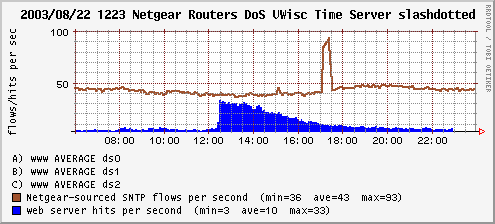
-
Why is a traditional manufacturer recall/defect solution not a possibility?
Both Netgear and other members of the review team felt that it was unlikely
that all but a very small subset of the owners would return the affected
device since they appear to be working fine. Also, very few customers have
registered these products with the manufacturer, so it is impractical
to contact them. -
I’m with [the IT press], do you have some time to speak with me?
When this report was first presented, an astute audience member
proposed that the IT press ostensibly plays an important role in
evaluating whether or not consumer products comply with Internet
standards and best current practice.Given that, if you’re with the IT press and your publication does
Internet product reviews or makes “Editor’s Choice” awards, I am
willing to correspond with you by email about this story.
Specifically, the Internet community may benefit from our exploring the
IT press’ familiarity with Internet standards and best practices and
the press’ assessment of its ability to evaluate products.By tying the reporting of this story in with the product evaluation and
recommendation function of the IT press, I’m hopeful that the community
could reduce the likelihood of such flaws causing such problems.
It’s just an idea, let me know what you think. -
How has this story been covered in the press?
While certainly not an exhaustive list, here is a sampling of
coverage.
(Please be aware that some of these articles are
misleading or incorrect about the details;
Only a few of them contacted me to check the facts.)
Copyright 2003, Dave Plonka.
$Id: index.wml,v 1.39 2006/07/19 15:20:28 plonka Exp $

$Log: index.wml,v $
Revision 1.39  2006/07/19 15:20:28  plonka
updated figure 8a

Revision 1.38  2005/04/28 16:13:02  plonka
updated figured 8a

added NANOG and LISA talks to references

added news story url to faq entry

fixed a typo

Revision 1.37  2004/09/28 18:37:16  plonka
fixed a typo

Revision 1.36  2004/05/19 22:54:31  plonka
updated figure 8a

Revision 1.35  2004/02/05 17:29:12  plonka
added figure 8a, Netgear SNTP Clients Per Day

Revision 1.34  2003/12/04 22:30:58  plonka
fixed a typo

Revision 1.33  2003/10/16 22:30:05  plonka
added a faq entry

Revision 1.32  2003/09/15 22:13:13  plonka
fixed some typos and the host address counts for /20 and /21 blocks

Revision 1.31  2003/09/12 18:09:49  plonka
added info about code upgrade for HR314

Revision 1.30  2003/09/10 15:03:26  plonka
fixed a typo

Revision 1.29  2003/09/10 14:58:50  plonka
added using DHCP "Network Time Protocol Servers Option" to "Suggested Fixes"

Revision 1.28  2003/08/30 02:22:20  plonka
added faq entry

Revision 1.27  2003/08/27 18:42:42  plonka
added graph evidencing the flash crowd when this report was slashdotted

Revision 1.26  2003/08/26 21:40:46  plonka
fixed some typos and reworded a couple sentences

Revision 1.25  2003/08/25 23:54:09  plonka
added faq entries
💬 **What’s your take?**
Share your thoughts in the comments below!
#️⃣ **#Flawed #Routers #Flood #University #Wisconsin #Internet #Time #Server**
🕒 **Posted on**: 1789334495
🌟 **Want more?** Click here for more info! 🌟
