


🚀 Check out this must-read post from Hacker News 📖
📂 **Category**:
💡 **What You’ll Learn**:

When the Aspen Skiing Company wanted to raise its lift ticket prices from $10 to $12 in 1975, it had to ask the US Forest Service for permission.
When Aspen residents wanted to fight the proposed price increase, they wrote letters to their local forest supervisor.
That’s the way ski business was done half a century ago: through a federal intermediary. Most ski resorts in the western United States operate under Forest Service permits, and in the 1970s, politicians, national forest employees, skiers, and ski resort owners all recognized that the agency had a mandate to regulate the prices charged by private companies on public land.
“These guys [ski company managers] would come in with their hat in their hand, literally, and be as polite as possible and say, ‘Can we raise our ticket price fifty cents or a dollar,’” recalled Erik Martin, a ski resort specialist in the 1970s for White River National Forest, which manages land used by the four Aspen-Snowmass area resorts.
At the time, ski areas had to renew a required operating permit with the Forest Service annually, and federal employees like Martin understood that stopping unreasonable rate hikes was part of the job.
“We controlled everything. They were our ski areas,” Martin told historian Michael Childers for his 2012 book Colorado Powder Keg: Ski Resorts and the Environmental Movement.
In 1975, Martin’s office was flooded with mail opposing Aspen’s proposed 20% lift ticket increase. U.S. Sen. Floyd Haskell, a Democrat from Colorado, took note of the controversy and demanded action as well. In the end, the Forest Service decided that Aspen could only raise prices by 10%, from $10 to $11.
Adjusted for inflation, the $11 lift ticket would have cost around $66 in 2026 dollars. A one-day ticket to Aspen costs $254 today. Vail, which had the same rates as Aspen in the mid-70s, is charging up to $356 for a day ticket this season, a 436% increase from its inflation-adjusted rates in 1975.
Although the Forest Service technically still has the ability to control prices at most ski resorts, the agency’s regulatory will has atrophied. Skiers angry about high parking fees, overpriced cafeteria lunches, long lift lines, and the disappearance of independent resorts may plaster lift poles with “Vail Sucks” stickers, but almost nobody thinks to demand action from their local Forest Service supervisor anymore.
What changed over the last fifty years? Industry deregulation that began under President Jimmy Carter and was embraced by subsequent administrations has allowed the ski industry to move ever closer to a duopoly — all while skiing costs rise and the Forest Service sits on its hands.
Some of the first ski areas in the western US were built on public lands with public funds and were publicly owned. In the Rocky Mountains above Denver, Franklin Delano Roosevelt’s Work Progress Administration and Civilian Conservation Corps, both cornerstones of the New Deal, cleared ski trails, built lodges, and set up rope tows in the 1930s. Berthoud Pass saw the construction of a government-owned ski lodge in 1938, complete with dining facilities, dorms, and private rooms. A resort in Winter Park opened soon afterwards with funding from the WPA and the City of Denver, the latter of which still owns Winter Park.
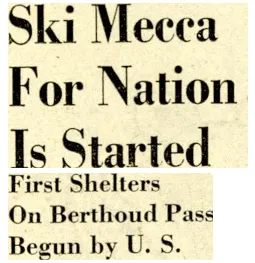
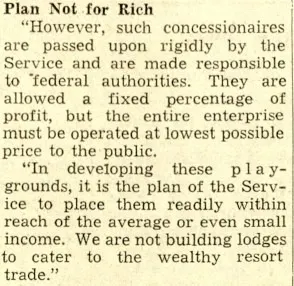
After World War II, when skiing soldiers trained in the US Army’s Tenth Mountain Division started returning home, the ski industry began to modernize with T-bars and chairlifts. The federal government largely gave up the operation of ski facilities, but it still strictly regulated resorts built on public land, limiting the number of new ski areas that were allowed to open and overseeing development.
Skiing saw a rapid growth in popularity throughout the 50s and 60s as hollowed-out mining towns like Aspen began to transform into winter destinations. Vail Resort opened in 1962 and developers quickly built a base village in what had been a rural ranching valley.
But even as skiing began to attract a wealthier clientele, it was widely recognized that the growth of the industry was possible thanks to federal public lands — and that the federal government was responsible for keeping ski resorts affordable to the public.
As part of the fight over the proposed lift ticket increases in 1975, Sen. Floyd Haskell asked the Forest Service to allow him to review the financial information from the ski resorts that were seeking increases. The Forest Service said the documents were confidential.
“It was inconceivable to me that a Government agency could base a decision which so fundamentally affects the leisure lives of citizens on information which it refuses to make public,” recalled Haskell.
Haskell drafted a bill in 1976 that would have required ski companies to disclose financial information. It would have also strengthened environmental standards and required public hearings over ski rate increases. Haskell hoped to ensure that ticket prices would not be “unreasonable” nor would they “unduly restrict access to the facility” for any “consumer class.”
“I firmly believe that the local family skier is becoming an endangered species on our publicly owned ski slopes,” he said at a Senate subcommittee hearing in 1977.
That phrase, “publicly owned ski slopes,” was at the heart of the conversation at the time. Haskell contended that ski companies should remember they have the “privilege of pursuing private gain on public lands.” The purpose of the permits, he continued, is not to generate profits for ski companies but to provide “high-quality services at a reasonable cost to the owners of that resource: the public.”
Colorado state representative for the Aspen area, Nancy Dick, agreed. “Let us remember the public owns the national forest land,” she said at the hearing. By operating on public land, companies should serve the public interest. And the public, she said, has an interest in the cost of lift tickets.
But during the same period the ski industry was mobilizing a counteroffensive, arguing that lift ticket prices should be deregulated. The Forest Service under Jimmy Carter, who was engaged in a deregulatory spree across the US economy, hired consultants with ties to the ski industry to write a report, which concluded lift ticket prices would be controlled by competition if the feds relaxed oversight. The market would prevent unreasonable price hikes.
Haskell’s bill passed the Senate but never became law. The Forest Service directed supervisors to roll back regulation of prices, and lift tickets jumped by up to 25% the following season. In Ketchum, Idaho, skiers outraged over a proposed 18% increase at Sun Valley Resort formed a group known as the Skiflation Committee. The nonprofit excoriated the consultants’ report that had advised deregulation and demanded the Forest Service step back in to control prices. “The essentials of free enterprise don’t exist in the ski industry,” a Skiflation member told The Idaho Statesman. “We’re going to look out for this community because the Forest Service won’t.” They soon had an ally in Idaho Gov. John Evans, who joined Skiflation’s calls for federal action.
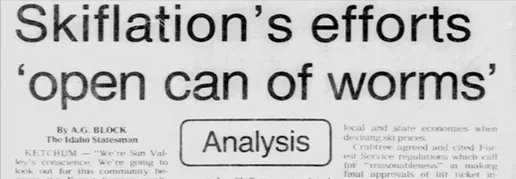
Due in part to the outcry, the Carter administration briefly re-regulated ski prices, setting a 9.5% annual increase cap in the late 70s as part of his inflation-control policies, but under Ronald Reagan, costs for skiers continued to rise.
In 1986, Reagan signed the National Forest Ski Area Permit Act into law, which allowed ski areas to operate under the 40-year permits that most hold today. The bill formalized the fee structure for ski companies, which the Government Accountability Office has repeatedly found to be below fair market value. One permittee justified the discrepancy by reasoning, “I took over sheep pasture and should, at the most, have to pay only a sheep pasture rent.”
The following year, Aspen raised its prices to an unprecedented $35 per day, and newspapers interviewed outraged skiers. Aspen Mayor Bill Stirling traveled to Washington, D.C., and led a coalition of Colorado ski towns urging public hearings. Even under the 1986 law, the Forest Service retained the power to regulate ticket prices, but that power hadn’t been exercised since the late 70s. And federal authority had been weakened because permits no longer required annual Forest Service approval. Stirling’s complaints went nowhere. The “outrageous” $35 ticket is the equivalent of $102 in today’s dollars, less than half of Aspen’s current ticket price.
In the early 1990s, the ski industry began to consolidate. Apollo Global Management, an investment group co-founded by close Jeffery Epstein associate and billionaire Leon Black, purchased Vail and Beaver Creek in 1992, and it acquired Keystone, Breckenridge, and Arapahoe Basin in 1996. Apollo soon took Vail Resorts public, and its expanding control of the ski industry in Colorado sparked an antitrust inquiry from the Colorado Attorney General and the US Department of Justice. Vail Resorts initially offered A-Basin to the state, but when Colorado refused to accept it, the company was forced to sell the resort to a third party for its acquisition of Keystone and Breckenridge to proceed.
Antitrust actions had been part of skiflation battles in the 1970s as well. Sen. Haskell included anti-monopoly provisions in his ski reform bill, which would have increased competition among neighboring resorts. And a lawsuit brought by Aspen Highlands against the Aspen Skiing Company in 1979 was appealed to the Supreme Court in 1985. In a unanimous decision, the court found that Aspen, the owner of three area resorts, had violated the Sherman Act when it changed the terms of a previous agreement for a four-resort ticket that included Highlands.
Critics of the Vail acquisitions in 1996 said that even without A-Basin, Vail was creating a monopoly in central Colorado. Denver-owned Winter Park Resort, after failing to prevent the merger, responded by offering a $200 season pass, an incredibly low price at the time. That move set off a shift in the industry where season passes, which used to be expensive compared to day tickets, started to come down in price and day tickets began to rise.
Since 2000, the ski industry has only continued to consolidate. Vail now owns 42 resorts around the world, and its main competitor, Alterra Mountain Company, owns 19 resorts. Vail’s Epic pass offers access to over 90 resorts through partnership agreements, and Alterra’s Ikon pass is linked to over 60 ski destinations. Both companies initially followed the Winter Park model, offering cheaper season passes with high day tickets to incentivize skiers to buy passes over the summer, locking in profits for companies before the snow starts to fall (a clever hedge against climate uncertainty and sustained drought in the West). But pass prices have also started to rise, and resorts like Vail and Park City have been plagued by long lines and overcrowding. After years of rapid growth, Epic pass sales have fallen for the last two seasons.
Labor actions by underpaid ski patrol unions have grown more frequent as well with last year’s strike at Vail-owned Park City (which is built on private land) and the recent ski patrol strike in Telluride, an Epic pass partner. The failure of Vail and Telluride to offer a satisfactory contract to the patrol unions led to near-complete shutdowns of the ski areas for close to two weeks. In Telluride, business owners and others staged a protest demanding the union come to a deal. At local town council and county commission meetings, there was widespread recognition that the community was being upended by the whims of the erratic 81-year-old billionaire that owns Telluride Ski and Golf, or Telski. National forest representatives were nowhere to be seen.
Ski companies like Telski have not only been given free reign to raise ticket prices since the 1970s, but they can upset entire ski town economies by refusing modest wage increases requested by unions.
University of Utah economist and antitrust expert Hal Singer has said industry consolidation is leading to “clear market failure” in the ski industry. “An antitrust authority,” Singer wrote last year, “whether federal or state, or a group of private enforcers, should bring a case against Vail, seeking divestiture of those properties that contribute to Vail’s monopoly power over skiers and its monopsony power over workers or both.”
I recently filed a FOIA request for Telluride’s 40-year special use permit with the Forest Service, which contains much of the same boilerplate language found in other ski area permits, including a mandate that the resort comply with “federal, state, and local” laws. Colorado allows municipalities and counties to set minimum wages. Could Mountain Village Town Council, which voiced support for the ski patrol union in December, pass a minimum wage ordinance targeting Telski employees? Violations of the local ordinance would theoretically give the Forest Service cause to suspend or terminate the ski area permit in addition to other repercussions.
The permits also include the following paragraph:

Even if the Forest Service hasn’t used its power to regulate rates at ski areas in decades, that authority still exists. The broad language of the section, including the reference to the “adequacy and type of services provided to the public,” could offer the Forest Service and the Department of Agriculture a lane to reclaim stewardship over facilities built on public land.
It’s not entirely unimaginable that Trump could see some value in being able to claim he fixed the “raw deal” that Big Ski is offering the average skier or snowboarder. Maybe he should direct the Forest Service to start regulating lift tickets again.
If not Trump, then opportunities abound for politicians willing to make this a signature issue. Could a future Forest Service director help incentivize the purchase of ski areas by local communities, such as the 1,500-person town of Nederland’s pending $120 million purchase of Eldora? Who will bring the powder to the people?
As anger at the duopoly grows, we need a new Floyd Haskell to remind the ski industry that the private gain it receives from public lands is a privilege, not a right.
{💬|⚡|🔥} **What’s your take?**
Share your thoughts in the comments below!
#️⃣ **#history #federal #lift #ticket #regulation**
🕒 **Posted on**: 1787732257
🌟 **Want more?** Click here for more info! 🌟
