

🚀 Read this awesome post from Hacker News 📖
📂 **Category**:
✅ **What You’ll Learn**:
Yesterday, California Attorney General Rob Bonta filed for an immediate halt to what he says is a widespread price-fixing scheme run by the largest online retailer in America, Amazon. “Amazon tells vendors what prices it wants to see to maintain its own profitability,” Bonta alleged. “Amazon can do this because it is the world’s largest, most powerful online retailer.”
His claim is that Amazon has been forcing vendors who sell on and off the platform to raise prices, and cooperating with other major online retailers to do so.
Vendors, cowed by Amazon’s overwhelming bargaining leverage and fearing punishment, comply—agreeing to raise prices on competitors’ websites (often with the awareness and cooperation of the competing retailer) or to remove products from competing websites altogether. , and it should be immediately enjoined.
Amazon is scheduled for a series of trials in January of 2027, but Bonta’s legal move is a big deal, because he’s asking a court to bring Amazon to heel now, a year early. The only way a judge can do that is if he concludes Amazon is likely to lose, which means that Bonta believes his evidence is so strong it’s basically a foregone conclusion Amazon will be held liable for fostering serious harm to consumers.
The scale of the scheme is almost unfathomable; according to its latest investor reports, Amazon earned $426 billion of revenue in its 2025 North America online shopping business, which is about $3000 for every household in America. As Stacy Mitchell noted, prices for third party goods on the online platform, roughly 60% of its total sales, have been going up at 7% a year, more than twice the rate of inflation. And because this scheme impacts goods sold off of Amazon’s website as well, there’s a reasonable chance that it has had an impact on price levels overall in America. With a similar Pepsi-Walmart alleged conspiracy revealed earlier this year, it’s becoming increasingly clear that consolidation and price-fixing are linked to inflation.
How exactly does the scheme work? Long-standing readers of BIG may remember a piece in 2021 titled “Amazon Prime is an Economy-Distorting Lie” in which I laid out what’s happening. At the time, the D.C. Attorney General, a lawyer named Karl Racine, sued Amazon for prohibiting vendors that sold on its website from offering discounts outside of Amazon. Such anti-discounting provisions raise prices for consumers, and prevent new platforms from emerging to challenge Amazon.
The key leverage point for Amazon is the scale of its Prime program, which has 200 million members nationwide. As Scott Galloway noted a few years ago, more U.S. households belong to Prime than decorate a Christmas tree or go to church.

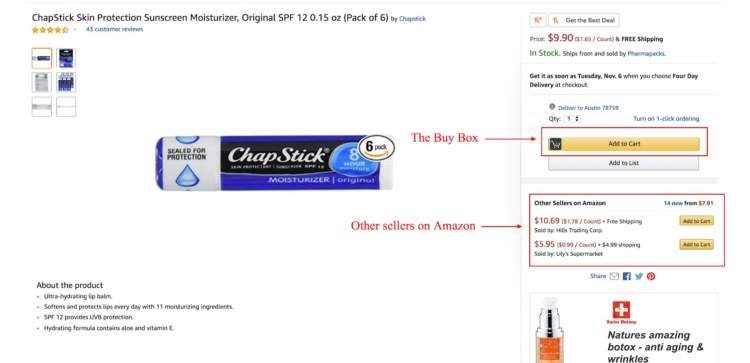
Prime members get ‘free shipping,’ which means they tend not to shop around. They just accept the price and vendor they are given on Amazon through what’s called the “Buy Box.”

So which vendor gets the ‘Buy Box’ and thus the sale to the Prime member? Here’s what I wrote in 2021.
Amazon awards the Buy Box to merchants based on a number of factors. One factor is whether a product is ‘Prime eligible,’ which is to say offered to Prime members with free shipping. In order to become Prime eligible, a seller often must use Amazon’s warehousing and logistics service, Fulfillment by Amazon (FBA). In other words, Amazon ties the ability to access Prime customers to whether a seller pays Amazon for managing its inventory. This strategy has worked – Amazon now fulfills roughly two thirds of the products bought on its platform.
The high prices of overall marketplace access fees, including FBA, is how Amazon generates cash from its Marketplace and retail operations. From 2014 to 2020, the amount it charges third party sellers grew from $11.75 billion to more than $80 billion. “Seller fees now account for 21% of Amazon’s total corporate revenue,” noted Racine, also pointing out that its profit margins for Marketplace sales by third party sellers are four times higher than its own retail sales…
Now, if this were all that was happening, sellers and brands could just sell outside of Amazon, avoid the 35-45% commission, and charge a lower price to entice customers. “Buy Cheaper at Walmart.com!” should be in ads all over the web. But it’s not. And that’s where the main claim from Racine comes in. Amazon uses its Buy Box algorithm to make sure that sellers can’t sell through a different store or even through their own site with a lower price and access Amazon customers, even if they would be able to sell it more cheaply. If they do, they get cut off from the Buy Box, and thus, cut off de facto from being able to sell on Amazon.
The net effect is that prices everywhere, not just on Amazon, are higher than they ordinary would be.
So that’s how the scheme worked, and Racine was the first law enforcer to act. But others followed; Bonta filed his more comprehensive lawsuit in 2022. In 2023, Federal Trade Commission Chair Lina Khan filed against Amazon on similar grounds, though with more details and additional wrinkles. The FTC found that Amazon was running something called “Project Nessie” in which it would use its algorithm to encourage other online retailers, perhaps Walmart.com or Target.com, to raise prices on similar products.
All of these cases, as well as other similar ones, have passed the necessary legal hurdle to go to trial, but an actual remedy is years away. And Amazon keeps growing through this alleged illicit behavior, inflating prices not just on its own site, but across the retail landscape.
According to Bonta, Amazon has three primary methods of inflating prices. In the first one, if Amazon and a competitor are engaged in a price war over a product, Amazon will tell its vendor that sells to its rival to increase the price directly. In the second one, if a competitor is discounting an item, Amazon will ask it to stop through a vendor. And in the third, a vendor will stop selling a product for a lower price outside of Amazon, and Amazon will then raise its price.
This kind of arrangement is known as a “hub-and-spoke” conspiracy, or “vertical price-fixing,” because it’s cooperating on price through common customers or vendors. Such a scheme distinguishes it from direct collaboration among rivals, which is a more standard “horizontal” conspiracy. The relief requested by Bonta is extensive, but amounts to barring the company from making agreements through vendors to set pricing for the online retail economy and prohibiting the company from communicating with vendors about prices and terms for non-Amazon retailers. He is also seeking a monitor to ensure Amazon stops the bad behavior.
What makes it a big deal is that it’s a request for a temporary injunction right now, meant to last until the trial process concludes or it’s otherwise lifted. Judges only grant such injunctions when they think that a party is likely going to lose, the immediate harm of the behavior is significant, and the public interest is served. While we can’t see most of the evidence because it’s redacted, Bonta must really believe he’s got the goods. And if he succeeds in this gambit, it almost certainly means Amazon has violated antitrust law on a major line of business. It also flips the incentives, because Amazon will have less of an incentive to delay a trial. Instead, it will be subject to this injunction until the trial concludes. So it may stop trying dilatory tactics.
There’s one last observation about the complaint. Again, it’s redacted, but Bonta is hinting at Amazon’s internal process to hide what it is doing.

And that wouldn’t be surprising, since the FTC has told the judge in its case that top Amazon officials, including Jeff Bezos, have been destroying evidence.
According to Law.com: “The FTC said in a heavily redacted brief on Friday that it’s missing both the ‘raw notes’ of important meetings and key messages from the Signal apps of Bezos and other senior executives, who, in some instances, set messages to automatically delete in ‘as short as ten seconds or one minute.’”
That kind of behavior is the digital equivalent of shredding documents while under a legal hold, and evidence of lawlessness. And there’s a reason for that. For as long as I’ve been writing BIG, and years before that, laws have not really applied to the rich and powerful. But our work is bearing fruit. And it’s not just Amazon. Today, the Antitrust Division won a big legal motion on its price-fixing case against a meat conspiracy led by Agri-Stats, and the Ninth Circuit had a terrific ruling on a Robinson-Patman Act price discrimination suit. As the people elect new populist politicians, enforcers and plaintiff lawyers are developing the law and the cases to match their frustration.
There’s also a change in public attitudes. In years past, a company like Amazon used to be considered innovative and consumer-friendly. Today, it is understood as bureaucratic and coercive, a result of an environment of lawlessness. Americans are increasingly angry about the situation, seeing the Epstein class and the high inflation environment as a direct threat to their welfare, a conspiracy to extract. Because it is. And at least some elected leaders see that, and are acting to stop it.
Thanks for reading! Your tips make this newsletter what it is, so please send me tips on weird monopolies, stories I’ve missed, or other thoughts. And if you liked this issue of BIG, you can sign up here for more issues, a newsletter on how to restore fair commerce, innovation, and democracy. Consider becoming a paying subscriber to support this work, or if you are a paying subscriber, giving a gift subscription to a friend, colleague, or family member. If you really liked it, read my book, Goliath: The 100-Year War Between Monopoly Power and Democracy.
cheers,
Matt Stoller
🔥 **What’s your take?**
Share your thoughts in the comments below!
#️⃣ **#Amazon #BUSTED #Widespread #Scheme #Inflate #Prices #Economy**
🕒 **Posted on**: 1771995237
🌟 **Want more?** Click here for more info! 🌟
