

💥 Discover this must-read post from Hacker News 📖
📂 Category:
📌 Key idea:
Ember’s report outlines how falling battery capital expenditures and improved performance metrics have lowered the levelized cost of storage, making dispatchable solar a competitive, anytime electricity option globally.
A report from energy think tank Ember details how cost reductions in battery storage technology are enabling dispatchable solar power to compete with conventional power sources.
Ember’s assessment draws on data from recent auctions across international markets, including Italy, Saudi Arabia, and India, supplemented by expert interviews conducted in October 2025.
This research indicates the industry is moving into a new environment where scaling of manufacturing capacity and competition have pushed costs down. The cost of core BESS equipment fell by 40% in 2024 compared with 2023, according to BloombergNEF’s global benchmark, reaching a record low of $165 per kWh.
Ember’s October 2025 data said a further large fall in 2025 is on track. Over the last 10 years, installed costs have fallen by 20% per year on average, while deployment has increased by around 80% per year.
According to the findings, the all-in capital expenditure for building a large, long-duration utility-scale battery energy storage system project in global markets outside of the U.S. and China is now approximately $125 per kWh. This figure reflects project pricing, comprising $75 per kWh for core equipment sourced from China, including battery enclosures, the power conversion system (PCS), and energy management system (EMS) and $50 per kWh for local installation, engineering, and grid connection activities.
These capital costs translate into a levelized cost of storage (LCOS) of $65 per MWh. This LCOS reflects the cost of shifting electricity to a different time period.
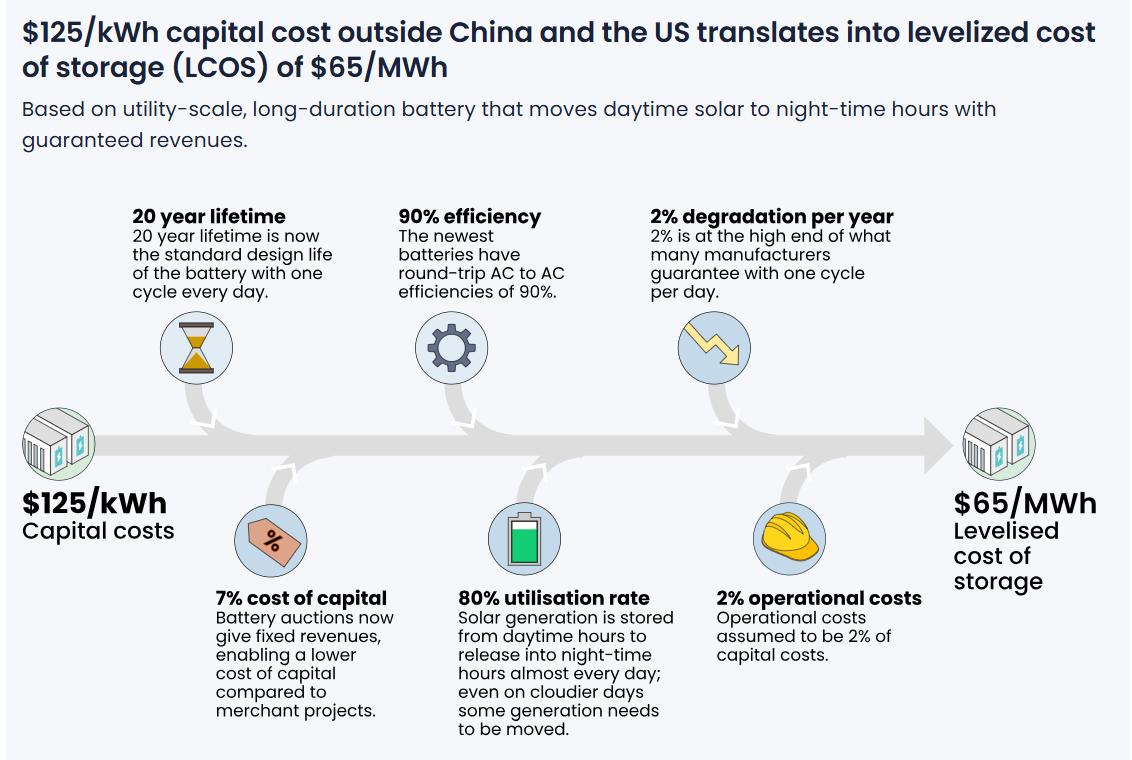
Ember said this reduction in LCOS is driven by equipment costs and improved performance metrics, such as a 20-year design life for LFP technology, 90% efficiency, and lower project financing costs due to de-risked revenue models. Longer lifetimes, higher efficiency, and lower project risks reduce the LCOS by 35% even before accounting for the falling equipment prices, said the report.
The core implication of this analysis is the economic viability of dispatchable solar.
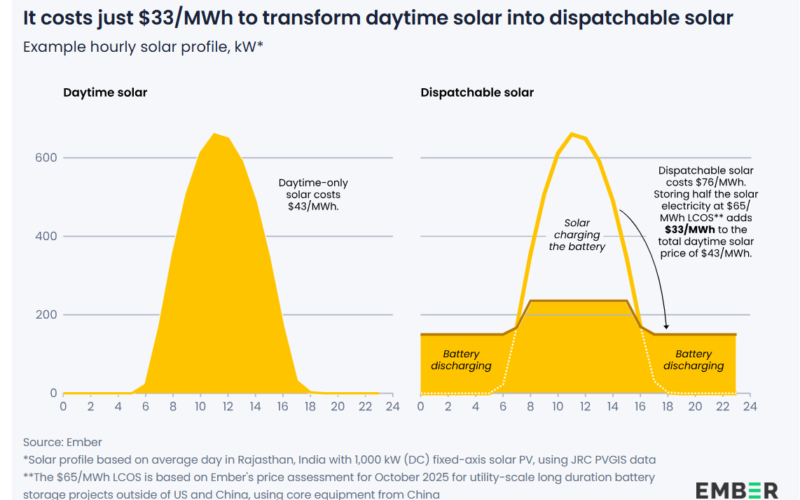
Storing 50% of a day’s solar output to meet night-time demand adds $33 per MWh to the generation cost. Using the 2024 global average solar price of $43 per MWh, the total cost for dispatchable solar is calculated at $76 per MWh.
This positions dispatchable solar as a cost-effective alternative to new gas power plants, particularly in regions reliant on imported LNG.
For the U.S., core equipment costs can reach $100 per kWh or higher in markets with higher tariffs or stricter standards. With the U.S. market facing various tariffs on Chinese imports and domestic content requirements via the Inflation Reduction Act (IRA), the $125 per kWh BESS project capex estimate is not directly applicable to the U.S. market.
The total equipment costs are 10% to 15% cheaper for four-hour projects, a key project duration in the U.S., as some components are sized to power rather than energy. However, even with cost variations, the U.S. is the second biggest BESS market globally, behind China, and saw record growth in Q1 2025 across all segments.
In 2024, Texas, California, Arizona, and Nevada all saw significant utility-scale battery growth, with the U.S. adding 10 GW of utility-scale batteries nationally, an 80% increase over the previous year. This growth is accelerating the integration of solar into the grid.
Ember’s conclusion is that solar has evolved beyond daytime electricity; coupled with storage, it becomes dispatchable, anytime power, positioned to meet a substantial portion of the world’s future energy needs.
This content is protected by copyright and may not be reused. If you want to cooperate with us and would like to reuse some of our content, please contact: editors@pv-magazine.com.
Popular content

{💬|⚡|🔥} {What do you think?|Share your opinion below!|Tell us your thoughts in comments!}
#️⃣ #Analysis #finds #anytime #electricity #solar #battery #costs #plummet #magazine #USA
🕒 Posted on 1765649000
