

🚀 Explore this awesome post from Hacker News 📖
📂 Category:
📌 Main takeaway:
[POSTECH, KAIST, and Gyeongsang National University achieve a record-breaking energy density of 1,270 Wh/L]
Could an electric vehicle travel from Seoul to Busan and back on a single charge? Could drivers stop worrying about battery performance even in winter? A Korean research team has taken a major step toward answering these questions by developing an anode-free lithium metal battery that can deliver nearly double driving range using the same battery volume.
A joint research team led by Professor Soojin Park and Dr. Dong-Yeob Han of the Department of Chemistry at POSTECH, together with Professor Nam-Soon Choi and Dr. Saehun Kim of KAIST, and Professor Tae Kyung Lee and researcher Junsu Son of Gyeongsang National University, has successfully achieved a volumetric energy density of 1,270 Wh/L in an anode-free lithium metal battery. This value is nearly twice that of current lithium-ion batteries used in electric vehicles, which typically deliver around 650 Wh/L. The achievement was published as a Front Cover article in Advanced Materials.
An anode-free lithium metal battery eliminates the conventional anode altogether. Instead, lithium ions stored in the cathode move during charging and deposit directly onto a copper current collector. By removing unnecessary components, more internal space can be devoted to energy storage, much like fitting more fuel into the same-sized tank. However, this design comes with serious challenges. If lithium deposits unevenly, sharp needle-like structures known as dendrites can form, increasing the risk of short circuits and potential safety hazards. Repeated charging and discharging can also damage the lithium surface, rapidly shortening battery life.
To address these issues, the research team adopted a dual strategy combining a Reversible Host (RH) and a Designed Electrolyte (DEL). The reversible host consists of a polymer framework embedded with uniformly distributed silver (Ag) nanoparticles, guiding lithium to deposit in designated locations rather than randomly. In simple terms, it acts like a dedicated parking lot for lithium, ensuring ordered and uniform deposition.
The designed electrolyte further enhances stability by forming a thin but robust protective layer composed of Li₂O and Li₃N on the lithium surface. This layer functions like a bandage on skin, preventing harmful dendrite growth while maintaining open pathways for lithium ions transport.
When combined, the RH–DEL system delivered outstanding performance. Under high areal capacity (4.6 mAh cm⁻²) and current density (2.3 mA cm⁻²), the battery retained 81.9% of its initial capacity after 100 cycles and achieved an average Coulombic efficiency of 99.6%. These results enabled the team to reach the record-breaking 1,270 Wh/L volumetric energy density in anode-free lithium metal batteries.
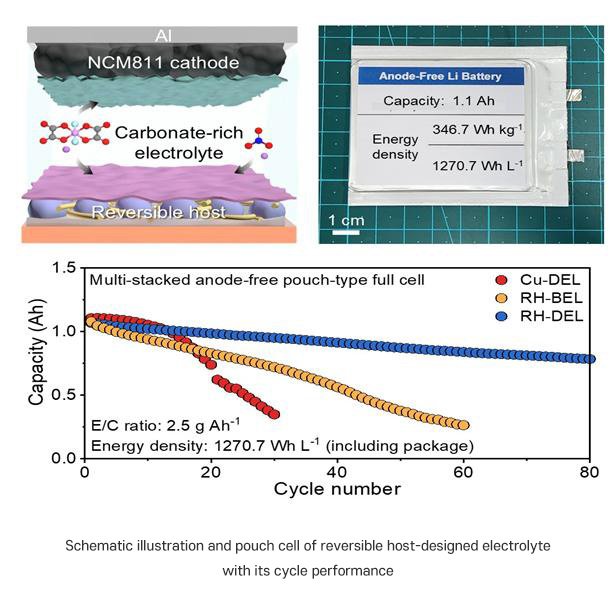
Importantly, this performance was validated not only in small laboratory cells but also in pouch-type batteries, which are closer to real-world electric vehicle applications. Even with a minimal amount of electrolyte (E/C = 2.5 g Ah⁻¹) and under low stack pressure (20 kPa), the batteries operated stably. This demonstrates strong potential for reducing battery weight and volume while lowering manufacturing burdens, significantly improving commercial viability.
Professor Soojin Park commented, “This work represents a meaningful breakthrough by simultaneously addressing efficiency and lifetime issues in anode-free lithium metal batteries.” Professor Tae Kyung Lee added, “Our study demonstrates that electrolyte design based on commercially available solvents can achieve both high lithium-ion mobility and interfacial stability.”
This research was supported by the Ministry of Science and ICT (MSIT) of Korea.
DOI: https://doi.org/10.1002/adma.202515906
💬 What do you think?
#️⃣ #AnodeFree #Battery #Doubles #Electric #Vehicle #Driving #Range
🕒 Posted on 1766605238
