


💥 Explore this must-read post from Hacker News 📖
📂 **Category**:
✅ **What You’ll Learn**:
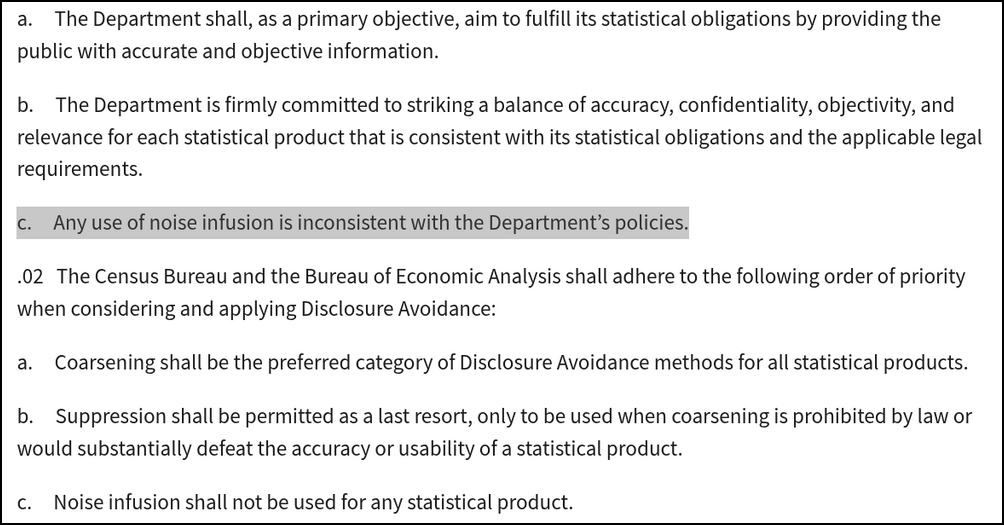
Last week, the United States Department of Commerce issued an order
declaring that “noise infusion” will be banned from all statistical products
published by the Census Bureau and the Bureau of Economic Analysis.
What does it mean, and why should you care?
Statistical products are a bunch of numbers published from a secret dataset.
Often, that dataset contains confidential information, and it is important that
the numbers don’t reveal that information. The U.S.
Census is a well-known
example: the statistics are made public, but the contents of each form filled by
individual U.S. residents must stay secret.
Scientists have developed a number of techniques that can be used to publish
useful statistics while protecting the privacy of the original data. This field
is called disclosure avoidance in statistical communities. Here are a few of
these techniques.
- Suppression: removing data that doesn’t pass certain thresholds (e.g. if a
count of people is below 5, we don’t publish it). - Coarsening (or generalization): making data attributes less precise (e.g.
transform a county into its state, a date of birth into an age range, etc.). - Sampling: randomly removing some records from the dataset.
- Swapping: taking attributes from different records and exchanging them
randomly. - Contribution bounding: making sure that a single individual cannot
contribute “too much” to a statistic by limiting their maximum impact. - Noise addition: adding a random number to statistics to hide their true
value.
Some of these techniques, when combined, achieve a definition called
differential privacy. This
definition has a lot of nice fundamental
properties and is widely considered the
gold standard of privacy protection among scientists. To achieve it, scientists
typically rely on a combination of contribution bounding and
carefully-calibrated noise addition.
From 1990 to 2010, the U.S. Census Bureau primarily relied on swapping for the
decennial census. Then, they realized that this technique was actually very
unsafe, and that it was pretty easy to
reconstruct individual records using the published statistics. This is bad,
because the Bureau is required by federal law to keep these records
confidential. So they tried a few alternative approaches, and decided to adopt
differential privacy for the 2020 Census: this was the one that kept the
statistics most useful, while preventing these attacks.
It bears repeating: differential privacy wasn’t chosen because the math was nice
and compelling. It was selected because among the different options that
mitigated the attack, it was the one that preserved the most utility. Its exact
privacy parameters were chosen not because they provided rock-solid provable
guarantees, but because they squeezed most usefulness out of the data while
reaching an acceptable level of privacy protection.
Sadly, “preserved the most utility under newly-discovered privacy constraints”
did not mean “preserved as much utility as the 2010 Census”: the numbers got
less accurate, and the inaccuracies got a lot more transparent, and therefore
impossible to ignore. This made a number of people very angry.
- Demographers and social scientists could no longer ignore that the data they
were working with was noisy data. This required a major
shift in how they
conceptualized and worked with this data. - People who were using Census data to actually reconstruct records could no
longer do so. Demographers admitted that this was common
practice. It’s also an open secret that
this was done by political operatives as part of
gerrymandering efforts.
Phew, that was a lot of context.
The administration has now decided that noise infusion was no longer an
acceptable disclosure avoidance technique.
The order clearly targets differential privacy, but also seems to impact other
techniques that involve randomness: the text explicitly mentions that coarsening
should always be preferred, falling back to suppression as a “last resort”. I
have no idea why the order is so specific. Maybe they wanted to make sure the
scientists working at the U.S. Census couldn’t still use similar techniques
without calling them differential privacy?
The order also carefully says it “shall not be interpreted to conflict with any
constitutional, statutory, regulatory, or other legal provision”. So the
confidentiality obligations surrounding these statistical products still apply.
The consequences will be dire for utility or for privacy, and possibly both.
It’s hard to understate this point: future statistical releases will either be
useless compared to past ones, or they will be incredibly unsafe.
For starters, taking away useful tools from the disclosure avoidance toolbox
will always lead to more painful privacy/utility trade-offs. The whole point of
this research field is to better understand and quantify privacy risk, and
develop better tools to mitigate this risk while preserving utility.
For statistical releases, differential privacy is simply the best tool we have
right now. It provides a finer way of quantifying trade-offs, and allows us to
get more utility out of the data than competing techniques at similar privacy
levels. If you take it away, you’re left with techniques that either have worse
utility at similar levels of privacy, or worse privacy for the same utility.
But all competing techniques also rely on noise addition. The Cell Key
method,
used at other statistical agencies, adds noise to statistics. Swapping, used
from 1990 to 2010 for the U.S. Census, also injects randomness into the process.
Sampling is everywhere in statistical work. Hell, even
imputation technically
adds noise to the data!
By contrast, coarsening and suppression are very blunt instruments. They only
work in situations where the statistics are already very coarse, and not too
many of them are published. For complex data products with many statistics about
small groups of people (like the U.S. Census), they either destroy all utility
of the data (especially for minority populations), or are very vulnerable to
privacy attacks.
It makes sense: privacy attacks on statistical releases are about solving a
system of equations. It is such an easier task
when you know for sure that the statistics are all perfectly accurate. Noise
forces you to compute probabilities, quantify the uncertainty, carefully
consider baselines, and so on. That’s why randomness is such a useful tool for
disclosure avoidance! Even without formal guarantees, it makes attakcs a lot
harder. Take it away and attacks become trivial.
I mean, who knows.
Maybe the goal is to force the U.S. Census to publish statistics that actually
enable re-identification, to help with future gerrymandering efforts? Or on the
contrary, maybe the idea is to stop the publication of useful demographic data,
to prevent researchers from showing unfair disparities among the population?
Hanlon’s razor provides an
alternative explanation. The fundamental privacy/utility trade-off inherent to
statistical data releases is annoying. It would be a lot easier if publishing
many statistics didn’t automatically come with a high privacy risk. Differential
privacy makes this trade-off explicit, and thus impossible to ignore. Maybe
banning it is a way of pretending that the problem doesn’t exist, in the hope
that it will go away?
Thanks to Adam Sealfon, Aloni Cohen, Ben Jacobsen, and Gautam Kamath for
helpful comments on earlier drafts of this post.
🔥 **What’s your take?**
Share your thoughts in the comments below!
#️⃣ **#Banning #noise #disaster #statistical #data #products**
🕒 **Posted on**: 1781362972
🌟 **Want more?** Click here for more info! 🌟
