


💥 Explore this must-read post from TechCrunch 📖
📂 Category: Media & Entertainment,Security,Anime,cybersecurity,Ghost In The Shell,hackers,hacking,manga,sci-fi,science fiction
💡 Main takeaway:
The year is 2030. A “mysterious, notorious hacker” known as the Puppet Master is wreaking havoc on the Internet, breaking into the so-called electronic minds of many humans as well as “every terminal on the network.” As it turns out, the puppet master is the creation of the Japanese Foreign Ministry.
In other words, the puppet master is what we today call a government-backed hacker, or advanced persistent threat (APT). But in this case, the “ghost” hacker goes rogue and is wanted for “stock manipulation, espionage, political engineering, terrorism, and breach of cyber privacy.”
That’s the basic premise of the classic Japanese anime series “Ghost in the Shell,” which this week celebrated its 30th anniversary since its debut, and is based on the chapters titled “Bye Bye Clay” and “Ghost Coast” from the first volume of the manga of the same name, released in May 1989.
To say that the story of The Puppet Master was ahead of its time would be an understatement. The World Wide Web, essentially what blossomed from the Internet as we know it today, was invented in 1989, the same year that the first volume of “Ghost in the Shell’s” manga – including the Puppet Master story – hit newsstands in Japan. (The World Wide Web was publicly launched in 1991.)
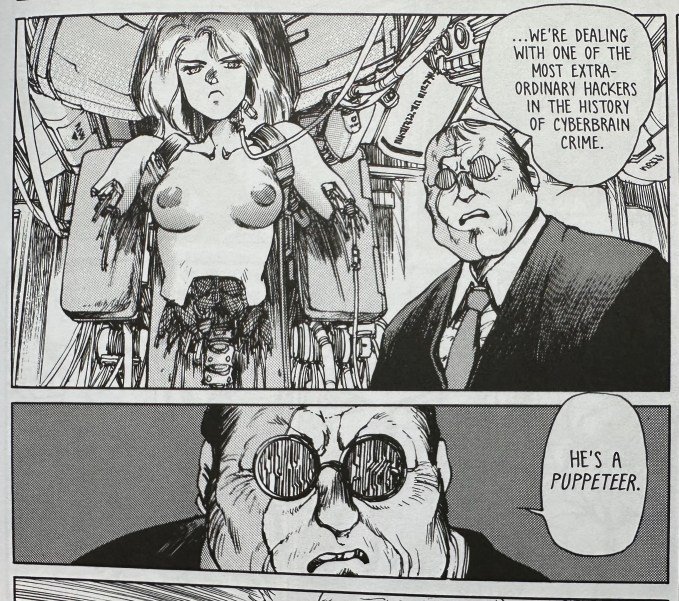
In the manga, when the Puppet Master is arrested, an official from Public Security Division 6, an agency of the Ministry of Foreign Affairs, explains that they have been pursuing the hacker “for a long time”, and have “identified his behavioral tendencies and software/technological patterns.”
“As a result, we were finally able to create a special anti-puppeteer attack barrier,” the manga official says.
At the risk of extrapolating too much from a couple of sentences, the truth is that what the official describes is essentially what cybersecurity companies, like antivirus companies, do every day to stop malware. They not only create so-called signatures based on the malware’s code, but also based on its behavior and characteristics, known as heuristics.
There are other elements of the plot that turn out to be prescient.
At the beginning of the investigation into Puppet Master, Major Motoko Kusanagi, the protagonist and leader of the anti-cyber-terrorism unit Section 9, hacks into the Sanitation Department’s network to track a garbage truck. (These days, government hackers working for intelligence agencies often break into large networks to spy on specific individual targets, rather than pulling data from the compromised network itself.)
While this is happening, one of the garbage men confesses to his colleague that he hacked his wife’s electronic brain because he thinks she is cheating on him. Right after that, we found out that he was using a computer virus that he got from “some programmers.” This is a clear case of technology-enabled domestic violence, or even stalking software, which TechCrunch has investigated extensively over the past few years.
As it turns out, the abusive garbage man never had a wife. His memories were all fabricated. His ghost – which is essentially his mind or consciousness – was infiltrated by a puppet master with the intention of using it to infiltrate government officials. In a way, this is similar to what some advanced hackers do when they infiltrate networks which they then use to hack into their actual target, as a way to cover their tracks while adding separation from themselves and the end target.
The Puppet Master as a government hacker, hacking into networks to track targets or using them to attack other networks, and hacking fueled by jealousy aren’t the only great bits of speculative hacking fiction in anime.
John Wilander, a veteran cybersecurity expert who writes fictional books about hackers, wrote a comprehensive analysis of the film that highlighted details that reference real-life scenarios. Wilander gave examples such as hackers reusing known exploits or malware to make attribution more difficult, investigating malware without alerting the authors and infecting yourself, and using computers for industrial espionage.
The manga and anime clearly take the basic – and realistic – premise of the Puppet Master as a hacker into more fantastical directions. The hacker, who turns out to be an advanced AI, can control humans through their cybernetic brains, and is so self-aware that — spoiler alert — he seeks political asylum and ends up suggesting to Kusanagi that they merge their “ghosts,” meaning basically their minds.

To understand how prophetic “Ghost in the Shell” was, it is important to place it in its historical context. In 1989 and 1995, cybersecurity was not even just a word yet, although the term “cyberspace” was coined by science fiction author William Gibson in his classic book “Neuromancer.”
However, computer security, or information security, was already a reality, and had been for several decades, but it was a very specialized discipline within computer science.
The first computer virus is believed to be a crawling worm, which was released in 1971 on ARPANET, the government-developed network that became the forerunner of the Internet. A handful of other viruses and worms wreaked havoc after that, before becoming ubiquitous once the Internet and World Wide Web became a reality.
Perhaps the first documented government espionage campaign on the Internet was the one discovered by Clifford Stoll, an astronomer by training who also ran computers at Lawrence Berkeley National Laboratory in California. In 1986, Stoll noticed a 75-cent accounting error in the network, which eventually led him to discover that a hacker had compromised the lab’s systems. Eventually, the hacker was identified and it was found that he had been feeding information from the lab and other US government networks to the KGB in the Soviet Union.
Stoll immortalized his meticulous, painstaking, months-long investigation in the book “The Cuckoo’s Egg,” a first-person account that reads like a highly detailed and extensive report by security researchers analyzing a hacking campaign carried out by government hackers. “The Cuckoo’s Egg” has since become a cult classic, but it’s fair to say that it didn’t hit the mainstream when it was released.
As far as I can tell, “Ghost in the Shell” creator Masamune Shirow has never talked about the real-life events that inspired the hacking plot points in the manga. But he was clearly paying attention to what was, at the time, a hidden world that was foreign to most people on Earth, who were still years away from being online, let alone being aware of the existence of hackers.
⚡ Tell us your thoughts in comments!
#️⃣ #classic #anime #Ghost #Shell #predict #future #cybersecurity #years
🕒 Posted on 1763600062
