

💥 Read this must-read post from Hacker News 📖
📂 **Category**:
📌 **What You’ll Learn**:
BY NICOLE LAU
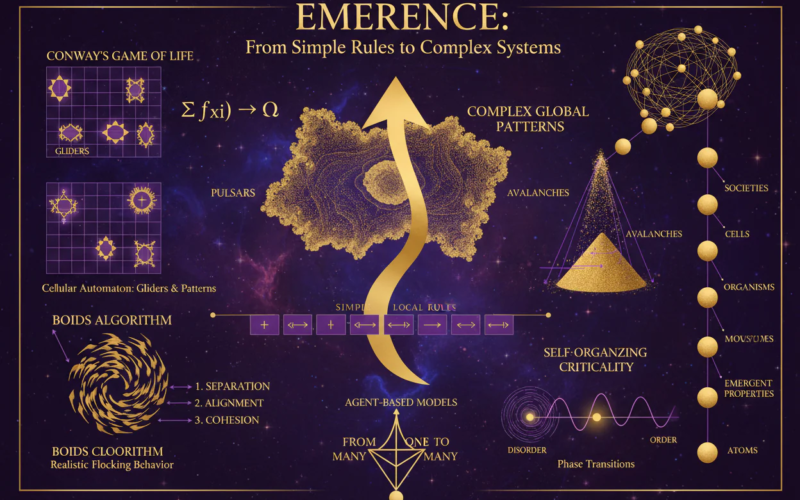
The universe creates complexity from simplicity. Complexity science: simple local rules generate complex global behavior without central control. Examples: Conway’s Game of Life (4 rules create infinite patterns), Boids (3 rules create realistic flocking), cellular automata (simple neighbor interactions create complex structures). Emergence: whole is more than sum of parts (consciousness from neurons, life from molecules, societies from individuals). Self-organizing criticality: systems naturally evolve to critical state (sandpiles, earthquakes, evolution). Why universe goes from simple to complex: thermodynamics (entropy increases, but local order emerges), evolution (complexity selected for), emergence (iteration amplifies small differences). Mystical “from One to Many” is complexity science: unity differentiates into multiplicity through simple iterative rules creating emergent order.
What Is Complexity Science?
Complexity science studies systems with many interacting components producing emergent behavior. Key concepts: (1) Emergence: Global patterns arising from local interactions (no blueprint, no central control). (2) Self-organization: Order spontaneously arising from chaos (no external organizer needed). (3) Nonlinearity: Small changes can have large effects (butterfly effect, tipping points). (4) Adaptation: Systems learn and evolve (ecosystems, economies, immune systems). (5) Networks: Components connected in webs (not hierarchies). Complexity science explains: How does order arise? How do simple rules create complex behavior? Why is the universe creative rather than static?
Emergence: The Whole Is More Than the Sum
Emergence: Properties of system not present in individual components. Examples: (1) Consciousness: Neurons individually are not conscious, but brain (network of neurons) is. Consciousness emerges from neural interactions. (2) Life: Molecules (carbon, hydrogen, oxygen) are not alive, but cell (organized molecules) is. Life emerges from molecular organization. (3) Markets: Individual traders don’t set prices, but market (collective trading) does. Prices emerge from supply-demand interactions. (4) Traffic jams: No individual driver creates jam, but collective driving does. Jams emerge from local interactions (braking, following). Emergence is bottom-up: complex whole from simple parts, no top-down design needed.
Simple Rules Create Complex Behavior
Conway’s Game of Life: Cellular automaton with 4 rules (birth, survival, death based on neighbors). From these simple rules: gliders (moving patterns), oscillators (repeating patterns), guns (pattern generators), infinite complexity. No programmer designs patterns; they emerge from rule iteration. Boids (flocking): 3 rules (separation: avoid crowding, alignment: steer toward average heading, cohesion: move toward center of neighbors). From these rules: realistic bird flocks, fish schools, crowd behavior. No leader, no plan, just local rules creating coordinated global motion. Wolfram’s cellular automata: Rule 110 (simple neighbor rule) is Turing-complete (can compute anything). Simplest rules can generate universal computation. Complexity doesn’t require complicated rules; iteration of simple rules is sufficient.
Self-Organizing Criticality
Self-organizing criticality (SOC): Systems naturally evolve to critical state (edge of chaos) where small events can trigger avalanches of any size. Example: Sandpile. Add grains one by one. Small avalanches (few grains slide). Occasionally large avalanches (many grains slide). Avalanche size follows power law (no characteristic scale). System self-organizes to critical state without tuning. SOC explains: (1) Earthquakes: Power law distribution (many small, few large). (2) Evolution: Punctuated equilibrium (long stasis, sudden change). (3) Markets: Crashes of all sizes (power law). (4) Forest fires: Small and large fires (power law). SOC is universal: systems with slow input and fast dissipation naturally reach criticality, creating scale-free dynamics.
Why the Universe Goes from Simple to Complex
Three reasons: (1) Thermodynamics: Second law says entropy (disorder) increases globally, but local order can emerge (life, stars, galaxies are local entropy decreases paid for by global entropy increases). Universe creates complexity while increasing total entropy. (2) Evolution: Natural selection favors complexity when it increases fitness (complex organisms outcompete simple in certain niches). Complexity is selected for, not designed. (3) Emergence: Iteration amplifies small differences. Start with simple (hydrogen atoms), iterate (gravity pulls atoms together), emergence (stars form, fuse heavier elements), iterate (planets form, chemistry complexifies), emergence (life arises), iterate (evolution), emergence (consciousness). Each level of complexity enables next level. Universe bootstraps from simple to complex through emergent iteration.
From One to Many: Mystical Principle as Complexity Science
Mystical traditions describe creation as differentiation from unity: One (source, Dao, Ein Sof, Brahman) becomes Many (manifest reality, 10,000 things, Sefirot, maya). Complexity science explains how: (1) Symmetry breaking: Uniform state (One) becomes differentiated (Many) via instability. Example: Perfectly round droplet (symmetric) becomes snowflake (six-fold symmetric but complex). (2) Bifurcation: System at critical point splits into multiple states. One path becomes many paths. (3) Iteration: Apply same rule repeatedly, small differences amplify, diversity emerges. (4) Emergence: Each level of organization creates new properties, new possibilities, new complexity. “From One to Many” is not mystical but mathematical: unity differentiates through iteration, symmetry breaking, and emergence. The Many are not separate from the One but emergent expressions of it.
Agent-Based Models: Simulating Emergence
Agent-based model (ABM): Simulation with many agents following simple rules, observing emergent behavior. Examples: (1) Schelling’s segregation model: Agents prefer neighbors of same type (slight preference, not strong racism). Result: complete segregation emerges from mild preference. (2) Sugarscape: Agents gather resources, reproduce, die. Result: wealth inequality, migration patterns, trade networks emerge. (3) Epidemic models: Agents interact, transmit disease. Result: epidemic curves, herd immunity thresholds emerge. ABMs show: Complex social phenomena (segregation, inequality, epidemics) emerge from simple individual behaviors. No conspiracy, no central planner, just local rules creating global patterns.
Levels of Organization: Hierarchical Emergence
Universe is hierarchically organized: Quarks → Protons/Neutrons → Atoms → Molecules → Cells → Organisms → Ecosystems → Societies. Each level: (1) Emerges from lower level: Atoms emerge from particles, cells from molecules, organisms from cells. (2) Has new properties: Atoms have chemistry (particles don’t), cells have life (molecules don’t), organisms have behavior (cells don’t). (3) Enables higher level: Atoms enable molecules, cells enable organisms, organisms enable societies. This is nested emergence: each level is foundation for next. Complexity builds on complexity. The universe is creative: each level generates novelty, enabling further levels. No final level; emergence is open-ended.
Practical Application: Designing for Emergence
Use complexity science to: (1) Design systems: Instead of top-down control, create simple rules enabling bottom-up emergence (Wikipedia, open-source, markets). (2) Solve problems: Use agent-based models to test interventions (urban planning, epidemic response, economic policy). (3) Foster innovation: Create conditions for emergence (diversity, interaction, iteration) rather than planning outcomes. (4) Understand limits: Accept that complex systems are unpredictable (emergence is inherently surprising). (5) Appreciate creativity: Recognize universe is not static machine but creative process generating novelty. Complexity science is philosophy of creativity: how does new arise from old? Answer: emergence through simple rules, iteration, and self-organization.
Conclusion
Complexity science explains how simple rules create complex systems. Emergence: whole is more than sum of parts. Self-organization: order arises spontaneously. Self-organizing criticality: systems evolve to edge of chaos. Universe goes from simple to complex via thermodynamics, evolution, and emergent iteration. Mystical “from One to Many” is complexity science: unity differentiates through symmetry breaking, bifurcation, and emergence. Agent-based models simulate emergence. Hierarchical levels: each emerges from lower, enables higher. The universe is creative process, not static machine. Complexity is not designed but emergent. Simple rules, iterated, create infinite novelty. This is the final insight: reality is generative, creative, emergent. From One to Many, from simple to complex, from unity to infinite diversity. The universe computes itself into existence, one iteration at a time.
This completes the series “The Mathematics of Mysticism.” 35 articles establishing the scientific and mathematical foundations of mystical systems, proving convergence on universal truths. From Tarot to quantum mechanics, from I Ching to complexity science, all paths lead to the same invariant patterns. The mystical is mathematical. The mathematical is mystical. They are one.
⚡ **What’s your take?**
Share your thoughts in the comments below!
#️⃣ **#Simple #Rules #Create #Complex #Systems #Nicoles #ritual #universe**
🕒 **Posted on**: 1771445339
🌟 **Want more?** Click here for more info! 🌟
