

✨ Explore this must-read post from Hacker News 📖
📂 Category:
📌 Key idea:
Did you know migratory birds and sea turtles are able to navigate using the Earth’s magnetic field? It’s called magnetoreception. Basically, being able to navigate was evolutionarily advantageous, so life evolved ways to feel the Earth’s magnetic field. A LOT of ways. Like a shocking amount of ways. Here’s a few examples:
-
Magnetotactic bacteria – magnetite chains as built-in compass needles.
-
Land plants – growth, germination, tropisms modulated by weak magnetic fields.
-
Honey bee – abdomen magnetite and magnetic compass in foragers.
-
American cockroach – behavior disrupted by specific RF fields, consistent with a magnetic sense.
-
Fruit fly – cryptochrome-dependent magnetic compass under blue light.
-
Monarch butterfly – time-compensated magnetic compass for migration.
-
Loggerhead sea turtle – hatchlings orient in coil-manipulated magnetic fields.
-
Common carp – spontaneous north–south body alignment in ponds.
-
Sharks and rays – ampullae of Lorenzini detect electric and magnetic fields for navigation and prey detection.
-
Tadpoles – magnetically driven orientation tied to visual system.
-
Box turtle – homing disrupted when local geomagnetic field is altered.
-
Domestic chicken – chicks trained to find social reward using a magnetic compass.
-
Homing pigeon – altered magnetic fields at the head deflect homing bearings.
-
Blind mole-rat – subterranean mammal with light-independent magnetic compass and map.
-
Cattle and deer – grazing/herd bodies align roughly north–south at global scale.
-
Domestic dogs – defecation posture tracks geomagnetic north–south under quiet field conditions.
-
Humans – alpha-band EEG shows robust, orientation-specific responses to Earth-strength field rotations.
It would seem evolution adores detecting magnetic fields. And it makes sense! A literal “sense of direction” is quite useful in staying alive – nearly all life benefits from it, including us.
We don’t totally understand how our magnetoreception works yet, but we know that it does. In 2019, some Caltech researchers put some people in a room shielded from the Earth’s magnetic field, with a big magnetic field generator in it. They hooked them up to an EEG, and watched what happened in their brains as they manipulated the magnetic field. The result: some of those people showed a response to the magnetic fields on the EEG!
That gets my noggin joggin. Our brain responds to magnetic field changes, but we aren’t aware of it? What if it affects our mood? Would you believe me if I told you lunar gravity influences the Earth’s magnetosphere? Perhaps I was too dismissive of astrology.
But seriously
Biomagnetism is “the phenomenon of magnetic fields produced by living organisms”. Hold up. Produced by? I made another list for you:
-
Weakly electric fish – electric organs generate pulsed currents whose surrounding magnetic fields (nanotesla scale) have been recorded directly near the fish.
-
Earthworms – single action potentials in the giant axon system produce biomagnetic fields detectable with magnetic resonance spectroscopy.
-
Crayfish – the giant axon’s action currents generate ~10⁻¹⁰–10⁻⁹ T fields measured directly with toroidal pickup coils.
-
Frogs – action potentials in the sciatic nerve produce pico– to 10⁻¹⁰ T magnetic fields, recorded non-invasively with SQUIDs and optical magnetometers.
-
Guinea pigs – isolated guinea-pig hearts generate magnetocardiograms; their heartbeat fields (tens of picotesla) are recorded with optically pumped magnetometers.
-
Cats – neuromagnetic fields from the auditory cortex of domestic cats are measured with magnetoencephalography.
-
Monkeys – cortical responses to tactile and auditory stimuli in macaque monkeys are mapped by measuring their brain’s magnetic fields with MEG.
-
Rabbits – SQUID magnetometry outside the skull of anesthetized rabbits detects magnetic signatures of spreading cortical depolarization.
-
Humans – multiple biomagnetic signals are routinely measured: heart fields (magnetocardiography), brain fields (magnetoencephalography), skeletal-muscle fields (magnetomyography) and peripheral-nerve fields (magnetoneurography).
Oh, right. We run on electricity, so we generate magnetic fields. Makes sense. But wait. We can detect magnetic fields AND we produce them? That’s…hmm. Interesting. Let’s read about magnetoencephalography (insane word).
Magnetoencephalography (MEG) is a functional neuroimaging technique for mapping brain activity by recording magnetic fields produced by electrical currents occurring naturally in the brain, using very sensitive magnetometers.
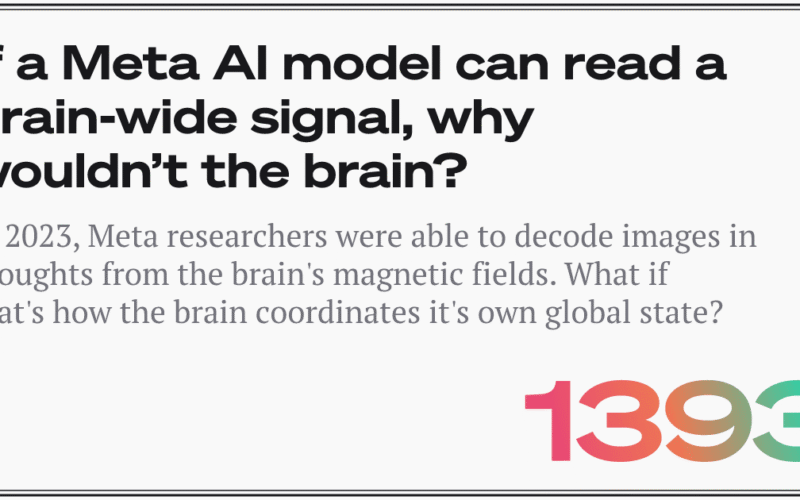
That’s not the interesting thing about MEG. The interesting thing about MEG is that researchers at Meta, using MEG, were able to decode the brains magnetic fields into actual images and words. Who else forgot we successfully read people’s minds in 2023? I know I did.
Here’s how it worked: they trained models on public MEG datasets, and then used those models to decode the thoughts of study participants.
In their words:
Overall, our results show that MEG can be used to decipher, with millisecond precision, the rise of complex representations generated in the brain.
I read this back when it happened, but then I read it again the other day and it struck me that it’s actually an insane line of research. Like, we can train a model to understand the information that underlies human brain waves. They were able to translate brain activity, from the magnetic field alone, into images and text.
So our brain’s magnetic field is like a constant (with millisecond precision) readout of the current state of our brain? That’s…HUH?
So, okay. Research has established that humans can sense magnetic fields, and Meta was able to show that our own brain’s magnetic field represents a high-enough-fidelity-to-read-data analog representation of our current “state” of mind. To such an extent that we’ve been able to decode it across many different brains, despite barely understanding it.
So, couldn’t our own brain be reading it’s own field? I mean, what are the chances evolution wouldn’t take advantage of an available wireless summary of the global state of the brain? Wouldn’t that answer the binding problem?
They’re minerals, Marie!
The question becomes how does the brain read the field? Well, let’s go back to magnetoreception for a minute. How does that work again?
Magnetite biomineralization is a genetically-controlled biochemical process through which organisms make perfect ferrimagnetic crystals, usually of single magnetic domain size. This process is an ancient one, having evolved about 2 billion years ago in the magnetotactic bacteria, and presumably was incorporated in the genome of higher organisms, including humans.
Our brains manufacture ferrimagnetic crystals. Table stakes. Established science.
But let’s not get too excited. The Earth’s magnetic field is quite strong. In fact it’s 50 to 500 MILLION times stronger than the brain’s magnetic field. So these magnets could detect the Earth’s magnetic field for sure, but could they detect the brain’s own much weaker fields?
I’m here to tell you: hell yeah they could. Those ferrimagnetic crystals created by our brains tend to be in a tight size range that could resonate with and potentially modulate the specific spectrum of known neural oscillations (A.K.A. brain waves). This “stochastic resonance”, which is mathematically possible in the brain, would allow for these tiny crystals to locally overcome the Earth’s magnetic field.
So now we have:
- The brain’s magnetic field can be read to extract the actual high-fidelity thoughts a person is having
- The brain creates magnetic crystals that just so happen to be the perfect size to interact with it’s own magnetic field
Feels like we’re getting somewhere. Let’s pull the thread.
Everything is computer
If those crystals can read the brain’s magnetic field, they can also certainly write to it. The brain’s hardwiring/neurochemistry could manipulate the crystals much more easily than the magnetic field could.
So, using those biological magnets, could the brain…self-tune itself?
Let me zoom out. Here’s how I’m thinking about it: the magnetic field seems to represent a current “state” of your thoughts. Nature loves analog systems. What if the brain used it’s own magnetic field as a sort of analog compression of all of the underlying information? It definitionally represents the the sum total of all of the electrical activity in the neurons in the brain. It’s as low-latency as it gets, limited only by the speed of light. We know our thoughts are encoded within it. Why not?
Let’s imagine how this might work. We have this global state vehicle, we can read it with magnetic crystals, but how do we complete the loop? There would need to be some global write system, right?
The blue spot
The locus coeruleus (LC) (latin for “blue spot”) is a tiny but obscenely important little part of our brain. It synthesizes “norepinephrine, which is a chemical that changes how alert, focused, and “plastic” (malleable) your brain is. I’ll quote the Wiki:
The projections of this nucleus reach far and wide. For example, they innervate the spinal cord, the brain stem, cerebellum, hypothalamus, the hippocampus, the thalamic relay nuclei, the amygdala, the basal telencephalon, and the cortex. The norepinephrine from the LC has an excitatory effect on most of the brain, mediating arousal and priming the brain’s neurons to be activated by stimuli.
The page continues to list all of the functions the LC-NA system is known to influence:
- Arousal and sleep-wake cycle
- Attention and memory
- Behavioral and cognitive flexibility, creativity, personality, behavioral inhibition, and stress
- Cognitive control
- Decision making and utility maximization
- Emotions
- Neuroplasticity
- Posture and balance
- Global model failure where predictions about the world are strongly violated
That sure sounds like a global write system.
Did I mention it’s located at the center of the brain?
Compacting…
Let’s summarize again.
- The brain’s magnetic field can be read to extract the actual high-fidelity thoughts a person is having
- The brain creates magnetic crystals that just so happen to be the perfect size to interact with it’s own magnetic field
- The brain has a single system that can, in response to stimuli, release a chemical that changes how the rest of the brain responds to stimuli
So let’s make this a causal loop.
- The brain creates a structured magnetic field pattern
- Magnetic crystals, in reaction to that pattern, trigger neurons to send signals (some to the LC-NA system)
- Based on the data the LC receives (danger, reward, big decision), it fires a burst of norepinephrine
- That norephinephrine globally changes brain neurochemistry, which changes how magnetic crystals react to the magnetic field
The brain could then use that process to heavily optimize itself locally based on global state.
The easier-than-expected problem of consciousness
So hold on, if the “brain computer” uses a lossy summary of all neuron activity to make decisions, doesn’t that kind of sound familiar? Isn’t a “lossy summary of all neuron activity” kind of equivalent to…what it feels like to be conscious?
Like, basically the brain is a computer, but imagine it has to compress all of this data into one dimension. “Feeling like” something is a compression artifact – it’s a lossy representation of all of the underlying data. So, we’re computers, but it feels like this to be a computer because of the way the data is compressed.
“What it feels like” to be conscious is the inevitable end result of…extremely optimized data compression. Incredible. Evolution is an unmatched engineer.
Air pollution may be more serious than we realize
The magnetic crystals created by our brains are not the only ones we’ve found in there. Among the perfectly shaped and sized biogenic crystals are pollution-derived magnetic particles of many shapes and sizes that are prolific in urban, airborne particulate matter. We breathe this in through the nose, and it enters the brain directly through the olfactory nerve.
Now, remember how the natural magnetic crystals are a very specific size and shape that allows them to resonate with the brain’s magnetic field and ultimately overcome the Earth’s magnetic field. Above a certain volume, pollution-derived particles would significantly change the math in that system, and could very easily impact the ability for the brain’s magnetic field to interact with it’s own natural magnetic crystals.
So, there should be evidence of a system breakdown among people who breathe enough sufficiently polluted air. We would see a breakdown of ability to learn – significant issues with memory. It would build up over time and it’s progression would be slow at first. The locus coeruleus in particular would become less active as the brain lost the ability to send signals to “self-tune” itself.
Air pollution has been significantly correlated with Alzheimer’s disease. They’ve even recently demonstrated evidence of causation.
And critically, where have we (inexplicably thus far) seen some of the earliest signs of Alzheimer’s pathology?
The locus coeruleus.
If you found this interesting, I put together a whitepaper with a lot more digging on the Alzheimer’s theory.
💬 What do you think?
#️⃣ #Meta #model #read #brainwide #signal #wouldnt #brain
🕒 Posted on 1765696715
