


🔥 Explore this must-read post from Hacker News 📖
📂 **Category**:
💡 **What You’ll Learn**:
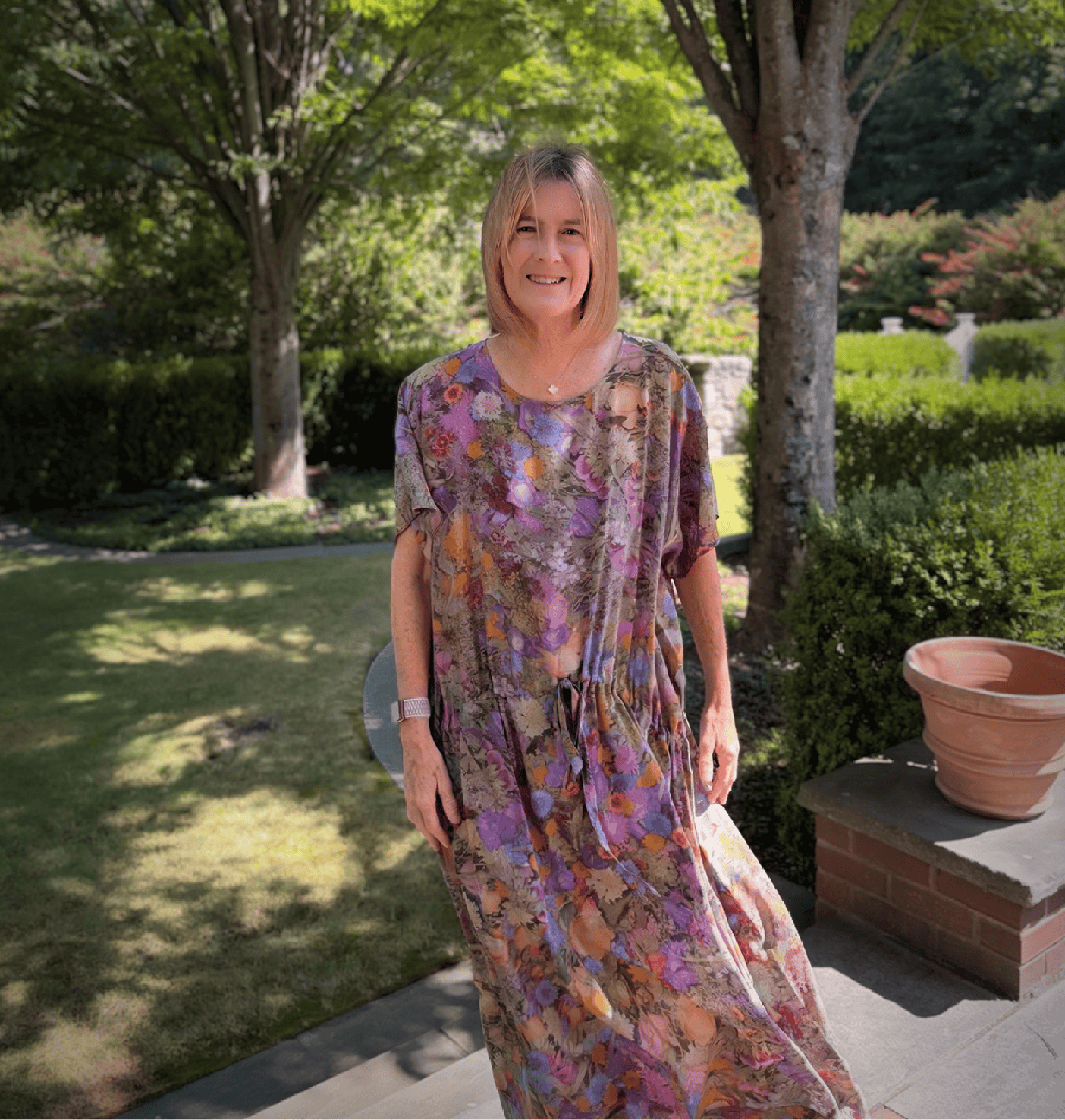
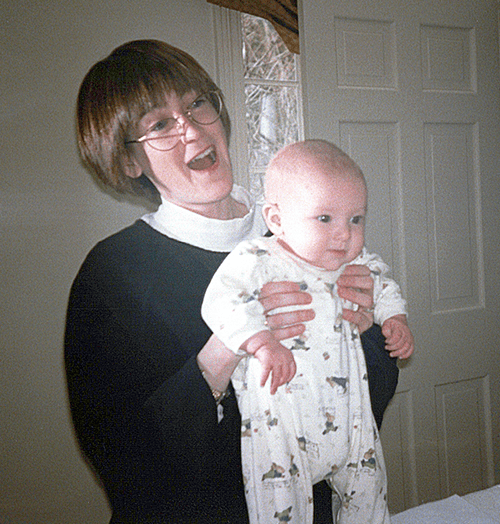
Something terrible just happened. My wife, Elise Cawley, was recovering from heart surgery and had just attended virtually a celebration for one of our children when she had a freak, vast cardiovascular event—and died instantly. We had been together for 36 years. The picture above was taken just hours before she died.
In all the writing and public speaking I have done, I have chosen, as a matter of privacy, to say little about my family. But now that Elise is gone I cannot restrain myself from telling the world something about the remarkable person with whom I shared the past 36 years of my life.
It was September 17, 1990, and I was in New York City. The event I had been attending finished a little early, so I decided to drop in on a friend of mine. And there, sitting stylishly on the floor, was Elise, a somewhat bashful but obviously brilliant young pure mathematician. It took me a couple of weeks to call her. But from that moment on we talked essentially every day for 36 years—until the day she died a week ago.
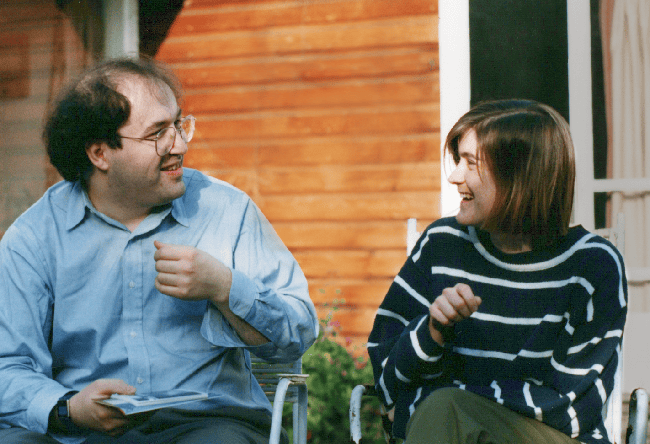
Somehow in the shock of what has happened it feels as if I just met Elise, and now she is gone. But actually there were 36 wonderful years in between, in which my life was lit up by Elise’s intellect, love and energy. She was deeply thematic, able to get, with remarkable ease, to the essence of things. Truth, beauty and our family and four children were her great themes. She always told me that truth and beauty were ultimately the same thing, and that one day I would understand that. What I could see is that she herself loved to create beauty—whether in mathematics, interior design, architecture or personal style. She was a forceful intellect, kind and sweet, but persistent and often feisty in arguing for what she thought was true.
Despite her deep knowledge and capability in abstract mathematics, she was at some level fundamentally a humanist, thinking about the world in human terms. She decried dry modernism and was drawn to the human connections of classicism. In recent years she thought increasingly about the foundations of mathematics, taking a Platonic view of truth and lamenting the twentieth-century transition to a more formalistic approach.
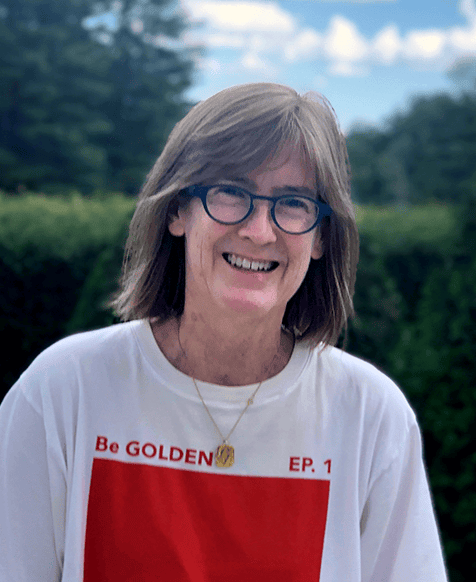
There was always a certain lively spontaneity to Elise, mixed with a drive towards the highest standards of intellectual and aesthetic rigor. People’s first impressions of Elise tended to be of her personal energy, her lively style and her keen intellect. But as they got to know her, they would also come to see how much she cared about the people around her and how much loving thought and effort she would put into things she did for them. Whether it was a gift or the interior design of a space, Elise would apply her creativity and go back and forth until it was just right.
Our four children were a defining part of Elise’s life, and she was immensely proud of all of them (as am I!). She had her own unique relationship with each of our children that helped them each develop in their own way. She also built us a wonderful home, full of warmth, architectural beauty and creative design. She took great pleasure in perfecting every detail, maintaining remarkable overall coherence, with dashes of the unexpected.
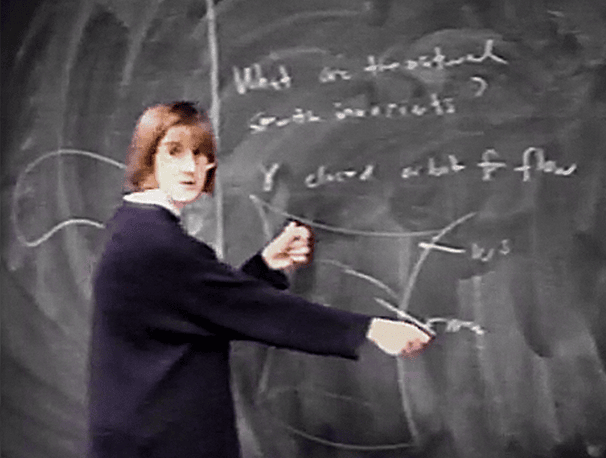
Elise was a very fine mathematician, top flight in technical mastery but, more importantly, able to thematically pull together grand conceptual arcs. She was always drawn to elegance, often with an abstract geometrical bent, and by the time I met her she had already established herself with results that continue to be cited today. Later in life Elise would refer to herself as a “retired mathematician”, but if exposed to her kind of math, she would immediately engage with great enthusiasm.
In all my years with Elise we never directly worked together on intellectual projects. Perhaps we were both too strong willed, and with her quick mind, it did not take long for her to get impatient with the differences in our styles of thinking. Still, I would often tell her about work I was doing. And it was remarkable how effortlessly she would see deeper themes, which she would then explain back to me, with varying degrees of patience.
She liked my concept of computational irreducibility, and I think was pleased that the efforts in science on which I had spent so many of our years together had led to a place that highlighted the limitations of science and of scientism, and aligned well with her humanistic worldview. When I began to form ideas about observers and the ruliad, she was far ahead of me in seeing their philosophical and metaphysical implications.
For years, the foundations of mathematics were something of a sore point between us (and our children were highly amused that one of the most vigorous arguments they ever saw between us was about the metaphysical character of the concept of a circle). Elise maintained that raw axiomatic formalization cannot be the true essence of math and that math is really something much more human. And finally, just a few years ago, by a long and circuitous route, I came to realize that—despite my obstinate insistence to the contrary—she’d been right about this all along. But then she made other assertions too, that she thought were quite significant. Like that the fundamental abstractions from which we build math as we know it are the concept of point (which she viewed as equivalent to space, continuity and infinity), and the concept of number. She also asserted that physics differs from math mainly in its introduction of the concept of time.
While Elise could be a very original thinker, she also believed in the value of existing wisdom and existing ways of doing things—and was constantly telling me that I shouldn’t try to figure out absolutely everything (including about everyday life) from first principles. Being with Elise was always something of an adventure. There was spontaneity (“no plan; let’s play it by ear”), yet also precision and perfection. And there were the forcefully delivered bursts of insight, not just about math and abstraction, but also about the human condition and the way the world works. Elise would say that there were people of action, and there were philosophers. She saw herself more as the latter. She had strong opinions about how things should be in the world. But she was much more interested in figuring out what should be than in what she saw as the grind of trying to make it actually happen.
Elise was a person who had both great confidence and great humility. While she was always convinced that she was right in things she thought (and in fact usually was), she was never one to advertise her capabilities. Still, if ever a conversation turned to things she knew or cared about, she wouldn’t restrain herself from making what was often a deeply insightful contribution.
I always thought Elise and I were an outstanding match—similar in many ways, yet also complementary. We both valued thematic thinking (though in many domains she was better at it than me), and we shared an appreciation for aesthetics and work well done. But for example our ways of interacting with people were somewhat different. My children say I have only one mode of interaction: full on. Elise was at some level more introverted and would imagine herself to be shy—though once engaged she would become highly talkative and animated. And when it was just Elise and me on our own, we always seemed to have things to talk about, in fact an infinite number of things.
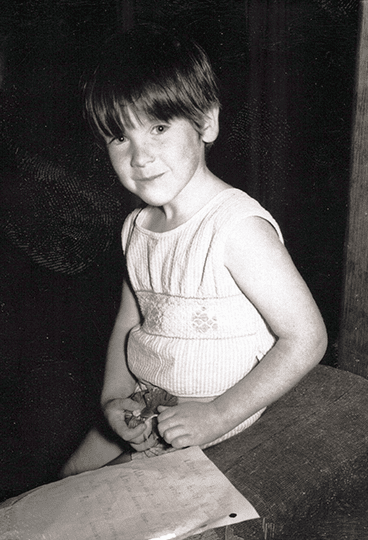
Elise was born in 1961 in Urbana, IL—ironically not far from the headquarters of our company—when her father was a physics graduate student at the University of Illinois. The second of four children, she grew up mostly in Columbia, MD, as a top student, particularly recognized for her math and her thematic essays. As she often mentioned to our children, in 6th grade her teacher characterized her writing as “the cat’s pajamas”—and for a while she imagined growing up to be a writer. In high school she had the formative experience of going to the Hampshire summer math program, where for the first time she met other people who were intensely interested in math.
She went to MIT for college, falling in with a group that included several later prominent mathematicians. She always told me that what really ignited her interest in conceptual pure mathematics was an epiphany she had in a class she took about topology. At MIT, she supported herself by working in the thesis bindery, using her calligraphic skills to label theses. She also made up language puzzles for a language acquisition study and had a summer job working on algorithms at an early speech recognition company. A family crisis took her back to Maryland, where she finished degrees in both math and physics at the University of Maryland. She also had an internship working on a PET scanner at NIH, volunteered at some hospitals and considered going to medical school. But in the end she decided on graduate school.
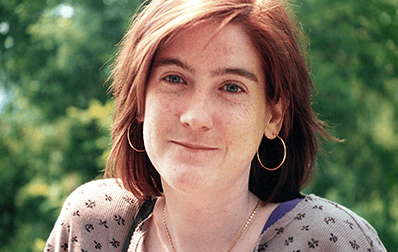
She couldn’t make her mind up between physics and math but ended up applying in physics. One of her physics professors had said she was the best student he’d ever seen but would be most suited to very theoretical physics. She had her choice between Harvard and Berkeley. And in her ever-typical fashion she waited until the last minute, picking Berkeley because she was told she’d be able to switch to math there.
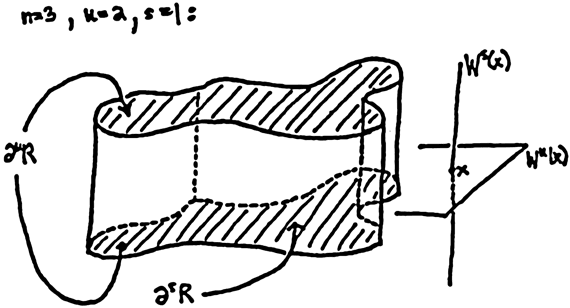
After an intense “think on your feet” interview process, she received a Hertz Foundation fellowship, which generously supported her graduate studies. Before even arriving at Berkeley she’d settled on math, and having impressed people with her elegant solution to a small open problem, she joined a group working on geometrical approaches to dynamical systems. After four years in graduate school she completed her PhD thesis on “Smooth Markov Partitions and Toral Automorphisms”. It was quintessential Elise. An elegant thematic idea implemented with clean technical proficiency.
It made her a hotshot young mathematician, sought after by many universities. She ended up with two jobs: a tenure-track professorship at Stony Brook and an NSF postdoc sponsored by the prominent mathematician Dennis Sullivan. She chose to defer the professorship and take the postdoc for a year, partly at CUNY in New York City and partly at IHES near Paris.
While at IHES, Elise lived in the very center of Paris, only steps from the Jardin du Luxembourg, in an unused studio owned by an artist who was the sister of another mathematician. It was a period of intense mathematical work for Elise about which she was very enthusiastic. And her thematic and aesthetic sensibilities drew her to the study of Teichmüller spaces, which are spaces of possible geometrical objects, or in a sense spaces of possible spaces. It was also at this time that she embarked on what would be a long-term interest in the so-called thermodynamic formalism, or Gibbs theory.
With connections to mathematical physics, Gibbs theory provides a way to talk about infinite collections of infinite structures, and their development, for example through time. (Ironically enough—as Elise would repeatedly mention—concepts such as transversals that appear in Gibbs theory are now directly relevant to my own work on infrageometry and the foundations of physics.)
Rather untypically for a mathematician, Elise was always notable for her distinctive personal style—often an interpretation of current fashion, but with her own spunky and colorful touches. As one of my daughters tells it, Elise’s interest in style began to expand with the funding she received from her Hertz fellowship and developed further during her time in New York City and Paris.
Upon returning from Paris, Elise was about to start at Stony Brook, but while waiting for her apartment to be ready, was staying with her long-time friend Lisa Goldberg in New York City. And that’s how, on September 17, 1990, Elise and I first met.
Lisa’s apartment was an elegant one, but I was not quite so elegant that day. I had been at a tech industry event where I had received a rather bulky award, which was in my jacket pocket weighing it down. Elise was sitting on the floor, with her bangs flopped across her face, in a pose that I thought might be yoga. We talked just a bit, but it was enough.
The next day I went back to Champaign, IL, where I was based at the time. It had been two and a half years since we’d released Mathematica 1.0 and our company was growing rapidly. I had started my career young, so even though I was only two years older than Elise (she was close to 29 and I had just turned 31), I had already done quite a bit, both in academia and the tech industry.
Early versions of Mathematica came with a book, that I had to write. And in September 1990 I was rushing to finish the second edition of that book, to accompany Mathematica 2.0. Two weeks after I returned to Champaign, I did finish, though promptly got sick with a high fever. And that was when I finally called Elise.
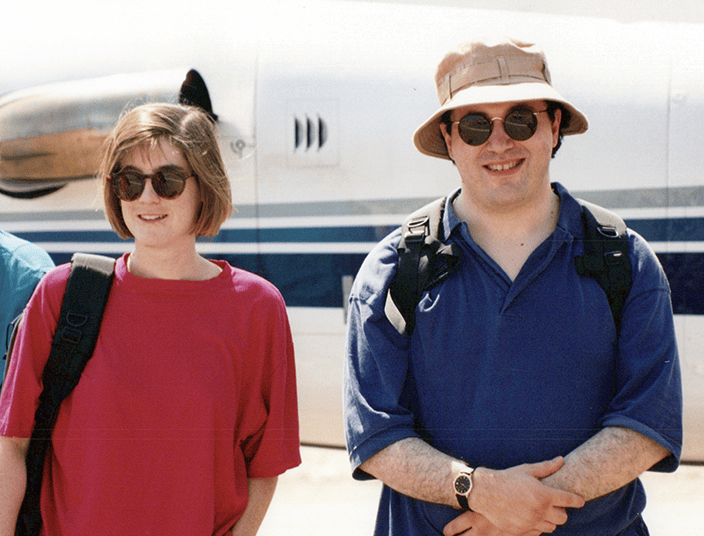
Soon I was taking trips to Stony Brook, and she to Champaign. And when apart we were talking by phone for hours each day. Lisa Goldberg made a point of telling me, “She’s a very fine mathematician, you know”. Elise had met another person a little earlier, and Lisa had dismissed them as unsuitable. But—as I just now learned from one of my children—when Elise asked Lisa about me she immediately responded with enthusiasm.
One notable trip was the result of a call I got from Elise where she explained that she’d mixed up contact lens solution and hydrogen peroxide and now had to patch both her eyes for a few days. I immediately got on the next flight. And while the only food I could cook at that time (and still today) was an omelette, she viewed this “rescue” as an act of chivalry that—as she told our children—was what definitively sold her on me.
On Elise’s 29th birthday in December 1990 I sent some flowers. She responded by email, now bittersweet:
Hi there. Some amazing flowers just arrived. I think I can make to92. I’m heading off to aerobics — tonight is the amazing Margaret(who plays great music). I has some good math conversation withcaroline s. today. And got a little bit of real work done.
I’ll be back around 9pm.
elise
The very next email I received from her was about a bug in the Mathematica Residue function.
My day job was (and still is) tech CEO. But what made me originally develop our technology was that I wanted to use it myself—to do science. By the spring of 1991 I was getting frustrated that I could inject new ideas into our company faster than it could absorb them. So I decided I should take something of a sabbatical and work on science for a while. Meanwhile, Elise still had time left on her NSF postdoc, that she could take anywhere. And so it was that we decided to get a house together in the hills above Oakland, CA, and she returned to Berkeley.
Before moving into the house that she found for us, she came with me on an 18-city tour of Europe+Russia to promote Mathematica 2.0. After that, we settled into a good routine. She would go off each day to do math. I would stay home to be a remote CEO, and work on science. And from time to time she’d jet off to Texas, Montana, France or wherever to give talks.
By late 1992 we were thinking about next steps. Elise was adamant that she couldn’t live in Champaign-Urbana (despite having been born there). But she thought the idea of living in the Chicago area was interesting. Meanwhile, she was highly in demand as a mathematician, and there were multiple opportunities for her there.
Elise took charge, and explored many different locations and houses around Chicago, eventually picking a house in Hinsdale, IL. We moved there in the middle of 1993, and Elise took up a position at the University of Chicago. It was a nice house, but Elise thought it could be nicer, and set about renovating it to have top-of-the-line interior design. She started working with a designer who she discovered by reading magazines, and learned that her aesthetic and geometric sensibilities translated well into creative interior design. Elise was particularly keen on integrating lively colors and unexpected elements into traditional design themes.
Meanwhile, at the University of Chicago, Elise was teaching a course about Gibbs theory. She wrote extensive notes which she planned eventually to turn into a book. Over the years, people asked for the book many times, and Elise had recently started talking about finally finishing it. Ironically enough, our daughter Catherine, now herself a mathematician, has ended up working in somewhat related areas.
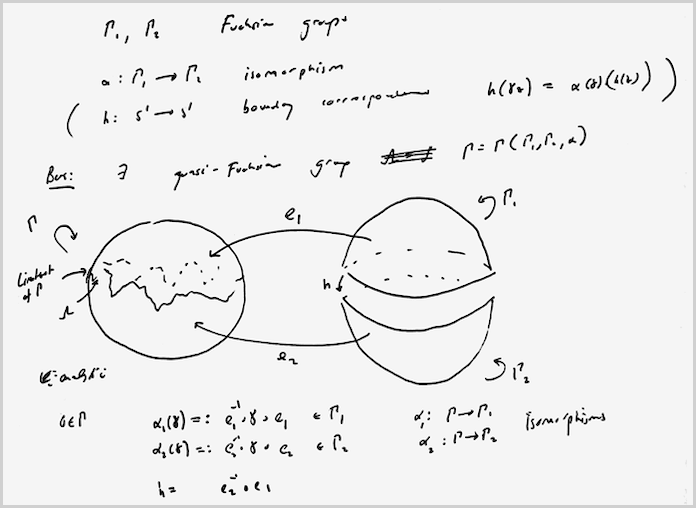
Elise interacted a lot with Bob Zimmer, who was then chairman of the math department (and would later become president of the University of Chicago). Together they devised the concept of a new activity for the math department: a professional master’s degree in financial mathematics, basically aimed at quants, and taught by math professors. Though Elise was never too interested in the messiness of actual market data, she liked the pure mathematics of market models, and helped develop a curriculum around it. The master’s degree ended up being highly successful and continues to this day.
In the fall of 1994 Elise and I married. And then, in December 1995, as Elise would later describe it, “the world overnight had a new center”: our first child, Alexander, was born. The next few years were dominated by the arrival of children, with Catherine being born in 1997 and Christopher in 1998—leaving Elise, as she put it, with “three under three”.
With our family growing—and our book collection reaching over 5000 volumes—we were outgrowing our house in Hinsdale, and started looking for a new home. At first, Elise found real estate in Lake Forest, IL. But when the deal for it fell through we started thinking more broadly and decided that since the Boston area was the place where together we knew the most people, that was where we should go. But which town in particular? Elise’s #1 initial criterion was that it should already have a Starbucks. From the list of such towns, she then started looking at USGS aerial photographs (or what would now be satellite images), and soon settled on Concord, MA. But finding no suitable existing house to buy there, she set about designing a house to build.
It was a complex process. The house had to accommodate what was by then a library of nearly 10,000 books, as well as space for my remote-CEO office and for our three children. Elise had been scouring architecture books, and interviewed several top-of-the-line architects before settling on one to work with. With her mathematical and aesthetic sensibilities she easily absorbed principles of architecture and soon developed her own intuition for it. Sometimes she’d bring in serious math—like number theory to design a staircase with aligned squiggly banisters, or circle packing to lay out an Italian-inspired tiling based on circles and Sierpinski patterns. She started off making sketches, but soon learned the latest CAD tools. And in the end her ideas defined much of the design of the house. (At the beginning, I had tried making some “suggestions” about the plans, but quickly realized that this was an Elise project, and I should stay out of it.)
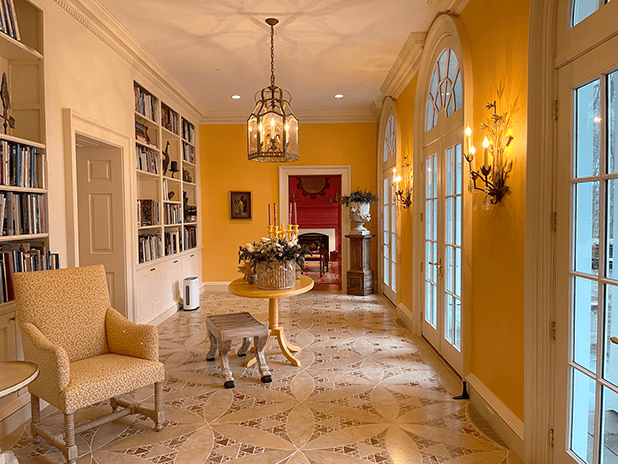
It took several years to build the house (with Elise regularly traveling to Boston to oversee the project) but in the spring of 2002 the project was finished—coincidentally at basically the same time as my 10-year project of writing A New Kind of Science. Other than in CAD drawings I’d only seen the house once, early in its construction, so when we drove from Hinsdale and arrived at the house I was in for a surprise. It was much bigger than I expected! And when we went inside I could see that it was a masterpiece, filled with personality: beautiful, elegant, creative—quintessential Elise.
And then there was the interior design. Bold and colorful, yet classic. Each room with a distinct character, gracefully flowing into the next. Over the years, Elise revised and updated the interior design of the house many times. She was often to be seen sketching on graph paper new possible designs based on new ideas. She kept the style fresh, constantly breathing new life into the house—even if it meant that our children would comment that every time they showed up the furniture seemed to have been rearranged. And 24 years after I first saw the house, I still find myself wowed by it.
By 2003, our oldest was encouraging us to have another child, noting, among other things, that the symmetry of the house had given it four children’s bedrooms. And so it was that in the fall of 2004 our fourth child, Elizabeth, was born.
In her earlier years, Elise had always said that she “couldn’t imagine her life not doing math”. But partly through me, and, more importantly through our children, her world had been broadened, and her perspectives had shifted. She would later describe her life as having several chapters, and this was a chapter about children.
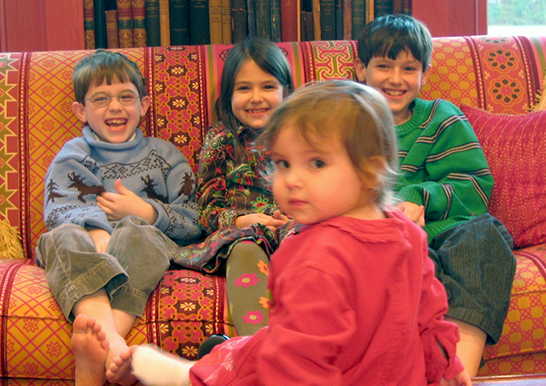
Through her children showing interest in math, she ended up coaching some middle-school MathCounts math competition teams. She wasn’t a fan of the way math was typically taught in schools, complaining that the beauty of math was being lost in the attempt to make math seem “applicable”, and noting that “most of math in modern textbooks is not really math at all”. In an email to me in 2010 Elise spiritedly went further:
What has happened to beauty in math? The beauty derivesfrom the simplicity and elegance. That has been lost in theproliferation of extraneous terminology, meant to make things “moreconceptual”, from early endless excursions with “place value” to absurdvariations on algorithms, to gummy descriptions of everything usingcontortions of language, rather than the language of mathematics itself.
Elise did nevertheless do some applications of math herself. During the pandemic, for example, she developed the idea that infection was not a binary phenomenon, but that instead each person had a constantly changing viral load and immunity, creating a “viral field” at the population level. Elise was always up to date on world affairs, and had a deep interest in understanding their thematic arcs at work.
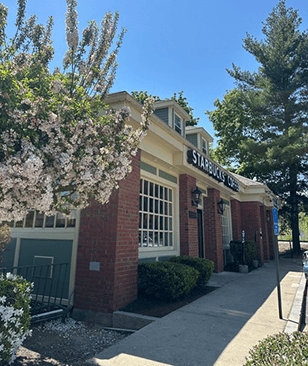
Elise loved the small-town atmosphere of Concord, MA, and enjoyed the feeling of being in a place “where everyone knows your name”. She was a regular at local cafes and exercise classes, bringing her liveliness wherever she went. She had a circle of friends with many different backgrounds, often met through their children or simply through repeatedly running into them at Starbucks. She took great pleasure in applying her knowledge and thinking to help her friends in all sorts of ways. Whether it was doing research on medical issues, solving interior design problems, or simply using her keen insight and judgment to provide life advice, she would reliably go above and beyond.
Our family had a definite routine, with dinner each day at about 6pm. Every Friday night—following a tradition from Elise’s own family growing up—we would go out to a movie (and, yes, that meant we saw many questionable movies). Before our children were old enough, it was just Elise and me; later it included various contingents of children too. Elise and I would talk after each movie, with her often being quite appalled by my lack of understanding of what seemed to her like the movie’s obvious thematic elements. (Elise also gave me a hard time about my failure to read fiction, claiming that many ideas, particularly about human nature, are best communicated in fiction.)
A dozen years ago two of our children were at the Stanford Online High School, and Elise was recruited as an inaugural member of the school’s Community Advisory Group. Originally this was just supposed to be for a year. But a decade later she was still there, a highly valued member of the group. She spent considerable effort thinking about the overall strategy and issues of the organization, and developed many ideas and opinions. Despite this, she’d often tell us that she didn’t think she’d end up saying anything at a given meeting. But with great consistency it would later transpire that actually she had been the most talkative and engaged person there.
In the early 2000s, the Hertz Foundation, from which Elise had received her graduate school fellowship, started reaching out to her, and she enjoyed engaging with the emerging Hertz community, and meeting fellows from a wide range of fields. In 2018 she was also recruited to the board of the Hertz Foundation. And here again she became a key contributor, often expecting not to say anything, but then ending up as one of the most vocal people there.
By 2023, our three older children had all graduated from college, but our youngest, Elizabeth, was just starting at Yale. Elizabeth has always been involved in a great many activities, and Elise took great pleasure in attending every possible concert, sporting or other event—and also for example hosting Elizabeth’s entire a cappella group for a retreat at our house.
A bit more than a decade ago Elise also discovered a love for the Southwest and for hiking. And with her brother Jason—with whom she was always very close—living in the Phoenix, AZ, area, we started spending time there each winter.
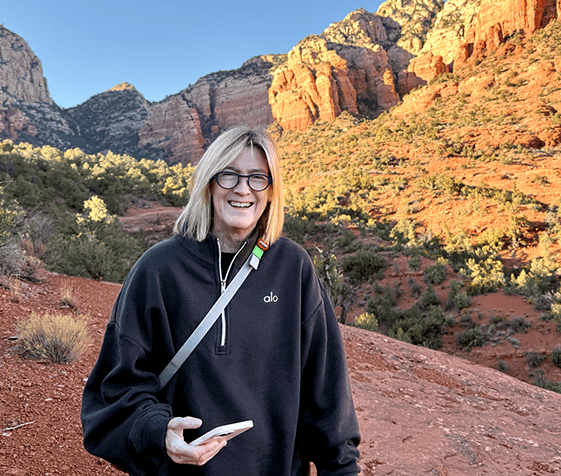
With Elizabeth off in college we were finally empty nesters, and Elise was ready for a new chapter in her life. She considered returning to where she’d left off in Gibbs theory 30 years ago, being told by an old colleague that her work there was still very current. She also considered getting more deeply involved in the philosophy of mathematics and was on the brink of writing a piece about it. She was also quite engaged in thinking about the purpose and direction of higher education, and the importance of free expression in the search for truth.
In some ways Elise and I were becoming “the old married couple”, with her admonishing me about my messiness in eating ice cream cones or her desire that I switch on self-driving to avoid her being subjected to my own substandard human driving.
Elise had always been a fit and healthy person, and was also very medically knowledgeable. So when she started noticing jaw pain when hiking in Colorado and Arizona, she was concerned. Tests at first showed nothing alarming, though, as she already knew, she had a small congenital heart issue that was gradually worsening. But just a few weeks ago her symptoms worsened and more invasive tests revealed that she needed urgent open heart surgery. She had an outstanding team of top doctors, the complex surgery went very well, and she was soon continuing her recovery from home.
Meanwhile there was a long-planned celebration for one of our children that Elise hoped to attend. But though it was not possible for her to be there in person, we arranged for her to attend virtually. It was a wonderful event, and Elise could be seen via video call beaming through all of it. But then, soon after, disaster struck, and she collapsed, the victim of a massive cardiovascular event. My only solace in this tragedy is that the end came instantly, after a day filled with nothing but joy.
There is so much that Elise was looking forward to. The imminent arrival of our first grandchild. Elizabeth’s graduation from college. The next chapter of her life. But Elise will not be here for any of these.
Elise had no idea the end was near. And even though she expected more, she had already had many chapters in her life, and many achievements of which she was proud. Elise had a beautiful life, full of things she valued greatly, especially her children. That she is gone is a tragedy for us all; she will be deeply missed.
Thank you, Elise, for all those wonderful years.
⚡ **What’s your take?**
Share your thoughts in the comments below!
#️⃣ **#Memory #Wife #Elise #Cawley #Wonderful #YearsStephen #Wolfram #Writings**
🕒 **Posted on**: 1785872203
🌟 **Want more?** Click here for more info! 🌟
