

🔥 Discover this awesome post from Hacker News 📖
📂 **Category**:
📌 **What You’ll Learn**:
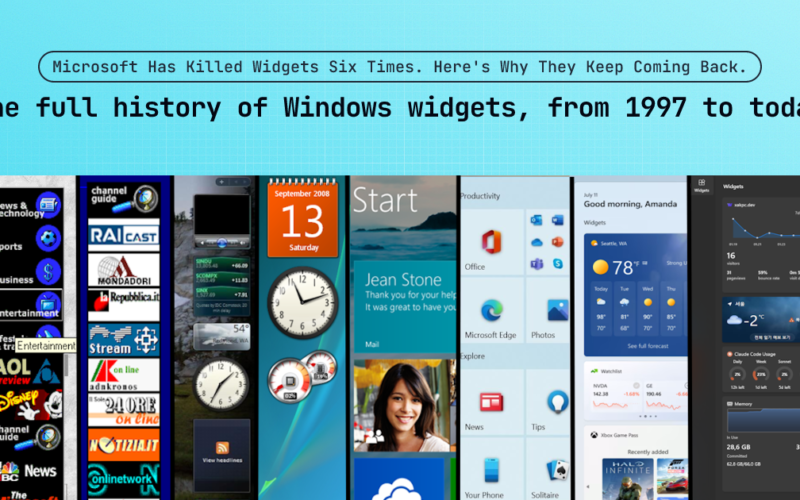
Microsoft has been trying to solve the same UX problem since 1997: how to surface live information without making you launch an app. They’ve shipped six different implementations across nearly 30 years. Each one died from a different fundamental flaw – performance, security, screen space, privacy, engagement. And each death triggered the same reflex: containment.
The pattern goes like this. Microsoft releases widgets into the wild. Users or attackers find the breaking point. Microsoft panics, kills the feature, and ships the next version locked inside a tighter box. Active Desktop splashed HTML across the wallpaper – performance collapsed, so Vista contained widgets in a rigid sidebar. Users hated losing screen space, so Windows 7 freed gadgets to float anywhere – then a security exploit blew the whole platform apart. Windows 8 responded by locking widgets into a full-screen Start Screen nobody wanted. The cycle repeats: build, ship, backlash, kill, rebuild with more walls.
Understanding why each containment failed tells you exactly what constraints shape the platform you’d build on today. Every design decision in the current architecture – the declarative Adaptive Cards format, the native WinUI 3 renderer, the overlay-instead-of-dock layout – exists because of a specific past disaster. The constraints you’ll hit when building widgets today aren’t arbitrary. They’re scar tissue.
What the Cycle Produced
The current Widget Board is the scar tissue made manifest. Declarative JSON with no executable code (security). Native WinUI 3 rendering, migrated off the original WebView2 pipeline (performance). An overlay, not a dock (screen space). Interactive widgets (engagement). Opt-in data access (privacy). Every lesson encoded in architecture.
But it’s not perfect. The developer API has constraints that limit what you can build. The discoverability problem – most Windows users have never pressed Win + W – remains unsolved. And while the news feed is finally optional, the tension between Microsoft’s desire to monetize the Discover surface and users’ desire for a clean utility board is far from resolved.
Those constraints, and how to work within them to ship something useful, are what the rest of this series will cover.
Building a widget for your product?
I offer fixed-price widget development for SaaS products.
Learn about my service
⚡ **What’s your take?**
Share your thoughts in the comments below!
#️⃣ **#Microsoft #Killed #Widgets #Times #Heres #Coming**
🕒 **Posted on**: 1770189367
🌟 **Want more?** Click here for more info! 🌟
