


💥 Read this awesome post from Hacker News 📖
📂 **Category**:
📌 **What You’ll Learn**:
For the last few years, while finally earning my belated Bachelor’s Degree in the University of London’s World Class program, I’ve met some amazing people from all across the world, completing their degrees after hours while balancing work, families, and other extremely challenging circumstances.
But few have circumstances as challenging as Django’s.
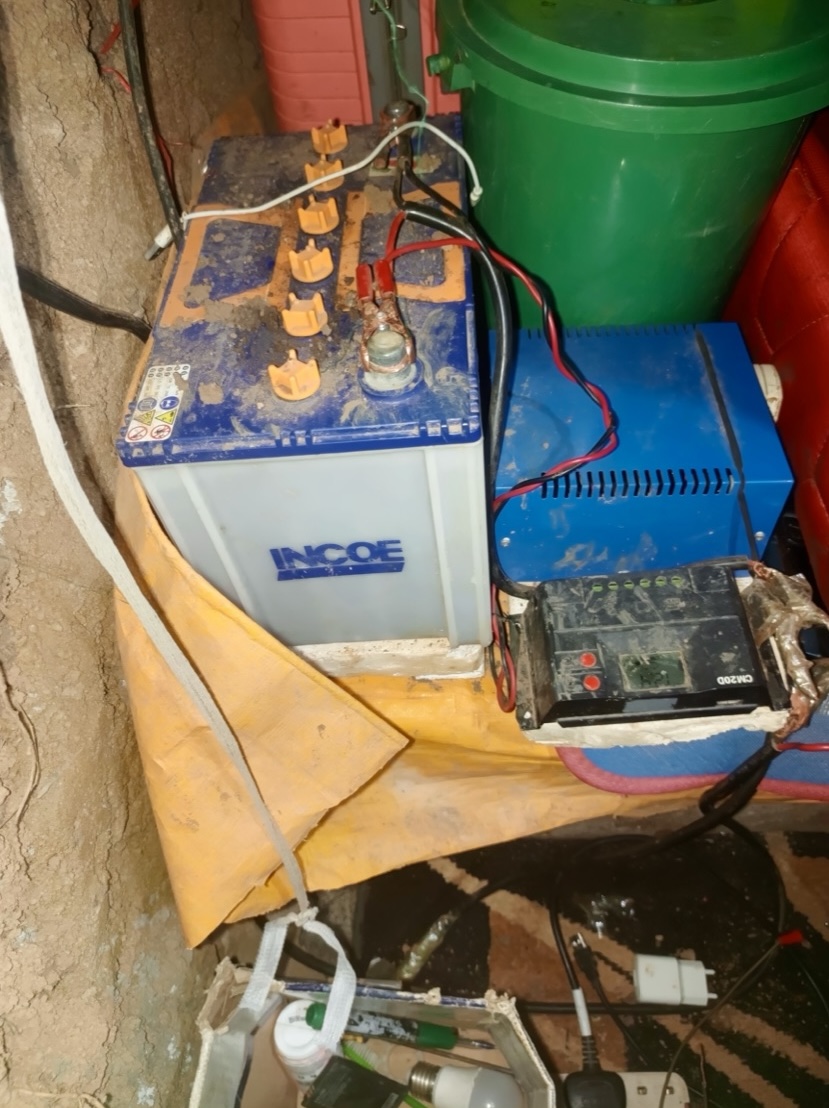
Django is a Congolese refugee living in a camp in Western Uganda. He has no reliable electricity in the camp and runs his laptop on solar power; his internet access comes from Airtel minutes, which he needs to ration on a very limited income. This makes completing a remote Computer Science degree – with video lectures, assignments that need to be uploaded on time and remotely proctored exams – at times seem nearly impossible.
Recently, Django found himself in a new predicament.
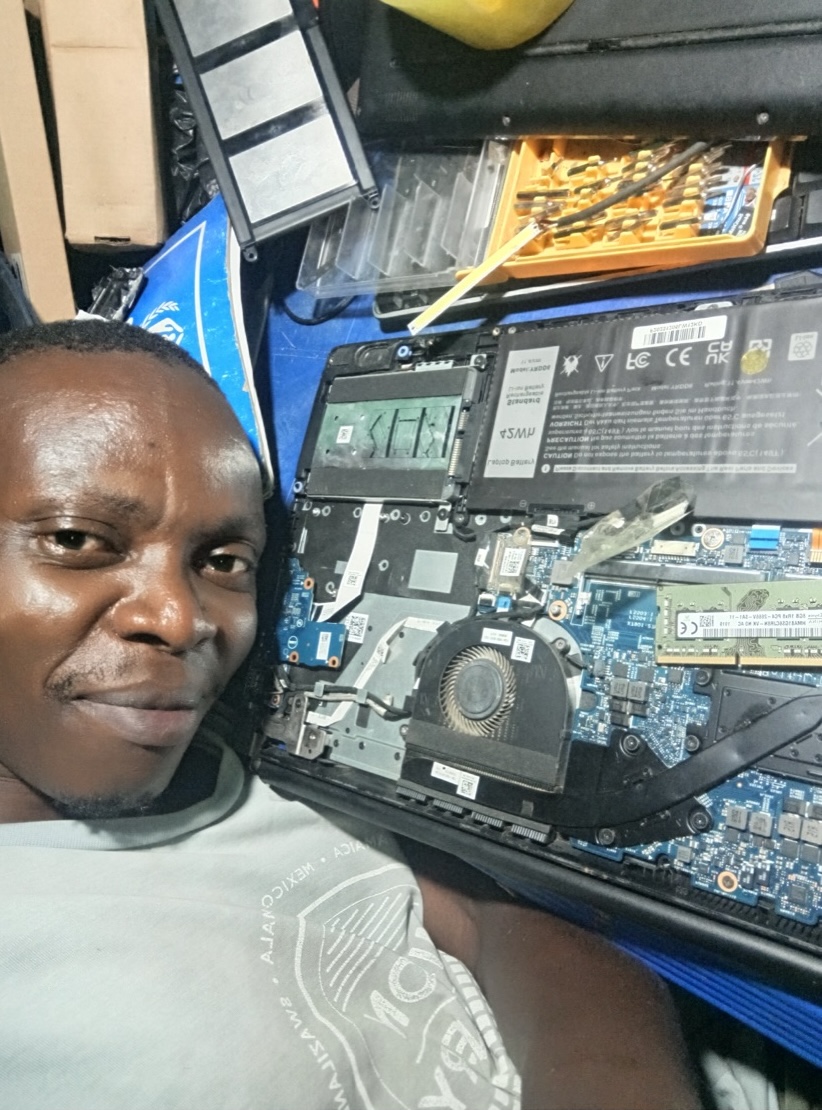
His laptop’s motherboard burned out after accidentally connecting a USB cable to a 12V battery output, and the next semester was set to start in a few weeks. He had tried to repair it to no avail: the laptop continued to overheat and would not turn on.
 |
 |
I have a few old MacBooks that are in working order, just sitting around the house. So I offered to send one to him.
Naively, I figured that I’d just go to my local post office, put it in a box with some bubble wrap, and he’d have it in a few days/weeks. However, the process turned out to be far more complicated than expected.
First attempt
I dusted off the laptop, wiped the hard drive and reinstalled macOS using Apple’s instructions. I wiped the screen with a lint-free cloth wetted with only water, avoiding alcohol-based cleaning products. For the keyboard, I used standard multipurpose wipes to remove my ancient finger grime.
I asked ChatGPT how to send the laptop, and it gave me a spiel about finding a reliable freight service or courier. I asked whether it would be possible to send via Australia Post (our national mail service) anyway, since an outlet was down the road from my house. Apparently, I could, as long as the lithium battery was installed in the device.
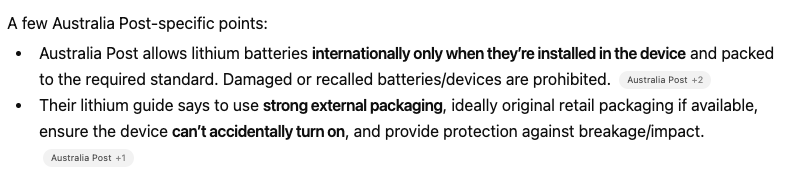
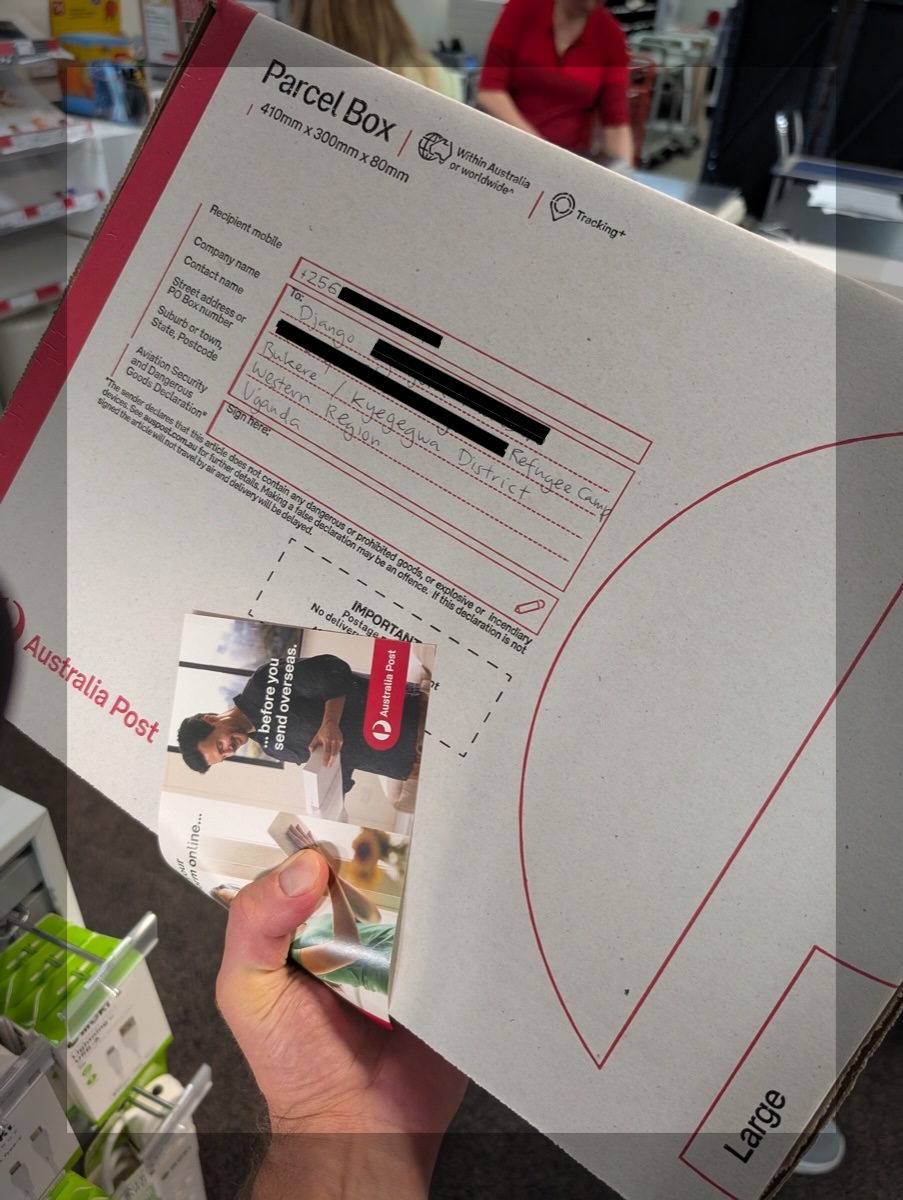
At the post office, a friendly staff member confirmed it could be sent, helped me package it up securely, and it cost me $111.60 AUD.
 |
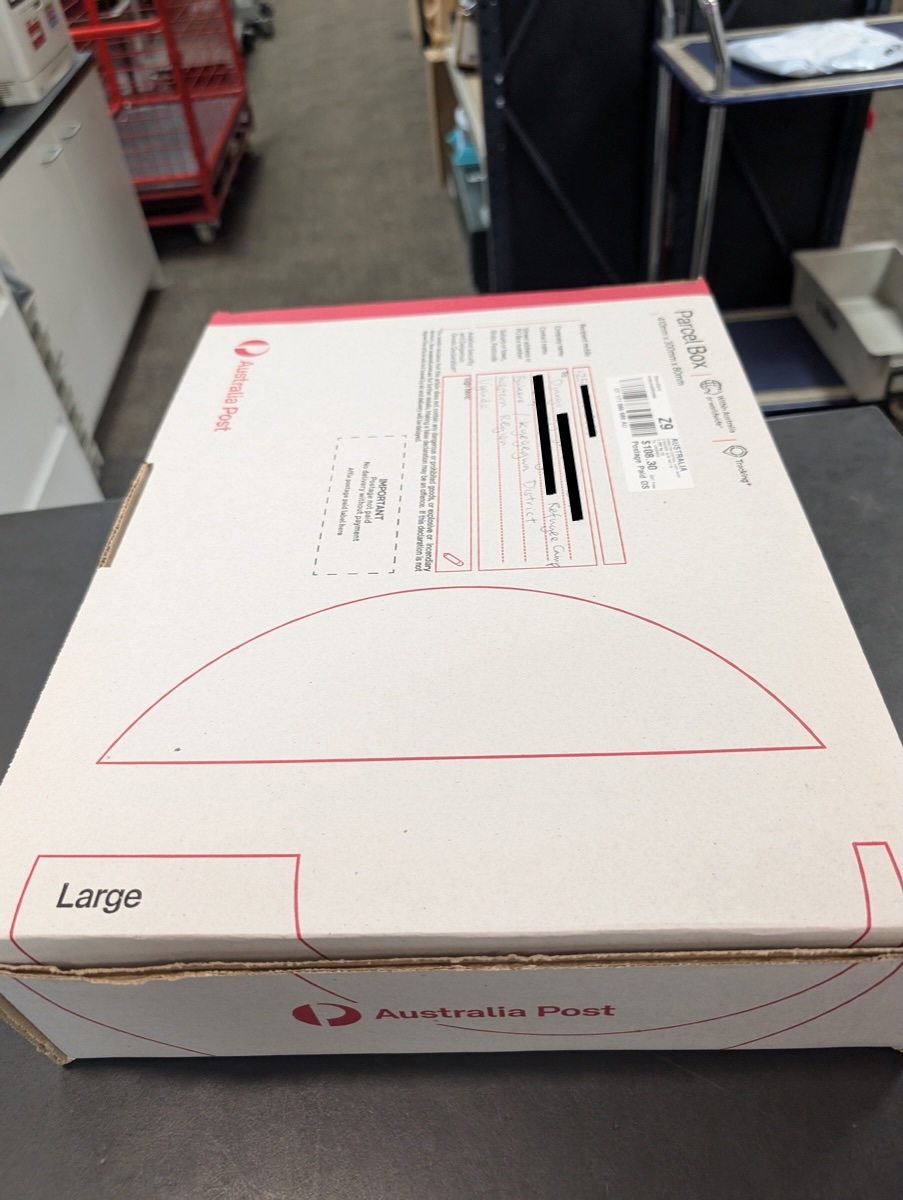 |
I shared the tracking number with Django on April 1st. Six days later, he messaged to say it looked like the package was arriving soon.
However, a few hours later, I got a knock at my door. The package had been returned to my house after failing to be processed at the distribution centre.
Turns out Australia Post won’t ship devices containing lithium batteries internationally by air, after all. I should have listened to ChatGPT.
I searched for how to actually send a laptop overseas, and a few freight services with well-tuned SEO popped up. I found a vendor called Pack & Send with an office a few km from my house.

I submitted a quote request on their website, and they called me back with a quote of $213 AUD.
I walked about 45 minutes to the office, in a neighbouring industrial suburb.
The woman at the front desk laughed at the packaging job I had done at the Post Office and said she’d repackage it properly.
This was April 9th, which was about 6 weeks into the Strait of Hormuz crisis, which had thrown global freight routes into chaos, so she told me to expect delays. She also mentioned there would be additional costs for Django in Uganda: customs fees and taxes she couldn’t estimate, and that he would need a buffer of at least $50–100 on his end.
Since money was extremely tight on Django’s end, I offered to send some for the buffer. Most Ugandan services accept Airtel Money, which I knew could be transferred easily via the WorldRemit app. He received the money in about 5 minutes.
Clearing Ugandan customs
Over the next few days, the package made its way through nine countries before reaching the Netherlands.
Then, on April 15th, Django received an email from an EHS Africa Logistics Agent with instructions on the next step: there was an agency fee of UGX 95,000 (~$35 AUD), then he’d need to register via the Uganda Revenue Authority (URA) Portal, complete a tax assessment, and pay any applicable taxes. All of this had to be cleared within 5 working days, or we would be paying storage fees, the agent warned.
However, registration required a Tax Identification Number (TIN), which Django, a refugee, does not have. Getting one requires physically presenting at a URA office, and there was none nearby in his district.
Django sent an email to the EHS rep asking if it could be completed without a TIN, but received no reply. So he decided to sort it himself.
Getting a TIN as a refugee
In his words:
Regarding the TIN, I first tried to do it online because the URA website suggested that the process could be started electronically. However, I discovered that for refugees and non-citizens, it was not truly an online process. Ugandan citizens could complete everything online, but refugees could only begin the application online and then had to physically appear at a URA office with documents for verification before approval.
Even starting the online part was difficult. The application form was an old Excel macro form that could not properly work on my phone. At that time, I did not yet have a computer, so there was practically no way for me to complete or upload the form myself.
I then went to a nearby organization that says it assists refugee youth. They told me they could help fill and submit the form, but they asked me for the equivalent of about 20 USD just to complete the submission process, and they also told me the process could take around two weeks. At another point, I was even told an amount closer to 40 USD. The difficult part was that this was not even the full service – after paying, I would still have to personally travel to a URA office for physical verification.
Since I urgently needed the TIN for customs clearance, I decided to do the rest myself instead of waiting.
From my area in the refugee settlement, I first walked for about two hours to reach a trading center “Bukere” where I could get a boda-boda motorcycle. From there, I travelled to the main road in “Kyegegwa” and boarded a public taxi/bus to another town, “Mubende”, where there was a URA office. The taxi constantly stopped along the road picking up passengers, so the trip took around three hours.
When I reached the town, I first went to a police station to ask for directions because I did not know where the URA office was located. A boda-boda rider was then called to take me there.
At the URA office, I was told that I needed to return all the way back to the refugee settlement and obtain a local authorization letter from the camp leadership before they could process my request. That day was a Friday. I explained repeatedly that I had travelled from very far away, using money that had originally been sent for the laptop clearance process itself, and that returning on Monday would be extremely difficult for me. But they continued insisting.
At some point, one man quietly pulled me aside and suggested that if I “gave something,” they could help solve the problem more easily. I refused. After some time, another officer finally agreed to look at my documents. However, after opening the file, he told me that “the network was down” and that I should come back on Monday.
He then told me to walk around town for one or two hours and come back later to check whether the network had returned. I did exactly that. When I returned, he again told me the network was still unavailable. So I remained sitting there in the office area for hours.
What made the situation painful was that while I was being told the network was not working, I could clearly see other people arriving, being served normally, and leaving. Many were speaking local languages, while I was struggling to explain myself in English and repeatedly trying to convince them that I had nowhere else to go and no money for repeated journeys.
After waiting several more hours, I approached again and asked whether they could please try once more. At that point, the same officer suddenly reopened the file and completed the entire process in only a few minutes. The actual generation and printing of the TIN certificate took less than ten minutes.
What had taken nearly two full days of travelling, waiting, stress, negotiation, and indirect requests for unofficial payments was finally completed in a matter of minutes.
When I finally received the printed TIN certificate, I was honestly overwhelmed with relief and gratitude. Before leaving, I found myself individually thanking almost everyone in the office – including some of the people who had initially refused to help me – simply because, after everything, I was deeply relieved that the process was finally over.
– Django
With the TIN in hand, Django could finally complete the Agent Appointment in the URA Portal and the tax worksheet. Taxes totalled UGX 127,657.76 (~$47 AUD), bringing the running total — including the failed Australia Post attempt — to ~$407 AUD, already close to the laptop’s value.
That was April 17th – three days before the new semester was due to start, with the laptop still sitting in the Netherlands.
Laptop seizure
The package next travelled to France → UK and finally to Uganda. However, we received a notice that there were “delivery restrictions”.

This caused the package to re-route through: UK → UAE → Kenya → Uganda.
Finally, on May 6th, it was in Uganda. But there was a new problem.
According to Ugandan regulations, used laptops cannot be imported unless accompanied by an original purchase receipt showing the exact purchase price. A customs invoice indicating an estimated value and noting that the laptop is used was not sufficient. Customs temporarily seized it.
We were told FedEx were in contact with the authorities to resolve the situation and were awaiting official communication from customs specifying the additional payment required. However, EHS informed us their system was down, causing further delays.
Meanwhile, Django managed to borrow a laptop for a small daily fee, so he could start the semester while waiting.
After some convincing, the authorities accepted a confirmation that the laptop was a used gift. The EHS representative requested a top-up payment of UGX 50,000 (~$18.50 AUD) to submit the amendment.

Django paid on May 8th. A day later, the shipment was released from customs and marked ready for delivery.

The final tally:
| Expense | AUD | UGX |
|---|---|---|
| Australia Post (failed attempt) | $111.60 | – |
| Pack & Send courier | $213.00 | – |
| Ugandan agency fee | ~$35.00 | 95,000 |
| URA customs taxes | ~$47.00 | 127,658 |
| Customs amendment top-up | ~$18.50 | 50,000 |
| Total | ~$426 | ~1,163,832 |
Finding the laptop in a hardware store
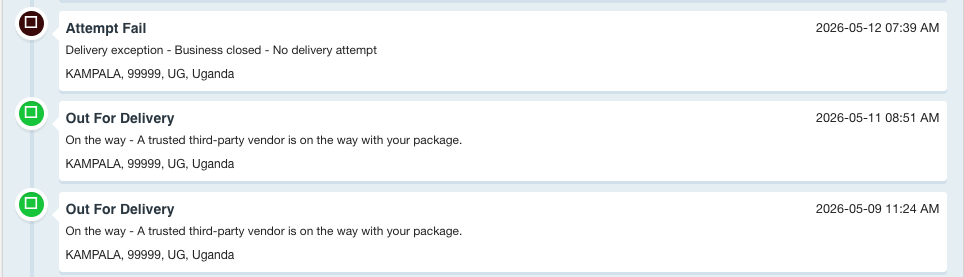
We received a notification that the laptop was out for delivery in Kampala, already about a 4-hour drive from Django’s home. He followed up and was told it had gone to Mbale – east of Kampala, and even further from him. Then he was told to wait until Thursday, the 14th, another 4 days away.
Meanwhile, the tracking showed an Attempt Failure.
So Django took matters into his own hands. In his words:
Since the tracking information was no longer reliable, I started tracing back through the different phone numbers that had previously called me regarding the shipment.
Some of those numbers no longer answered. Eventually, I called a woman from another town who had earlier contacted me when the laptop had temporarily passed through her hands. At that stage, the tracking system had described the shipment as being with a “third-party trusted delivery agent.”
She explained that she no longer had possession of it and then gave me another phone number to call.
I called the new number, and the man told me that the shipment had already been passed again to yet another delivery person. I asked him when I should expect to receive it, and he simply replied, “They will call you.”
After some time, I called him back. He said that the delivery people were already supposed to have contacted me by then. But instead of receiving a proper call, I only received a missed call from a new number.
I immediately called them back. The man who answered told me that he was “about to find any boda-boda rider” and simply give him the laptop together with some transport money so that the rider could bring it to me.
I asked him where exactly he was and whether he personally knew the boda-boda rider he intended to trust with the shipment. His answer was essentially that he would just stop any passing motorcycle rider and hand over the package.
At first, I tried to accept the situation calmly. But after a few minutes, I suddenly realized the reality of what was happening: my laptop, which had already crossed oceans and multiple customs stages, was now about to be handed to a completely random motorcycle rider by a man whose full identity I did not even know myself.
That was the moment I decided I could not continue waiting passively anymore.
I immediately called him back and told him not to hand the package to anyone else. I asked him to tell me exactly where he was so that I could come personally and collect it myself.
The moment I received the location, I left immediately. I did not even stop to change properly; I was still wearing sandals. I rushed to find a boda-boda motorcycle and began travelling toward the location as quickly as possible.
About three hours later, I finally arrived at the place where the laptop was supposedly waiting for me.
But when I reached the petrol station that had been described to me over the phone, there was no obvious delivery office, no courier sign, and no person visibly waiting with a package.
So I called the man again.
After several minutes of walking and phone communication, I finally reached a small hardware business they had described. This was not a delivery office. It was an ordinary hardware shop filled with metal materials, construction tools, and iron equipment. Outside, people were welding metal doors and iron structures. There was nothing there suggesting electronics, parcels, or courier services.
Then, to my complete surprise, the hardware shop owner climbed onto a shelf among the metal equipment and pulled out a cardboard box that had been sitting there between hardware items and iron materials.
That box was my laptop.
I remember standing there almost unable to process the situation. A MacBook that had travelled internationally, passed through customs procedures, taxes, agency clearances, and multiple transport stages was now resting quietly on a dusty hardware shelf beside welding equipment.
Before leaving, I asked him whether he even knew what was inside the package. He answered very casually that he had no idea and that he did not need to know. I then asked whether he at least knew which company had entrusted him with the delivery. He replied that it was simply “a friend” who had asked him to temporarily keep the box until someone came to collect it.
So right there, inside a hardware shop surrounded by iron bars, metal dust, and welding sparks, I finally opened the box.
And there it was.
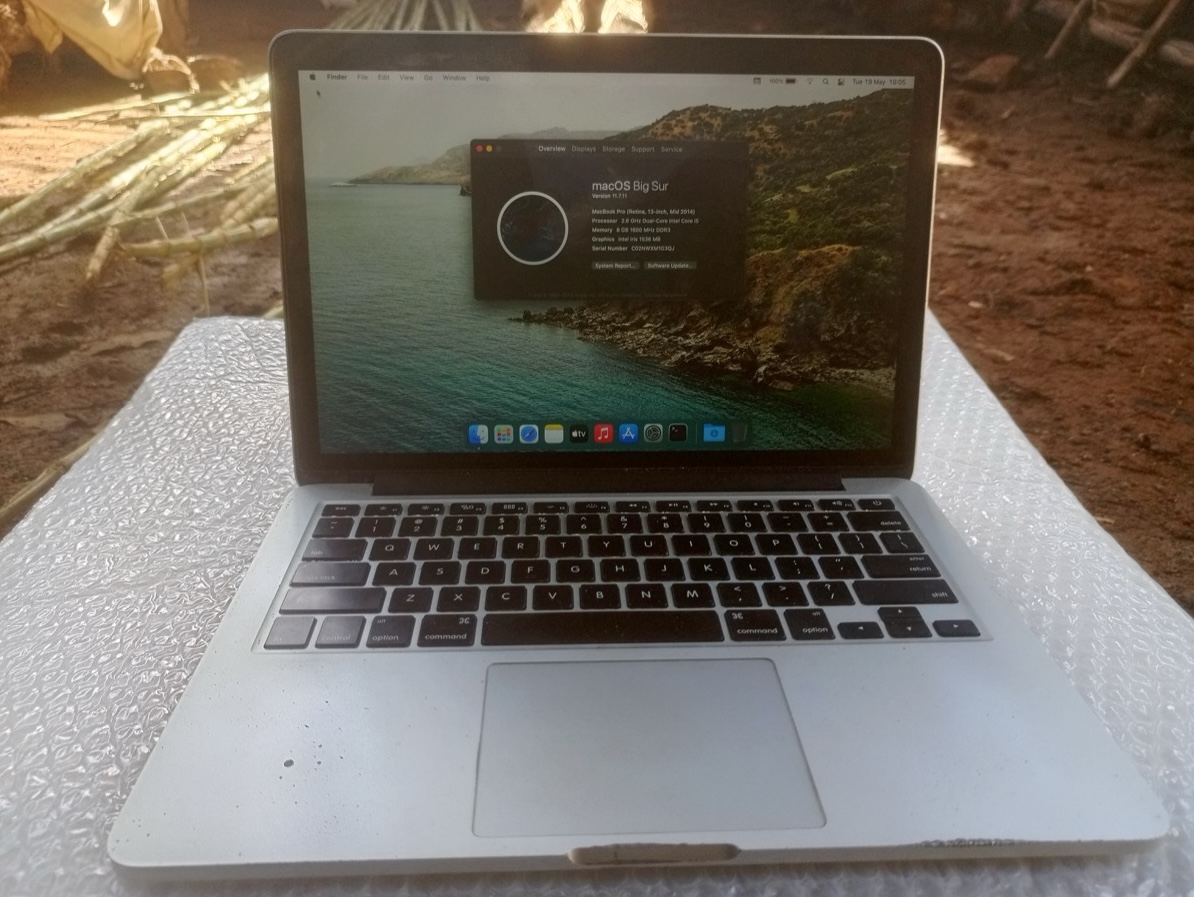
The MacBook had survived the entire journey.
I switched it on briefly, and that was actually the moment when the hardware shop owner himself suddenly became excited. Until then, he had apparently not known what kind of item he had been storing on his shelf. Seeing the Apple logo appear on the screen, he immediately smiled and said something along the lines of, “Ah… a MacBook is a MacBook. Apple is still Apple.”
At that moment, after all the stress, uncertainty, travelling, delays, calls, negotiations, and confusion, the atmosphere completely changed.
We shook hands, laughed, and genuinely celebrated the fact that the laptop had finally arrived safely.
Interestingly, even after I had physically received the laptop, the electronic tracking system still had not properly updated to show that the shipment had been delivered.
– Django
Mission accomplished
On his way home, Django sent me this email:
Dear Lex,
I am very happy to let you know that I have finally received the shipment safely. I turned it on, and everything appears to be working properly.
At the moment, I am still on my way back home and not yet fully settled, but I wanted to send this message immediately to let you know that it has safely reached me.
Honestly, after finally receiving it, I felt that all the trouble and effort were worth it. Earlier, we had talked about how expensive the whole process seemed and how it might have been easier to buy something locally instead. But once I held it in my hands, even the person helping me and I both reached the same conclusion: an Apple is still an Apple.
This is my first Apple device in my life, and now I truly understand why people speak so highly about it.
Thank you very much again, Lex. I truly appreciate your kindness, patience, and support throughout this journey.
Kind regards,
Django
Finally, on May 13th, after ~36,000 km across 12 countries over 42 days, the laptop had arrived.
🔥 **What’s your take?**
Share your thoughts in the comments below!
#️⃣ **#Shipping #Laptop #Refugee #Camp #Uganda**
🕒 **Posted on**: 1779490029
🌟 **Want more?** Click here for more info! 🌟
