

💥 Explore this trending post from Hacker News 📖
📂 **Category**:
📌 **What You’ll Learn**:
“We cannot reason ourselves out of our basic irrationality. All we can do is to learn the art of being irrational in a reasonable way.”
— Aldous Huxley, Island
It was cold out, but none of us were cold.
I sat with five men in the mountains of Montana. As the sun set, the fire in the center cast dancing light on our faces. Reclined against fallen trees in a tight circle, we ate mushrooms and fish we’d found under trees and along streams. The whole crew burst into laughter yet again, and one of the guides passed around a fresh batch of pine needle tea.
Bathed in warmth, I took off a layer and glanced skyward through an opening in the trees. The stars shone like crystals on black velvet, and the show—the biggest meteor shower of the year—was starting.
In that moment, there was nothing to do. Nothing to improve. Nothing to fix.
It was perfect.
***
The older I get, the more I think that self-help can be a trap. Sometimes the cure is worse than the disease. I say this after ~20 years of writing self-help and a lifetime of consuming it.
Spend enough time in the world of “improvement,” and you’ll notice something strange: The people most obsessed with self-help are often the least helped by it. Behind the smiles and motivational quotes, behind closed doors and after a drink or two, the truth is that they’re not able to outsmart their worries.
On one hand, perhaps this unhappiness is precisely what lands one in self-development in the first place, right? I long assumed this about myself, and it’s partially true.
On the other hand, what if self-help itself is actually creating or amplifying unhappiness?
Modern self-help contains an in-built flaw:
To continually improve yourself, you must continually locate the ways you are broken.
Fortunately, there are a few perspective shifts that make all the difference. It took me embarrassingly long to figure them out.
To get started, let’s take a fresh look at an old concept.
MASLOW’S HIERARCHY OF NEEDS?
“I suppose it is tempting, if the only tool you have is a hammer, to treat everything as if it were a nail.”
― Abraham Maslow
Maslow’s Hierarchy of Needs has captured the minds of hundreds of millions. It offers simplicity in a terrifyingly complex world.
Abraham Maslow’s “A Theory of Human Motivation” (1943) contains five levels, which are typically presented like the below pyramid. This one is pulled from the Wikipedia entry on the subject:
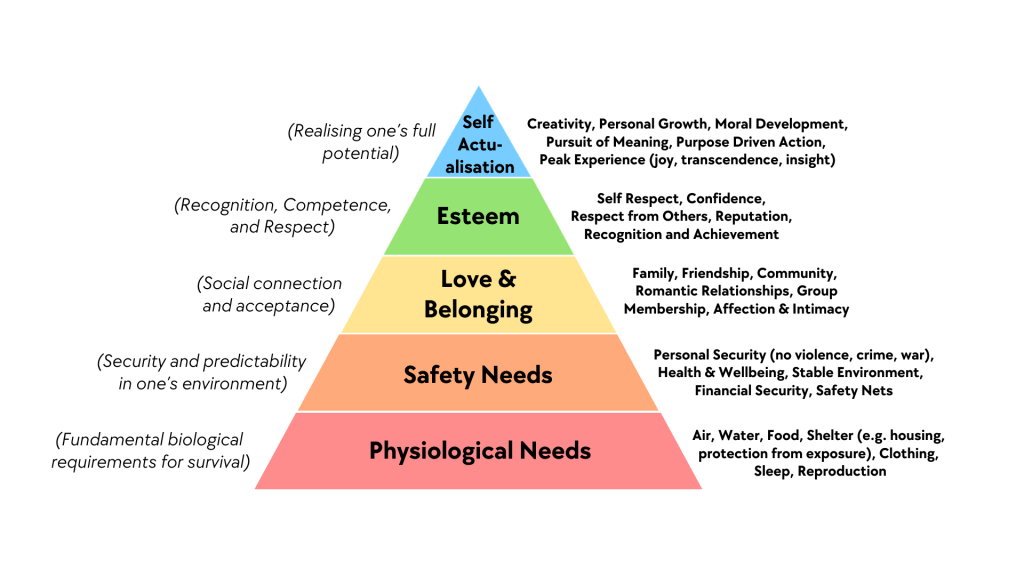
We’ve all seen it. Clear as day, you can see the goal post at the top: self-actualization.
LFG! It’s time to journal and 80/20 myself! Pass me a shaman and some modafinil.
That’s the mission. That’s the point.
Right?
But hold on. A critical footnote got lost in the shuffle. In his later writings, especially notes compiled in The Farther Reaches of Human Nature (1971), Maslow added a sixth level above self-actualization:
Self-transcendence.
That update never quite made it out of the crib. The consultants are to blame, but that comes later.
Self-transcendence means going beyond the self—seeking connection with something greater, such as service to others, nature, art, or the divine. Why is it important? Well, for one thing, as Tony Robbins put it at an event long ago: “‘I, I, I, me, me, me’ gets to be a really fucking boring song.”
But it’s not just a boring song; it’s dangerous to your health.
DON’T BE A SOMO
“The man who renounces himself, comes to himself.”
— Ralph Waldo Emerson
Self-help is dangerous precisely because it easily becomes self-fixation.
A focus on improving the self usually first requires finding problems with the self. This is quite the pickle. In a society that rewards problem-solving, you can end up hallucinating or exaggerating unease in order to fix it. This leaves you always in the red, always one step behind. Imagine a dog chasing its tail that has committed to being unhappy until it catches the tail… but it’s always just a few inches short. Still, it whirls around and around, “doing the work.” Perfection always recedes by one more book, one more seminar, one more habit tracker.
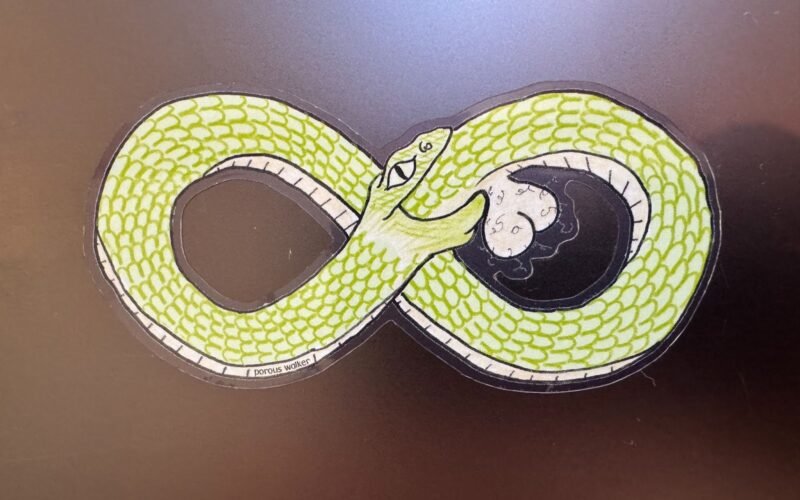
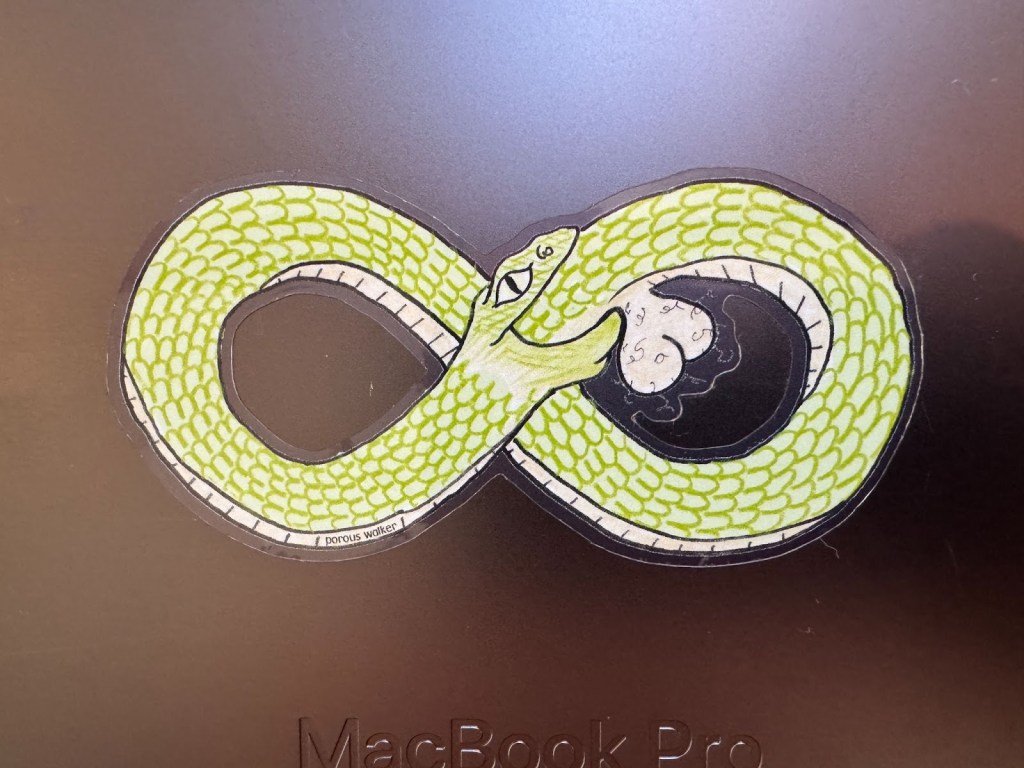
Put in more colorful terms, misdirected self-help turns you into a self-obsessed masturbatory ouroboros (SOMO).
To remind me of the SOMO risk, I have this sticker on my laptop:
Now, to be clear, I still love self-help. Ain’t no way Timmy can give up the sauce. There’s a place for it.
From The Bible to Seneca, and from Ben Franklin to Stephen Covey and far beyond, there’s a lot of valuable advice worth taking. I used to mainline it all—no time to waste!—and jump straight into action. This did some good, but there was a lot of collateral damage.
Why?
Because there are at least three “tectonic plates of self-help” that I couldn’t see for decades, and they dictate how much net-positive or net-negative comes from all the striving. Before you sprint, you want to calibrate your direction.
THE THREE TECTONIC PLATES OF SELF-HELP
“As to methods there may be a million and then some, but principles are few. The man who grasps principles can successfully select his own methods. The man who tries methods, ignoring principles, is sure to have trouble.”
— Harrington Emerson
In the last few years, my life has become much more of a joy than a grind, and that’s because I’ve focused on three tectonic plates.
Let’s take a close look at each.
1. Intention
Individual or Social?
Americans, in particular, worship at the altar of the rugged individualist. There are clear upsides to this. But steeped in a culture—offline and especially online—that puts the self on a pedestal; we can take self-improvement to be an end unto itself: a better self.
But is it an end unto itself? Does it automatically produce good things? I now have my doubts.
Here’s one analogy I’ve drawn for myself.
Let’s pretend that life is the game of soccer. You can work on the mechanics of soccer by yourself. You can always get better at dribbling, shooting, and running drills as a solo practitioner. You can read dozens of books, study tape, and earn a PhD in the physics of ball flight. You can post videos of stunning shots on YouTube and get showered by emojis.
But none of this is actually playing the game of soccer.
You can spend your whole life preparing for, instead of playing, the game of life.
But why would anyone, including yours truly, succumb to this?
Subconsciously, it spares you from the messiest but most rewarding game of all: human interaction. Perhaps people hurt or traumatized you long ago. You might also justify the endless polishing, as I did, with some version of “Once I’ve perfected myself, then I’ll be ready for relationships.” But here’s the rub: that practice is exactly endless. You can always get better at dribbling and penalty kicks.
Digging further, focusing on improving the self is often in service of trying to control the world, especially if things were unpredictable or unstable when growing up. Banish emotion, live by spreadsheets, and all can be well. All can be controlled, or so the illusion goes. But as soon as you’re interacting with—let alone depending on—other people, control as a construct goes out the window. And so we consciously or subconsciously avoid the messiness. This is also one of the reasons why a lot of optimizing achiever folks have a hard time in intimate relationships.
So how do I think about “self-help” now, having realized all of the above?
It is refreshingly simple: the goal is to build and improve my relationships. The sooner you get on the real field with real players, the sooner you can get to playing soccer and engaging with life. No more auto-fellating, even with the best of intentions. We’ve evolved over millions of years to be deeply social creatures, and the more you dodge that IN REAL PHYSICAL LIFE, the more you will suffer. This is why solitary confinement in prisons is often considered cruel and unusual punishment… and yet we do it to ourselves all the time.
There are a few questions that help corral this tectonic plate of intention:
- How does any given “self-help” help me in my relationships, and how can I apply it with other people today or this week?
- How can I take the ship out of the harbor and test it where it counts?
2. Audience
Do you have an audience for your self-development? If so, be careful.
Nary a minute can be spent on social media without bumping into a CAPS-rich “HOW X CHANGED MY LIFE” or a photo carousel of an ayahuasca retreat. If only Costa Rica got a dime for every bikini-clad healer under a waterfall!
Welcome to the theater of performative self-help. I won’t belabor this, as we’ve all seen it, but I suggest reading about the insidious creep of audience capture here, and don’t forge ahead in the fame game before reading 11 reasons not to become famous. It’s hard to put the genie back in the bottle, so you should know what that genie will do to your life.
But the truth is that most of us aren’t extreme examples of this. But even minor tendencies in this direction can do extreme damage over time.
Below are a few questions that I’ve found helpful for nudging this particular tectonic plate in the right direction:
- If you couldn’t tell a soul about “the work” you’re doing, would you still do it? If not, you’re not developing yourself; you’re curating yourself.
- How has sharing your personal development created tradeoffs?
- If you had to take down 20% of your most popular posts, which would you take down and why?
- Are you describing strong catalysts (psychedelics, The Hoffman Process, you name it) instead of doing the post-session integration that makes them truly valuable?
- Have you become more robust or more fragile by offering your inner workings up to public vote?
- Has your social presence made you more or less of the person you want to be? How would the you of three or five years ago feel about your last year of posts? What about the you of 10 years from now?
3. Assumption
What are the fundamental assumptions behind your doing “the work”?
Let’s begin with a Buddhist parable that I first heard from the incredible Jack Kornfield.
The old Master points to a big boulder and asks a disciple, “See that large rock over there?”
“Yes,” says the disciple.
“Do you think it’s heavy?” continues the Master.
“Yes, it’s very heavy!” replies the student.
“Only if you pick it up,” smiles the Master.
Once again, the fundamental assumption behind self-help is often this: Something is not OK. Something is wrong. Something is not enough. Something needs fixing. If I can’t find it, I’ll create it.
We’ve established this. But there is a follow-on assumption that matters a lot.
If I fix the things that aren’t OK, all will be well. If I improve myself enough, if I only work hard enough, I can finally eliminate my suffering.
I hate to inform you, but this doesn’t work. I’m also thrilled to inform you that this doesn’t work. You can stop picking up a lot of boulders.
There is one book that most opened my eyes to this reframe – Already Free: Buddhism Meets Psychotherapy on the Path of Liberation by Bruce Tift. It offers a terrifying but ultimately liberating realization: there is no perfect escape from suffering. It doesn’t exist. But there is a way to find your long-sought unclenching, and it lies in cultivating your skill of acceptance as much as that of improvement.
Now, I can hear the chorus: Has Tim gone soft? Given up the good fight? Is he telling everyone to chill after he himself red-lined and got the spoils? How convenient! And…
Hold on a second. I’m telling you—intelligent acceptance is high-leverage. It’s probably one of the highest forms of leverage. This is an approach that helps preserve your energy for where it really matters. My early forays into Stoicism and Seneca The Younger helped set the conditions for my biggest wins from 2004–2010. Still, I only learned a small fraction of what I needed.
So how do you cultivate your skill of acceptance without becoming complacent?
This is a big question and what I love about Bruce’s book. Compared to a strictly Western or purely Eastern book, he blends them and offers a surgical guide to using both action and acceptance. You don’t have to be a bull in a china shop or a cow in the rain; there is a middle path. That middle path is where all the gold is buried.
If the only tool you have is “self-improvement,” you’ll become a hammer looking for nails in a world that is 50% screws. I tried it. It can create the veneer of success, but it will leave your inner world in turmoil.
Suffice to say, the dual dance is the most joyful. Upgrade your toolkit with that in mind. Read Bruce’s book. If it doesn’t click, try Radical Acceptance: Embracing Your Life with the Heart of a Buddha by Tara Brach, which had a large impact on my life a decade before I found Bruce’s book. In a sense, the writing of Seneca prepared me for Tara, which then prepared me for Bruce. So grab them all and thank me later.
If you want serenity, you need to be able to put the Serenity Prayer into practice. Seriously, I read it all the time.
MASLOW’S HAMBURGER OF NEEDS?
“The more one forgets himself—by giving himself to a cause to serve or another person to love—the more human he is and the more he actualizes himself. What is called ‘self-actualization’ is not an attainable aim at all, for the simple reason that the more one would strive for it, the more he would miss it. In other words, self-actualization is possible only as a side-effect of self-transcendence.”
― Viktor E. Frankl
How can we easily keep ourselves on the right track?
As I remind myself these days: It’s the relationships, stupid.
For a nice simple visual, let’s revise Maslow’s pyramid with all of this in mind. This is easy, as Maslow never drew his model as a rigid pyramid!
He described “classes” of needs that were unfixed, overlapping, and that could reverse in order. And believe it or not, self-actualization was only ever for the “self-actualizing minority.” In the 1960s, his work was co-opted by consultants and corporate trainers who needed a progression to sell. True story.
Given all this, and after decades of trial and error, here’s where I’ve landed:
Maslow’s Hamburger of Needs.
Ahhh… what? Not to worry. It’s the same good ol’ Maslow ingredients, but I think of it as a hamburger:
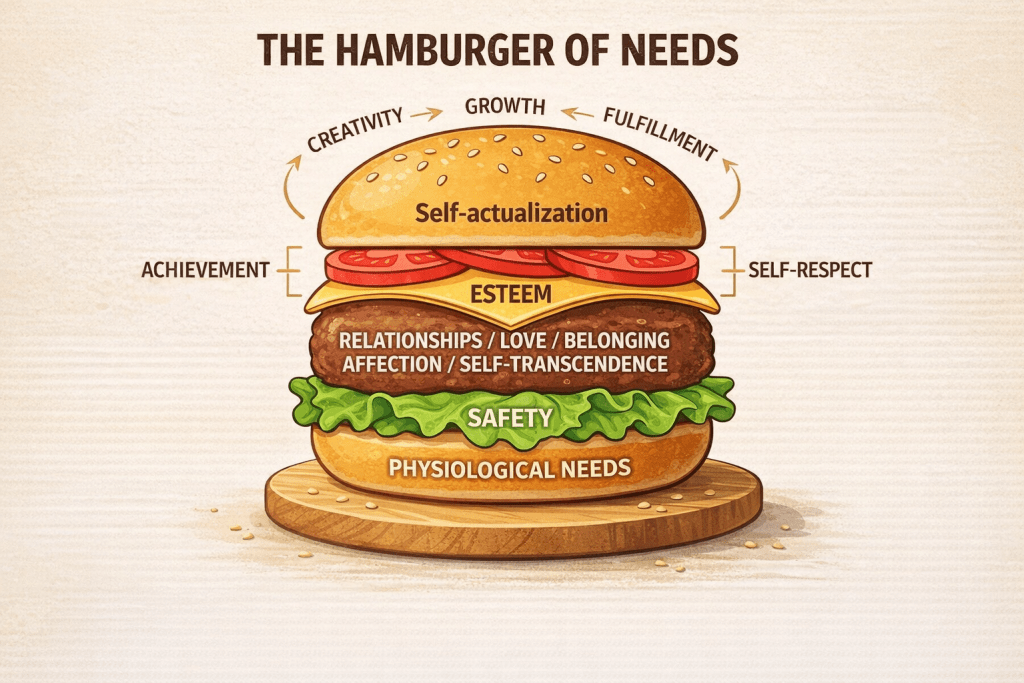
For our purposes, the meat, the whole point of the hamburger, is that middle layer: relationships. That is the center of life. The heartbeat.
As luck would have it, when you improve the heartbeat, it also feeds everything else.
You’ll notice that the meat contains Abe’s most-important addendum—the sixth level of self-transcendence. Focusing on things bigger than yourself is a critical piece of the ultimate puzzle. Faith, nature, family, meditation, causes that outlive you, etc.—take your pick. But be careful. If you do it to inflate the ego or impress others, it’s self-obsession again, not self-transcendence. If you need credit, it doesn’t count.
Of course, it should go without saying, but the top and bottom layers matter a lot. A hamburger is a giant mess without the bun. Friends will get sick of you crashing on their couch and eating their food.
But the bread and dressing layers exist to serve the middle. That’s the payload. Everything is in service of the payload. And the payload circulates benefits back to the edges, and then the cycle repeats. Even if you think this is oversimplified claptrap, temporarily assuming it’s true will help you.
What if nearly everything you focused on—calendar, habits, goals—aimed to improve your relational life somehow? What if you took this as a challenge for even a week? Your lens on the world changes dramatically.
You say yes differently.
You say no more clearly.
Your to-do list for life slowly transforms.
What if all that you focused on, all that you do, had to improve that middle layer in some fashion?
It’s a damn hard question if you’ve been on the self-help train for a while. I get it.
So let’s try something easier: What if it only changed how you approach your to-do list? Try hamburger-first each day for 1–2 weeks and tell me what happens. Add and do the things that improve your relational life FIRST. Nothing on the list? Create something. It could be as simple as cooking dinner for your spouse, complimenting at least three people a day for a week, or introducing yourself to the barista you see every morning. Getting started is how you get grooving.
ARE YOU DOING SELF-HELP, OR IS SELF-HELP DOING YOU?
For friendship makes prosperity more shining and lessens adversity by dividing and sharing it.
— Marcus Tullius Cicero
In his Moral Letters to Lucilius, Seneca the Younger famously wrote that “These individuals [who put money at the center of life] have riches just as we say that we ‘have a fever,’ when really the fever has us.”
What if self-help is similar?
Obsessing over the self never provides peace. It cannot make you whole, as you aren’t the whole. Becoming whole starts by putting down the rock you didn’t even know you were carrying.
Because at the end of the day—and at the end of a Montana night—the point was never yourself.
It was never the pyramid.
It was never the optimization.
It was the people around the fire.
💬 **What’s your take?**
Share your thoughts in the comments below!
#️⃣ **#SelfHelp #Trap #Years #Optimizing #Taught**
🕒 **Posted on**: 1772697047
🌟 **Want more?** Click here for more info! 🌟
