


🚀 Check out this trending post from Hacker News 📖
📂 **Category**:
📌 **What You’ll Learn**:
Scientists have been documenting the presence of microplastics in our oceans and soils, in air, drinking water, and food for more than a decade. More recently, peer-reviewed studies have revealed the presence of microplastics in the human body. But how much plastic do we consume, where is it coming from, and what is it doing to us?
Cassandra Rauert, an environmental chemist at the University of Queensland, in Australia, conducts research to better understand the impacts of such exposures. Her work has shown that current techniques used for detecting plastic in humans are vulnerable to contamination from lab equipment. And last year, she published an attention-grabbing paper that found lipids present in blood can give false positives for the most commonly produced plastic, polyethylene. All of which suggests that some reported levels of microplastics in humans may be overestimated.
In an interview with Yale Environment 360, Rauert describes how, after learning about the potential for microplastics to infiltrate a lab — whether from construction materials, equipment, clothing, or the air — she and her fellow researchers painstakingly rebuilt their workspace, using glass and steel, to drastically reduce the odds of contamination. The hope is that once researchers can accurately measure levels of microplastics in human tissue and blood, they’ll be able to determine what exactly plastic pollution is doing to us.
“I don’t think we’ve got really good evidence at all for what effects [microplastics] might be having,” Rauert says. And the much-hyped finding that we eat a credit card’s worth of plastic each week? “That has absolutely been debunked.”

Cassandra Rauert.
Courtesy of Cassandra Rauert
Yale Environment 360: Why is it so hard to study microplastics in the human body?
Cassandra Rauert: It’s quite a new field. And we’re trying to use analytical techniques that were developed for other purposes.
A few years ago, when we first started thinking about human exposure to plastics, we were like, “Oh, we should test some blood and just see what’s in there.” I tested a little bit of my blood and saw screamingly high levels of polyethylene. It just didn’t make sense. When I think about my diet, I’m not eating a lot of plastic-packaged foods. So that’s when we first started to think, “Okay, is there something else going on here with the analysis that we haven’t considered before?”
We assessed how reliable current measures are for trying to find microplastics in blood. And what we found is that lipids and fats will give you a false positive for polyethylene. Lipids are made up of the same building blocks as polyethylene, so when we analyze them, they look identical in our analysis instrument. This means that we can mistake a signal from a lipid for polyethylene if we don’t look at the data carefully.
e360: In a paper you published last year you found that 18 previous studies on microplastics in human blood had this issue.
Rauert: We were putting [the study] out there to say that you need to think about the data that’s coming out of your instrument, because there’s potential that these lipids, these fats, will give you a false positive. To our knowledge, these previous studies didn’t know about this issue and haven’t considered it, and future studies really should.
e360: Another challenge, you found, is that plastic is absolutely everywhere, including in lab equipment.
Rauert: In a normal chemistry lab, you’re surrounded by plastics. You have plastic pipettes. You have plastic Petri dishes. Plastics are quite necessary. They can be sterile. They’re single use. They have their purpose, but it means that you’ve got the potential for a lot of plastics to be shedding and to be in the lab around you.
“If your sample has touched plastic — for instance, a urine sample stored in plastic — there’s a potential for contamination.”
We’re talking about very small particles and fibers. You can’t see them — that’s how small — and they’re always in the air around us. If you’re not conscious of this, these small particles and fibers can be accidentally falling into your sample. Or if your sample has touched plastic — for instance, a urine sample that’s stored in plastic — there’s a potential for some of the plastic to come off, which can contaminate your sample.
e360: You overhauled your lab to get rid of plastic contamination. What was involved?
Rauert: We worked with an architect, and we built the lab pretty much from scratch. The first thing we had to work out is what to build the lab out of. We tested about 30 different construction materials trying to find some that didn’t contain plastics, but also didn’t contain plastic [additives] such as phthalates, but we couldn’t find any. Everything had either plastics or phthalates in them.
We can’t have any wood or cardboard in the lab. It can get mold. It can get bacteria. So we ended up going with stainless steel. It was the only way to not have any plastics. Even when you put a glass panel in the window, you have silicon holding the glass in. We tested all these different brands of silicon to try to find ones that had low levels of phthalates. It was a crazy amount of detail that we went to, but it was really worth it.
We ended up with three interconnected rooms, and they’re all positive pressure. The idea is that when you open the door, it pushes contamination out rather than bringing it in with you. And then when we commissioned the lab, the first thing we did was put background samplers in there to see what was in the air. In the lab, the plastics and the phthalates are about a hundred times lower than in our normal lab.
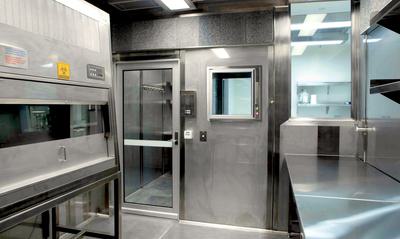
The plastics-free lab Cassandra Rauert and colleagues designed at the University of Queensland.
The University of Queensland
e360: Is it a little bit disturbing to consider that plastics are so ubiquitous that you have to build a clean room from the ground up just to be able to study them?
Rauert: It’s definitely made me think about my house a lot and all of the plastic consumer products that I have, and all the plastic stuff I have in my kitchen, which I have now been exchanging for metal and wood. You really don’t realize how much plastics you use in your everyday life until you start purposely looking for it. It’s just a given. You just grow up with it.
e360: As far as we know, how does plastic typically enter our bodies?
Rauert: We do know that, in terms of what’s in the air around us, we have higher concentrations inside our houses. We know a lot of these [plastic additives] end up in the dust in your house, so absolutely vacuuming more often is a great way to get rid of these.
e360: And what are the biggest sources of plastic in your home?
Rauert: We’ve been looking at residential balconies, and we’re seeing high concentrations of [particles from] tires [which are made with synthetic polymers]. There’s a potential for tire [particles] to be getting into your house dust. We still don’t have huge amounts of information on that.
“If we are inhaling [plastic] fibers, do we just cough them up again, or can they actually get deeper into our lungs?”
In terms of what you’re breathing in, it’s probably going to be mostly from synthetic fibers. If you’re using your dryer a lot, and you’re putting your polyester or your nylon products in the dryer, you’re shedding a lot of fibers. We recommend not using your dryer for those materials. See if you can hang them up.
But the biggest sources around your house are probably going to be what you’re preparing your food with. If you’re using a plastic chopping board, small pieces of plastic are being cut out of that and landing in your food. Using plastic kitchen utensils is probably not a good idea. I would change those over to bamboo or wood or metal. Heating your food in a plastic container will shed more of those plastics as well.
e360: Do we really eat a credit card’s worth of plastic each week?
Rauert: That has absolutely been debunked. We’ve been looking at what sheds from plastic food containers under different conditions, and they do shed plastics, and we can measure it, but it’s absolutely not that much plastic.
e360: What are some of the outstanding questions for researchers?
Rauert: I think the first thing is we don’t actually know what we’re exposed to. What plastic food containers actually shed plastics, and what do they look like? What size are they? We know that when we’re doing a load of washing, it releases fibers. Using your dryer will release synthetic fibers. But if we are inhaling those fibers, do we just cough them up again, or can they actually get deeper into our lungs?
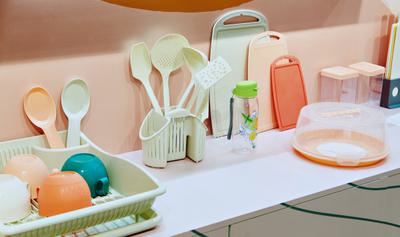
Plastic kitchen tools are a source of microplastic contamination.
Sergey Ryzhov / Alamy
e360: And while we know a lot about the impact of chemicals added to plastic — such as phthalates, which have been shown to impact fertility, or bisphenols, which have been linked to Type 2 diabetes — we know very little about what effect the plastic particles themselves might be having.
Rauert: Yeah, we do know that we are exposed to a lot of plastic [additives]. And we know that they’re endocrine disruptors. We’ve been monitoring them and analyzing them for decades.
I don’t think we’ve got really good evidence at all for what effects [microplastics particles on their own] might be having on human bodies. If we’re eating plastics, what size and what type of plastic can actually get into the bloodstream?
The majority of plastic [particles] that we know we are exposed to are too big to cross from our gut into the bloodstream — only very small particles can do this — therefore, we excrete them out. This mechanism hasn’t been studied in detail, but analysis of stool samples has shown a wide variety of plastic particles in them.
“In terms of pollution, plastic is horrendous, and it just keeps building up because we just keep producing new plastics.”
We still have very little knowledge of the smallest-sized plastics though, so we don’t know how many of these are excreted or how many can cross the barriers in our body. And I think we need to understand that a bit more so that we can then direct toxicology studies as well.
Also, a lot of the toxicology studies, especially in the past, have tended to use [lab-grade] polystyrene spheres as their representative microplastic particle. That’s the only standard that has been available to use in a toxicology study. But we’re not exposed to perfect spheres of polystyrene. If it’s going to be polystyrene, it’s going to be a fragment or a shard. So it’s not really representative.
e360: It has long been a tactic of corporations to resist regulation by saying not enough is known about their products’ health impacts. Do you see that happening here?
Rauert: Well, we do know that in terms of pollution, plastic is horrendous, and it just keeps building up because we just keep producing new plastics. We need to stop using so much plastic and so much single-use plastic.
I know it is easy to say we don’t have enough information yet, but we do know about [the health risks from] these chemicals that are in all the plastics that your food is wrapped in. From that perspective, it is still a good idea to reduce plastics or eliminate them where possible.
🔥 **What’s your take?**
Share your thoughts in the comments below!
#️⃣ **#Microplastics**
🕒 **Posted on**: 1783542610
🌟 **Want more?** Click here for more info! 🌟
