

🚀 Check out this awesome post from Business News 📖
📂 Category:
✅ Key idea:
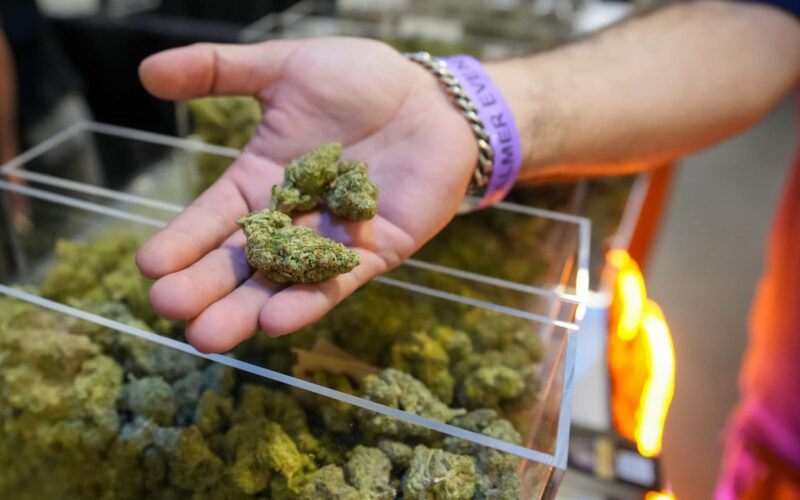
Tariq Adeh, of Tampa, Florida, looks at hemp flower from wholesaler Dep Kings at the Champs trade show at Palmer Events Center, on September 11, 2025.
Jay Janar | Hearst Newspapers | Getty Images
President Donald Trump is expected to sign an executive order this week that will broadly expand access to cannabis. Industry advocates, executives and researchers who spoke to CNBC said the changes would have major impacts on consumers and the health care industry.
Trump said Monday that he is “strongly” considering issuing an executive order that would reclassify marijuana as a Schedule III drug under the U.S. Drug Enforcement Agency, which would place cannabis alongside Tylenol with codeine, rather than Schedule I with the likes of heroin and LSD, as it is now classified. The order would also authorize a pilot program allowing Medicare to cover cannabis products for seniors.
The proposal is expected to apply specifically to cannabidiol products, known as CBD, which are intended to treat chronic pain, sleep deprivation, and other age-related ailments, said Shawn Hauser, a partner at the cannabis-focused law firm.
CBD has soared in popularity in recent years, moving into the mainstream via canned cocktails and body lotions, but it has yet to get full support from federal drug regulators.
“I expect the executive order will clarify what type of cannabis is covered, and that it must come from a federally legal source,” Hauser told CNBC.
While many in the cannabis industry view the shift to Schedule III as a done deal, the inclusion of the controversial Medicare provision adds an additional issue that could see cannabis-derived products integrated into the U.S. health care system, despite limited clinical evidence of their effectiveness, some experts told CNBC.
Insiders like Hauser expect the final order to outline legal cannabinoids, administrative methods, and a framework for FDA oversight.
“A lot of people want to see a reclassification, because it leads to massive amounts of research that can’t be done unless the reclassification is done,” Trump told reporters on Monday. “So we’re looking at that very aggressively.”
The rescheduling and Medicare coverage will likely lead to new investments from institutional capital and investors who typically follow federal insurance coverage for big drug companies, said Timothy Seymour, founder and chief investment officer of Seymour Asset Management and a CNBC contributor.
“Valuing the sector will be much more valuable because institutional investors will be allowed in, they will have access and liquidity, and they will be traded by exchanges,” Seymour told CNBC. “This could immediately double or triple this sector.”
The push for reclassification comes as a 2024 report found that more Americans reported daily, or near-daily, marijuana use than reported drinking alcohol with the same frequency. This was the first time the share of daily use had flipped in favor of marijuana, based on an analysis of 40 years of data from Carnegie Mellon University.
A friend organizes and inventoryes marijuana flower at The Health Center, a medical cannabis and recreational marijuana dispensary in Denver.
Vince Chandler | Denver Post | Getty Images
Medicare disputes
The Medicare initiative is backed by billionaire Howard Kessler, the financier and longtime Trump ally who founded Project Commonwealth in 2019. The organization says it advocates for the care of older adults, including through the use of cannabis.
Kessler and advocates like Hauser have urged the administration to move past typical FDA hurdles — such as years-long clinical trials — and use a pilot program to collect real-world data on the safety and outcomes of cannabis use in older adults.
Kessler did not respond to a request for comment. The White House also did not respond to a request for comment.
In September, shares of cannabis companies rose on optimism that Trump would soon weigh in after he shared a video of Project Commonwealth on Truth Social that called CBD coverage “the most important high-profile health initiative of the century.”
However, the Medicare proposal has drawn scrutiny, even from other Trump allies.
House Speaker Mike Johnson, R-La., has raised concerns about the cost and liability of such a program, the Washington Post first reported, while FDA officials claim that compensating Americans for treatments not approved by the agency would be unprecedented.
Politics aside, the scientific case for medical cannabis remains controversial.
Research transformations
The US Food and Drug Administration (FDA) has so far only approved the CBD-based drug Epidiolex to treat rare forms of epilepsy. This narrow approval reflects the caution of regulators and the fact that high-quality clinical trials are still limited relative to most other conditions in which cannabis is promoted.
Critics warn that the Medicare pilot could endanger seniors, a demographic that often takes multiple daily medications. A recent FDA-funded study suggested that prolonged use of CBD may cause liver toxicity and interfere with other life-saving medications.
“It’s not based on science at all,” said Meg Haney, director of Columbia University’s Cannabis Research Laboratory. “It’s all based on money, and that’s terrible. That’s not how we make medical decisions.” “[Kessler]”Who is a friend of the president…could make a lot of money selling something that has no evidence behind it.”
Other research has cast doubt on the efficacy of cannabis altogether, Haney said, suggesting it may not be effective in many of the conditions targeted by the proposed pilot program.
For example, a 2023 review of 134 studies that included adults aged 50 or older found that medical cannabis had inconsistent results for improving conditions such as end-stage cancer and dementia. The review also found more frequent links to harms including depression, anxiety, cognitive impairment and injury.
However, rescheduling cannabis would ease barriers to clinical trials that experts say have historically stifled scientific research.
“Medical research has been under lock and key,” said Ryan Fandrey, a Johns Hopkins University professor who helps run the Cannabis Science Laboratory. “Schedule I makes large placebo-controlled trials very difficult. Without this data, decision makers are asked to make decisions in the dark.”
Investment potential
For investors, the specific terms of the rescheduling are crucial.
The rescheduling would improve farmers’ access to banking and financial services because it would lift some IRS tax restrictions, which prevent cannabis businesses from deducting standard expenses.
The economic backdrop has already begun to change: the annual value of hemp production in the United States jumped 40% last year compared to the previous year, according to the Department of Agriculture. The global market for hemp-derived products is expected to reach $160 billion by 2032, according to Grand View Research.
Rumors about rescheduling and a potential pilot program helped shares of weed producers Tilray Brands and Canopy Growth jump 44% and 52%, respectively, on Friday.
As Seymour described it, Medicare coverage and participation in federal insurance is the “holy grail” that can unleash institutional capital.
A Schedule III designation could also help legitimize the sector for institutional investors who have been reluctant to delve into it, paving the way for more stocks to list on the NYSE and Nasdaq and shifting valuations from retail sentiment to fundamental cash flows.
“The Schedule I designation is what held back a lot of institutional investors,” Seymour said. “Having to go out and tell shareholders … that they own a company that sells something on par with heroin or LSD or cocaine … is a tough pill to swallow.”

Shares of the largest cannabis companies with market capitalization in the United States
Business risks
If cannabis transitions to a copayable drug model or federal legality, this category could attract the interest of major pharmaceutical companies and distribution could eventually move from state-licensed dispensaries to national pharmacy chains such as CVS and Walgreens.
This could spell trouble for small weed companies.
Already, Big Pharma has the financial resources to fund the multi-year, double-blind clinical trials required for FDA-approved drugs – a barrier to entry that only a few existing cannabis operators can overcome.
However, Seymour sees Medicare coverage as a catalyst for M&A activity rather than an immediate death knell.
“You will see more consolidation in this sector,” Seymour said. “Small companies that have good, profitable businesses…are more likely to be seen as targets.”
Meanwhile, Green Thumb Industries CEO Ben Kovler expects more competition between pharmaceutical companies and cannabis companies for medical breakthroughs.
“The pharmaceutical sector has, in the past, been one of the main lobby groups against… [cannabis] “Because it represents a threat. So, yes, it is a huge opportunity for pharmaceutical companies,” Seymour added.
— CNBC’s Brandon Gomez contributed to this report.
🔥 Tell us your thoughts in comments!
#️⃣ #means #seniors #research #stocks
