

✨ Explore this trending post from PBS NewsHour – Politics 📖
📂 **Category**: Donald Trump news,nicolas maduro,oil industry,venezuela
💡 **What You’ll Learn**:
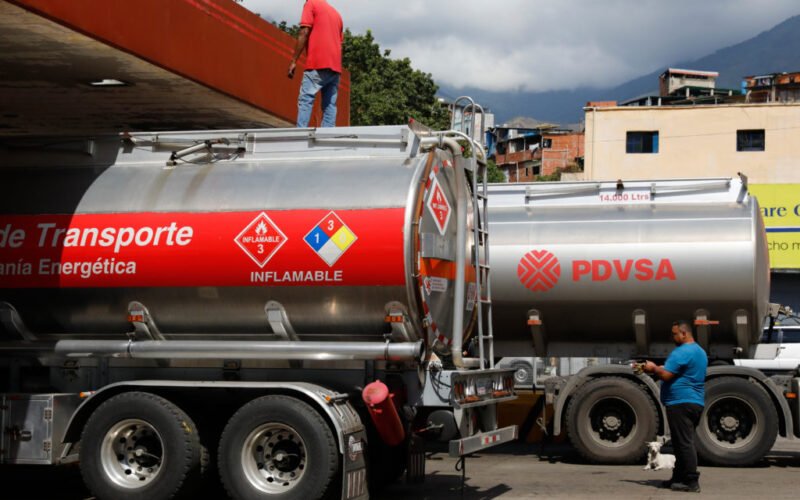
Trump proposed a plan for those companies to return and rebuild the besieged oil industry in Venezuela. It was later announced that Venezuela would provide between 30 and 50 million barrels of oil to the United States, and Venezuela’s state-owned oil company PDVSA said it was in negotiations with the US government to sell the crude oil.
The administration also “selectively” lifted sanctions to enable the shipment and sale of Venezuelan oil to markets around the world, saying the proceeds would be settled in U.S.-controlled accounts and disbursed to the American and Venezuelan people, according to the Energy Department.
These moves may be part of a long-term strategy to gain a foothold in a country with vast oil reserves.
Interest in Venezuela’s massive oil reserves
Venezuela has one of the world’s largest oil reserves, and some energy analysts predict there will not be enough oil to meet global demand in the coming years.
Read more: Cuba, which depends on Venezuelan oil and support, faces an uncertain future after the United States ousted Maduro
The South American country has an estimated 303 billion barrels of crude oil in the ground, representing about 17% of global supplies, according to the US Energy Information Administration. Unlike other parts of the world, where geologists have to search for untapped oil, experts say the reserves beneath Venezuelan soil are largely identified and known. But because of crumbling infrastructure, the country produces only about 1% of the world’s oil.
“Venezuela has enormous reserves,” said Claudio Galimberti, director of global market analysis and chief economist at Rystad Energy. “If you ask any oil company around the world, and you go to their exploration team and their geologists, and you ask them where the oil is going to come from in the 2030s and 2040s, their answer is pretty scary: ‘We don’t know.’ So there’s going to be a problem finding oil in the next few years.”
In the short term, global oil supply exceeds demand, so there is no urgent need to increase production from Venezuela. But the International Energy Agency estimates that under current policies, nearly 25 million barrels per day of new oil supply projects will be needed by 2035 to keep markets balanced.
Potential help for US refiners and consumers
The oil in Venezuela is heavy and sour crude, which is what refineries on the US Gulf Coast make, and there are only a few countries that produce it. In contrast, most of the oil produced in the United States is light, sweet crude. If Venezuelan oil flows freely, it will likely lead to lower oil and gasoline prices.
He watches: White House: The United States will control the Venezuelan oil industry “indefinitely”
Kevin Bock, managing director of ClearView Energy Partners, said U.S. refineries could benefit financially from processing more crude oil, and it could increase the availability of diesel and jet fuel.
Bock said, “There appear to be two goals. The first is to reduce energy prices in general by increasing global supplies, and the second is to produce more heavy, high-sulphur crude, which is currently in short supply compared to other crudes.” “The former generally benefits end users everywhere because lower prices reduce transportation and energy costs.”
However, more Venezuelan crude would not necessarily help U.S. oil producers, because having more oil on the market could depress oil prices, dampen production and make it difficult for those companies to remain profitable.
Options available to major American oil companies
After Chavez nationalized hundreds of private companies and foreign-owned assets in 2007, including oil projects run by ExxonMobil and ConocoPhillips, international arbitration panels ordered Venezuela to repay billions of dollars to both companies, but the debts have yet to be collected.
In theory, if sanctions are lifted and Venezuela comes under new leadership, major oil companies could invest in infrastructure and profit from selling oil.
Trump said he believes Venezuela’s devastated oil industry can be rebuilt in less than 18 months with American support. It is expected that major oil companies will return to Venezuela to make these investments and benefit from its oil industry.
But experts say that given the unrest and decades of severe damage to infrastructure, it is unlikely to top the list of places where oil companies choose to invest.
Read more: Trump’s plan to take over and revitalize Venezuela’s oil industry faces major obstacles, experts say
“Imagine you’re Exxon and you have global operations. Where would you put your money? Where would it give you the biggest return,” Galimberti said.
Companies also need assurances that a future government won’t seize assets again, said Daniel Sternoff, a senior fellow at Columbia University’s Center on Global Energy Policy.
“You have to start with basic political stability before you have companies interested in making this type of investment,” Sternoff said. “We have more questions than answers about what Venezuela’s government will look like.”
A ConocoPhillips spokesman said the company is monitoring developments in Venezuela and their potential impacts on global energy supply and stability. “It would be too early to speculate on any future business activities or investments,” he said.
ExxonMobil did not respond to a request for comment.
Production barriers
The infrastructure and equipment the oil industry needs to maintain and increase production has been severely damaged in recent years.
“There’s been a lot of chaos and looting, and so there’s a tremendous amount of damage to surface oil production equipment across the country,” said Amy Myers Jaffe, director of the Energy, Climate Justice and Sustainability Lab at New York University.
“There are a lot of pipelines that are leaking, it requires extensive cleanup, and there is a lot of physical destruction.”
There are also major fuel shortages and frequent power outages across the country, Jaffe said, “and to really be able to produce oil, you need a stable grid.”
He watches: How are Venezuelans in Caracas reacting to the arrest of Maduro by US forces?
In addition, many workers with technical expertise left the country. Millions of Venezuelans fled as a result of the departure of Chavez and Maduro, and “there was a massive brain drain,” Sternoff said.
Rystad Energy estimates that it will take $54 billion in investments in oil and gas over the next 15 years to keep Venezuela’s oil production steady at about 1.1 million barrels per day, and that with additional investment over two to three years, an additional 300,000 barrels per day could be added. The group said that exceeding 1.4 million barrels per day would require an additional amount ranging between 8 and 9 billion dollars annually.
There is also no precedent where a regime change in a major oil-producing country led to a rapid increase in production, Sternoff said. He added that in most cases, such as Iraq, Iran, Libya and the Soviet Union, oil production declined dramatically, often for years, before returning to previous peak levels.
“One of the lessons learned from Iraq is that businesses did come back, but it was very difficult to operate when there was a difficult political and domestic backdrop that could range from insurgency to governance and corruption issues to infrastructure challenges,” Jaffe said.
A free press is the cornerstone of a healthy democracy.
Support trustworthy journalism and civil dialogue.
💬 **What’s your take?**
Share your thoughts in the comments below!
#️⃣ **#Venezuelas #oil #matter #United #States**
🕒 **Posted on**: 1767906349
🌟 **Want more?** Click here for more info! 🌟
