


✨ Explore this insightful post from Hacker News 📖
📂 **Category**:
✅ **What You’ll Learn**:
Kaeru no Tame ni Kane wa Naru
(カエルの為に鐘は鳴る)
is a Japanese-only Game Boy title published in 1992 by Nintendo
and developed by Intelligent Systems.
The title’s official English translation is “The Frog for Whom the Bell Tolls”.
For brevity, I’ll be using the title “Frog Game” in this article.
After I finished Link’s Awakening, the Frog Game started popping up
everywhere in my digital life. The first occurrence was without my knowledge: some of the
characters in Link’s Awakening, Prince Richard and his frogs,
are originally from the Frog Game and use the same sprites and music.
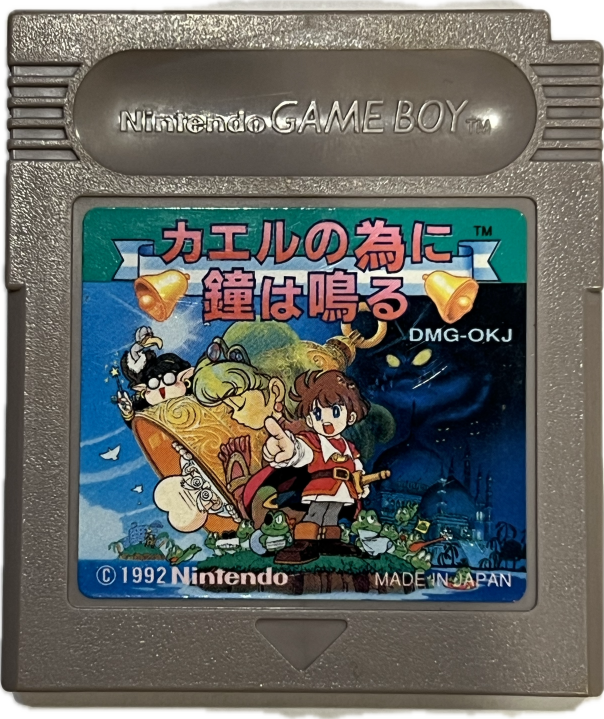
Picture of my “Kaeru no Tame ni Kane wa Naru” Game Boy cartridge.
While researching what game to play after Link’s Awakening I watched a
video by AntDude
detailing the history of hand-held Legend
of Zelda games. The video starts by mentioning “Frog Game”
instead of the actual first Zelda game on the Game Boy: Link’s Awakening.
Very intriguing…
After further research I stumbled across a project by Iván Delgado (Bluesky, YouTube)
to create a colorization patch for “Frog Game” that appears to still be in progress.
I was already a subscriber to Iván’s blog and had previously
read their series of posts about colorizing Game Boy games.
Everything I read about the game made me want to play: the game
was affordable, short (7 hours to beat), with a light and funny narrative, and
had ties to some of my favorite games. I’ve since played Frog Game
and I recommend the game as a quick and fun “pocket-sized”
adventure.
Playing with English translations§
Kaeru no Tame ni Kane wa Naru was never released
outside of Japan and despite multiple re-releases
to the 3DS eShop and now Nintendo Classics,
there is no official English translation.
I can’t read
Japanese, but to experience the dialogue. Luckily for me, there is a fan-created
English translation patch from 2011. I would need the actual game ROM to apply the patch.

Japanese title screen for “Kaeru no Tame ni Kane wa Naru”
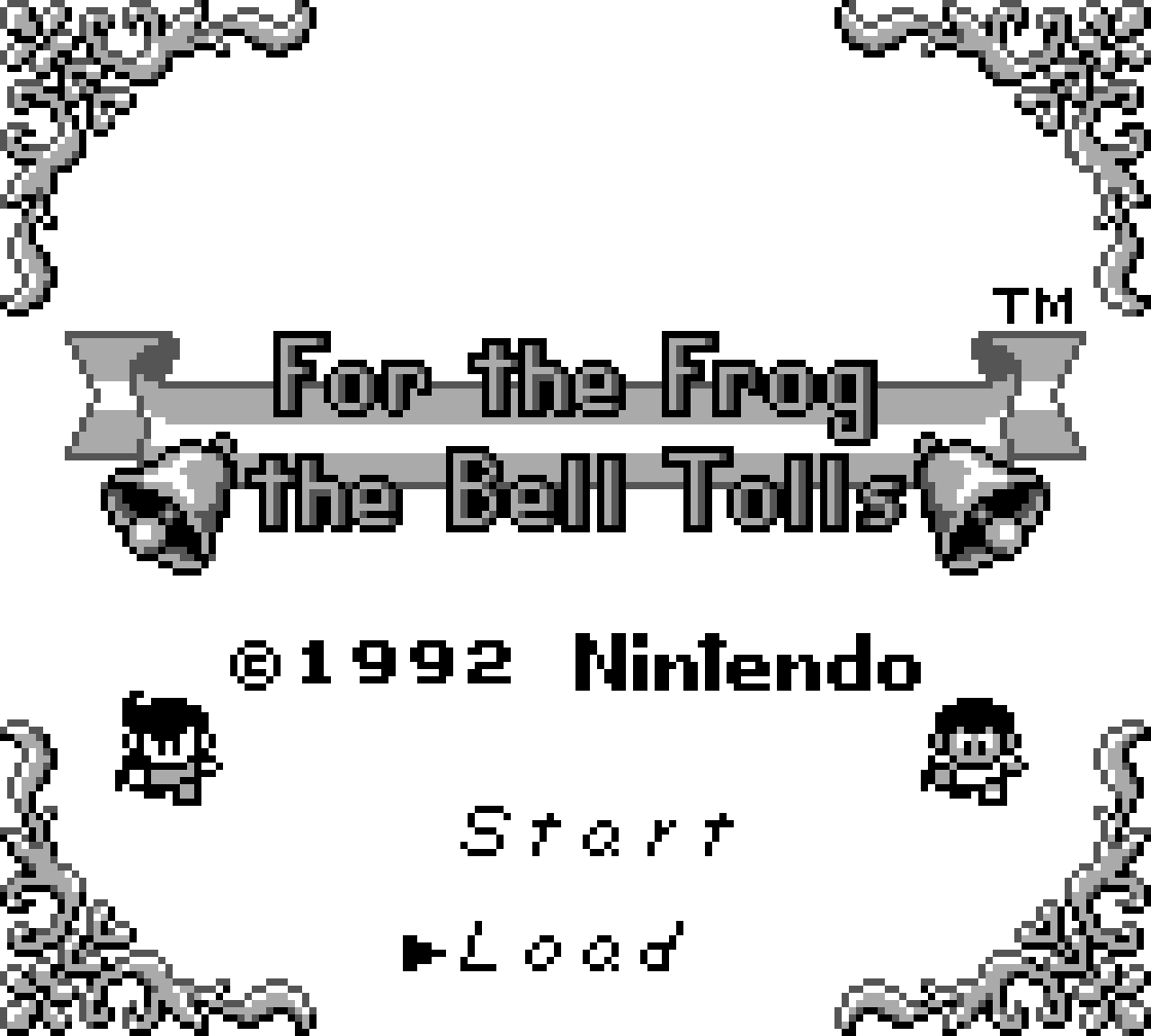
Title screen with the English translation patch applied
I purchased the game cartridge for $10 on eBay and dumped the
ROM using GB Operator. Next I applied the English translation patch (.ips)
using ROM Patcher JS by Marco Bledo.
I loaded the resulting ROM into the Delta Emulator and played exclusively
on this platform (with RetroAchievements enabled).
Beware: There are minor spoilers beyond this point!
References§
While game’s title is a reference to “For Whom the Bell Tolls” by Ernest Hemingway,
the game’s story definitely isn’t.
One of the goals of the protagonists is to repair and ring the “Spring Bell”
to break the curse on the princes and their army: transforming
them from frogs back into humans.
The developers of Frog Game, Intelligent Systems, also developed
my favorite game of all time: “Paper Mario: The Thousand Year Door”.
Chapter 4 of Paper Mario is titled “For Pigs the Bell Tolls” which is another reference to Hemingway and potentially Frog Game?
Chapter 4’s story in Paper Mario has the villain “Doo*liss” ringing the Creepy Steeple bell
which transforms the Twilight Town inhabitants one-by-one into pigs.
Frog Game references Nintendo very directly multiple times. During your
adventure you visit “Nantendo Inc.” (not a typo!) to talk to the scientists there.
One of the “products” you end up needing from Nantendo is a “Mamicon”,
likely a reference to the Nintendo Famicom. From just the name alone
you will never guess what the Mamicom does, you’ll have to play the
game to find out!
Frog Game is referenced in a few other Nintendo games beyond Link’s Awakening,
including an Assist Trophy and
Single-Player Challenge in Super Smash Bros. Mad Scienstein
from Nantendo Inc. cameos in Wario Land 3, Wario Land 4, and Dr. Mario 64.
Gameplay§
The rumors about Link’s Awakening sharing an
engine with Frog Game likely come from using a mix
of top-down and side-scrolling platformer perspectives.
Frog Game uses the top-down perspective when exploring
the world map or different towns and then switches to
side-scrolling when in dungeons or the castle.
Folks who have dug into the
assembly of both games are fairly sure the two games don’t share an engine,
meaning the rumors are unlikely to be true.
Still a fun story 🙂
Despite appearing to be a traditional RPG
with stats like Health, Attack, Speed, and
the ability to upgrade your equipment, this game does not
play like many RPGs. There are no tactics in combat beyond being
able to run away from a battle or use an item, which for
most of the story is only to heal using Wine. Battles
proceed automatically in a cloud of dust and
will consistently resolve as either a victory or defeat.
Combat and stats are used to limit progression with difficult
“boss enemies” until you’ve discovered or unlocked every
new stat upgrade in an area. Stat upgrades are given out
similar to any other item: hidden in chests or as a reward
for defeating an enemy. You can’t increase your
stats on your own using “experience points” or “leveling up”
meaning the game is in control of how strong you are.
The “illusion of control” is my favorite design choice of
Frog Game, and it goes beyond just combat and items, too.
There are many points in the game where, without you even
noticing, the game has set you on a “one-way track” where your
combat ability, health, and resources are exactly managed to produce
an outcome later in the story. It’s fun trying to break the
flow and seeing how the game responds!
Factions§
The universe of Frog Game has multiple kingdoms and
three factions: humans, frogs and snakes.
Frogs are afraid of snakes, as snakes will actively pursue
frogs as prey, but frogs and humans are either neutral
or friendly towards each other.
The antagonist, Lord Delarin, leads the “Croakian Army”, an
army of soldiers who are friendly towards frogs but hostile
towards humans of other kingdoms and snakes.
Humans, frogs, and snakes can only converse with
members of their group and this “information asymmetry” is used
throughout the story.
Prince Richard, Prince Sablé, and the Custard Kingdom army
are all “cursed” by Mandola the witch, transforming them into frogs.
Prince Sablé eventually
gains the ability to transform into a frog, snake, and human
somewhat at-will from Mandola through additional “curses”. These
curses end up being instrumental to your success, similar
to the “curses” from Black Chests in Paper Mario
or Li’l Devils from Link’s Awakening.
Story§
The story of Frog Game after the initial few chapters is quite
light. You’re trying to accomplish the
main goal which is to defeat Delarin and find Princess Tiramisu,
but a lot of that happens in the background. The bulk
of the story is solving your minute-to-minute troubles
caused either by your short-sightedness or the Croakian army.
You don’t meet Delarin until the very end and despite
a few twists at the end: the Princess does not escape
her fate. At the end of the day it’s a Game Boy game, so
the expectations of the story are not high.
Wow, you made it to the end!
⚡ **What’s your take?**
Share your thoughts in the comments below!
#️⃣ **#Frog #Bell #Tolls #Seth #Larson**
🕒 **Posted on**: 1777973537
🌟 **Want more?** Click here for more info! 🌟
